
Space.com reports that scientists have observed clear signs of a spinning black hole pulling on space and time while tearing apart a nearby star.
Features
Scientists observe a black hole dragging space and time as it consumes a star
Scientists observed a spinning black hole dragging space and time as it tore apart a star, confirming a key prediction of Einstein’s theory of relativity
-
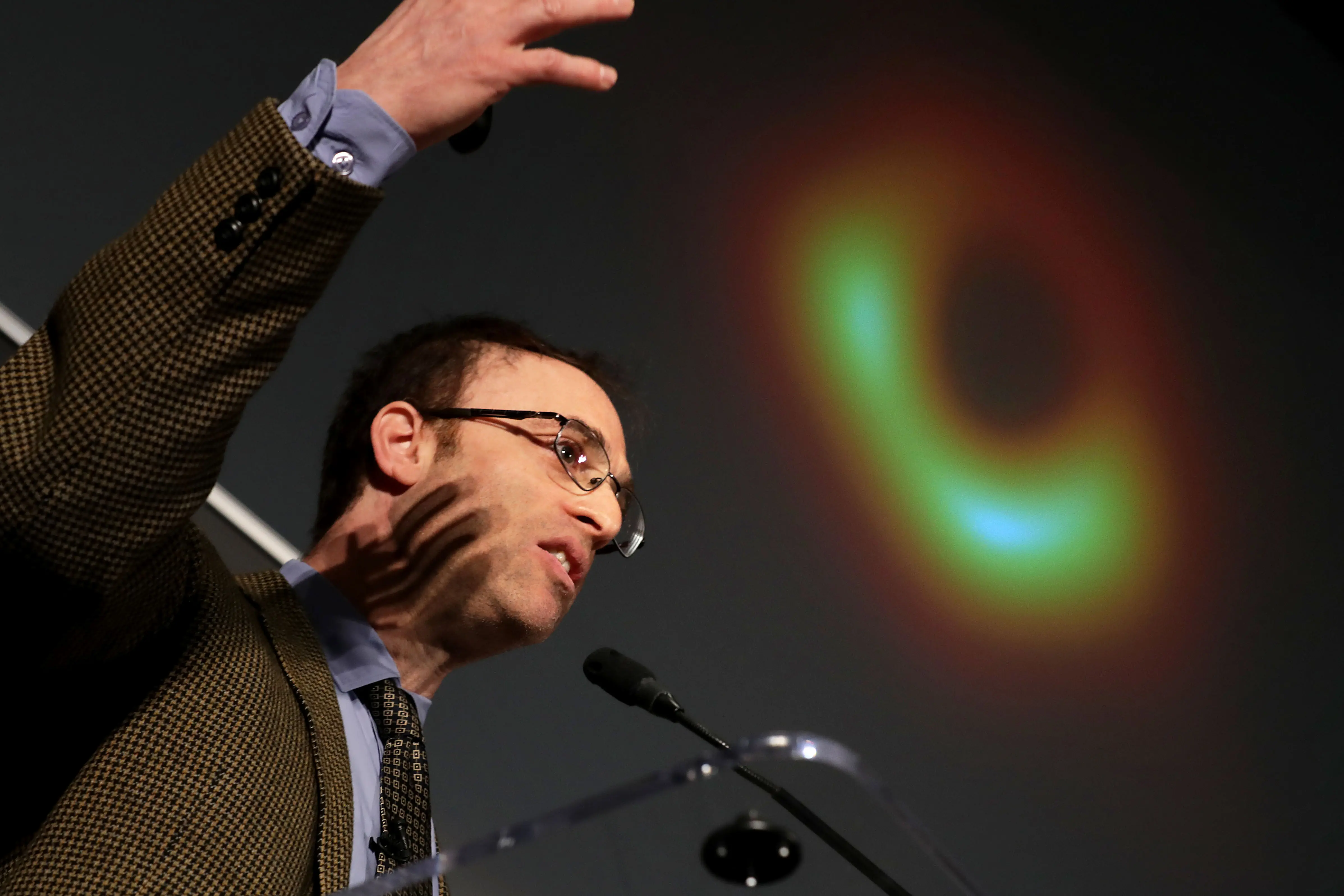 Event Horizon Telescope Director Sheperd Doeleman reveals the first photograph of a black hole (Image via Getty)
The finding comes from the study of a tidal disruption event, known as AT2020afhd, where a star moved too close to a supermassive black hole and was broken apart by strong gravity.
As the star’s material fell inward, it formed a flat disk of gas around the black hole and produced signals in X-ray and radio light.
Researchers found that these signals changed in a regular pattern. The changes suggest that the inner part of the disk was slowly wobbling.
This motion matches predictions from Einstein’s theory of general relativity, first proposed in 1915, and later refined by Josef Lense and Hans Thirring in 1918.
Their work described how a rotating massive object can drag space and time around with it, an effect known as frame-dragging.
The data were collected using NASA’s Neil Gehrels Swift Observatory and the Karl G. Jansky Very Large Array on Earth.
The study was published in Science Advances. Scientists say the result offers a new way to study black hole spin and how black holes interact with nearby matter.
How did scientists detect the space-time drag in black holes?
The research team studied light from AT2020afhd over time, focusing on X-ray and radio signals.
These signals come from gas very close to the black hole and from narrow jets of material moving outward at high speed.
Unlike earlier tidal disruption events, the radio signal from this source showed short-term changes that repeated about every 20 days.
Team member Cosimo Inserra said, “Our study shows the most compelling evidence yet of Lense–Thirring precession.”
He explained that the repeating changes were not linked to changes in energy output, but to motion in the disk and jet themselves. The wobble seen in both types of light suggested a shared cause.
By modeling the data, researchers showed that the observed pattern matched what would be expected if the black hole’s rotation was dragging nearby space-time.
Inserra added that the black hole was “dragging space time along with it in much the same way” predicted by theory.
This link between observation and theory allowed the team to rule out other explanations for the signal changes.
Why does the finding matter for black hole studies?
Frame-dragging has been difficult to observe directly, especially around black holes. Most earlier evidence came from indirect measurements or from objects much closer to Earth.
This event provided a rare chance to study the effect near a supermassive black hole while it was actively pulling in stellar material.
Inserra noted that the results help scientists understand both black hole spin and tidal disruption events. “These observations also tell us more about the nature of TDEs,” he said, referring to how stars are broken apart and how their material behaves afterward.
The study also showed that disk motion and jet motion can be linked through the same physical process.
The researchers compared the effect to magnetism, stating, “In the same way a charged object creates a magnetic field when it rotates, we’re seeing how a massive spinning object generates a gravitomagnetic field.”
This comparison helps explain how gravity and motion work together near black holes.
Future studies may use similar methods to measure black hole properties in other galaxies.
The team says continued monitoring of tidal disruption events could provide more data on how space and time behave under extreme conditions.
_________________________________________________
Stay tuned for more updates.
TOPICS: Astronomy, black hole consumes star, Black Holes, Einstein's Theory or Relativity, X-Rays
More Astronomy
on Primetimer:
- Expedition 74 completes first full week aboard the International Space Station
- Interstellar comet 3I/ATLAS shows a growing green glow as its chemistry evolves
- Blue Origin to launch first-ever wheelchair user into space on December 18
- Comet Lemmon lights up Hawaii’s night sky in rare Milky Way portrait