
New image reveals comet 3I/ATLAS emerging from behind the Sun over Egypt
-
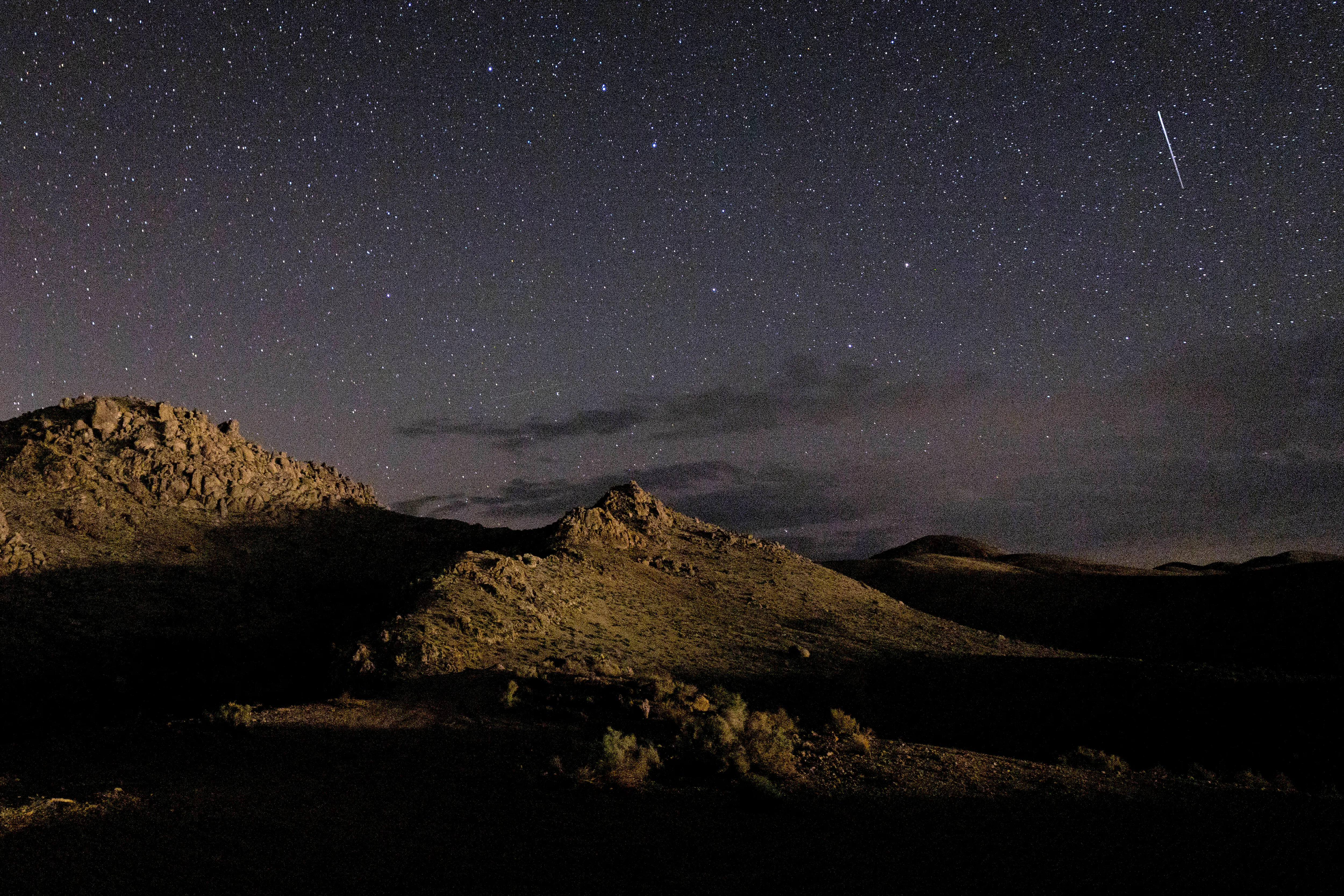 A meteor steaks across the sky over the Alabama Hills (Image via Getty)
BBC Sky at Night Magazine reports that interstellar comet 3I/ATLAS is once again visible after passing behind the Sun in autumn 2025.
The comet, which came from outside our Solar System, is moving across the winter sky and can now be viewed with telescopes, including smart telescope systems used by many amateur observers.
The magazine highlights a new ground-based image taken in Egypt’s Black Desert by photographer Osama Fathi. He captured the comet on 29 November 2025 at around 03:00 local time using an astro-modified Nikon Z6 camera paired with a RedCat telescope lens.
Fathi described the scene as the comet moved across the desert horizon, saying, “An object from another star system drifts through our sky.” He also noted the faint cyan appearance produced by gas in the coma, explaining that it comes from “cyanide radical gas emission in its coma.”
The photographer called the comet “a visitor older than our Sun,” referring to its origin beyond the Solar System.
The comet has been imaged by several major space missions, including Hubble, the James Webb Space Telescope, and NASA solar observatories, as well as spacecraft near Mars and a European probe on its route to Jupiter.
How was the image captured?
Fathi explained that the image was created using long exposures and careful planning. He used an astro-modified Nikon Z6 camera with a RedCat telescope lens set to 3× optical zoom for an effective focal length of about 750mm.
He said this setup allowed him to “isolate this rare traveler against the desert horizon.” To bring out the comet’s gas halo and shape, he stacked 60 exposures of 60 seconds at ISO 1500, followed by 60 exposures of 30 seconds.
He noted that “these long integrations allowed the comet’s delicate coma and motion against the background stars to emerge clearly.”
The shoot took place in the Black Desert, far from artificial light sources. Fathi began at 03:00, working in quiet conditions that let him track the comet without interference from city glow.
He said the comet appeared faintly in the frame before taking shape through stacking and processing. The technique helped show its structure as it crossed the sky during the early hours of the morning.
He also described the field location, pointing out the shapes of the desert hills and isolated trees around him during the session, elements that provided scale for the appearance of the comet in the finished image.
Observing and photographing comet 3I/ATLAS
3I/ATLAS is visible to observers with telescopes now that it has cleared its solar passage. Many amateur astronomers are using smart telescope systems to track it.
These devices can locate the comet automatically, allowing beginners to capture basic images without manual alignment. The magazine points readers to its guide on comet photography and also shares Fathi’s method for those using DSLR or mirrorless systems.
Fathi said that long exposures were essential to bring out the comet clearly. He advised observers to “plan the frame and give the comet time to show its motion,” noting that even short movement across the star background becomes visible during stacking.
He also recommended working under dark skies to reduce interference, explaining that “extremely dark Saharan skies” helped his own data.
The comet has been monitored by several spacecraft, including Hubble, JWST, and missions near the Sun. JWST observed 3I/ATLAS with its Near-Infrared Spectrograph instrument on 6 August 2025, adding new data on its composition.
The comet is expected to pass through the Solar System only once before heading back toward interstellar space.
Observers are encouraged to record their own images and share them with astronomy communities, including the contact address provided by the magazine.
___________________________________________
Stay tuned for more updates.TOPICS: Astronomy, 3I/ATLAS, 3I/ATLAS comet, 3I/ATLAS images, 3I/ATLAS interstellar object, Egypt's Black Desert
- NASA’s new X-ray technique reveals how supermassive black holes shape galaxy clusters
- SpaceX expands Starlink network with successful Falcon 9 launch
- A guide to tonight’s night sky, including how to find Lacerta and other seasonal constellations
- James Webb Space Telescope spots mysterious twin helium tails streaming from a distant hot Jupiter