
James Webb Space Telescope spots mysterious twin helium tails streaming from a distant hot Jupiter
-
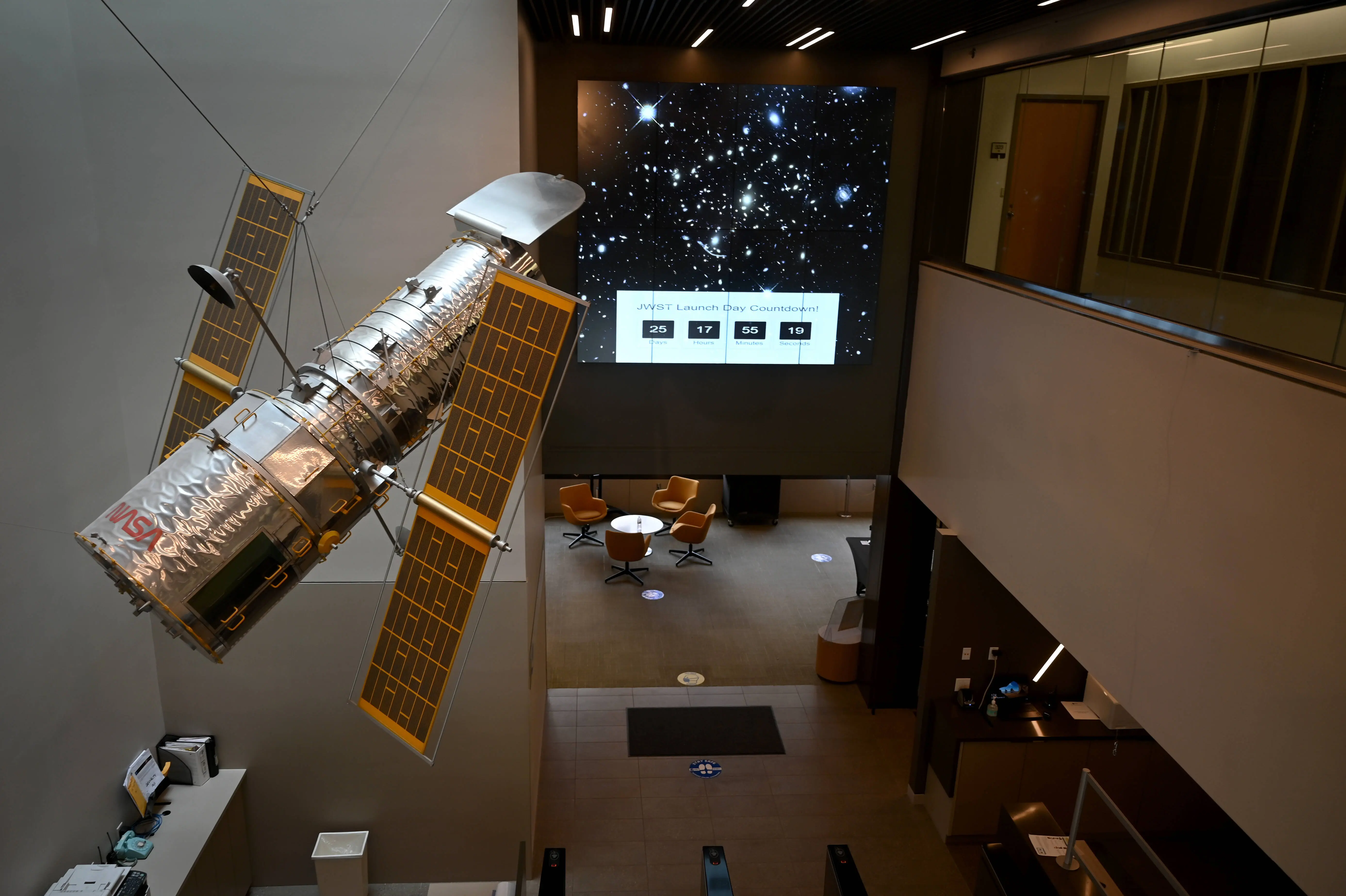 A model of the NASA Hubble Space Telescope (Image via Getty)
James Webb Space Telescope Discoveries reports on new findings about the exoplanet WASP-121b. The James Webb Space Telescope (JWST) recorded continuous data of the planet for about 37 hours using its Near-Infrared Spectrograph.
These observations show that the planet releases helium into space in two long gas tails. WASP-121b orbits its star every 30 hours and is classified as an ultrahot Jupiter.
Because of the strong radiation from its star, light gases escape from its atmosphere over long periods of time. Earlier observations only captured this escape during transits, which limited understanding of how steady the process was.
The new study shows that the escape continues for more than half the planet’s orbit. The team calls this “the most complete picture of helium escape observed so far.”
The helium tails reach a length about 100 times wider than the planet itself. One tail trails behind the planet, while the other leads it in its orbit. Researchers say these patterns do not match current models. As team lead, Romain Allart states,
“We are only beginning to discover the true complexity of these worlds.”
The findings were published in Nature Communications on December 8.
Helium escape patterns measured in the James-Webb Space Telescope
The team measured how helium absorbs light during the planet’s orbit. The signal stayed visible for more than half of the 30-hour cycle. This allowed the researchers to follow changes in the gas flow without relying only on transit events.
According to the study, the gas extends far beyond the planet, forming two clear structures. One of the researchers explained, “We were surprised to see how long the helium escape lasted.”
The first tail streams behind the planet as radiation and stellar wind push the gas outward. The second tail moves ahead of the planet, shaped by the gravity of the star.
The two tails together span a distance about three times wider than the separation between the planet and its star. The team notes that no current model explains why the gas forms two distinct directions instead of one.
Vincent Bourrier, another team member, said, “New observations show us where our models fall short.” Because helium is an easy tracer for atmospheric loss, these results may help refine future studies of other exoplanets.
The data also show how close-orbiting gas giants may change as they lose material over long timescales.
Observation methods and study context
The researchers used JWST’s NIRSpec instrument to monitor WASP-121b continuously. This instrument can detect infrared signatures of helium even at large distances.
The team followed the planet across its full orbit, allowing them to compare the escape rate before, during, and after transit. This method removes earlier gaps in data where scientists could only evaluate short observation windows. As one researcher noted, “Continuous coverage gives us clearer patterns that were not visible before.”
The planet sits around 858 light-years from Earth and belongs to a group known as hot Jupiters. These planets orbit very close to their stars and complete orbits in short periods.
Because of intense heating, gases such as hydrogen and helium can move away from the atmosphere. Over millions of years, this process can change the size and composition of the planet.
The new findings give researchers a better way to track how this process works outside of transit events. The study also shows how stellar radiation and gravity shape the gas in different directions. The team says the results will help build future models that explain how these planets evolve and how their atmospheres respond to their stars.
_____________________________________________________
Stay tuned for more updates.TOPICS: Astronomy, Helium tails, James Webb Space Telescope, Jupiter, NASA
- A guide to tonight’s night sky, including how to find Lacerta and other seasonal constellations
- Interstellar comet 3I/ATLAS shines in fresh views from Hubble and the Juice spacecraft
- Researchers uncover solar wind event that may explain Uranus’ strange magnetic behavior
- Interstellar visitor 3I/Atlas makes surprise appearance in NASA’s Punch observations