
Features
Expedition 74 crew advances stem cell and space technology research and prepares for upcoming rack transfers
Expedition 74 crew conducts stem cell and space technology research aboard the ISS, maintains life support systems and prepares for upcoming cargo and science rack transfers, according to NASA.
-
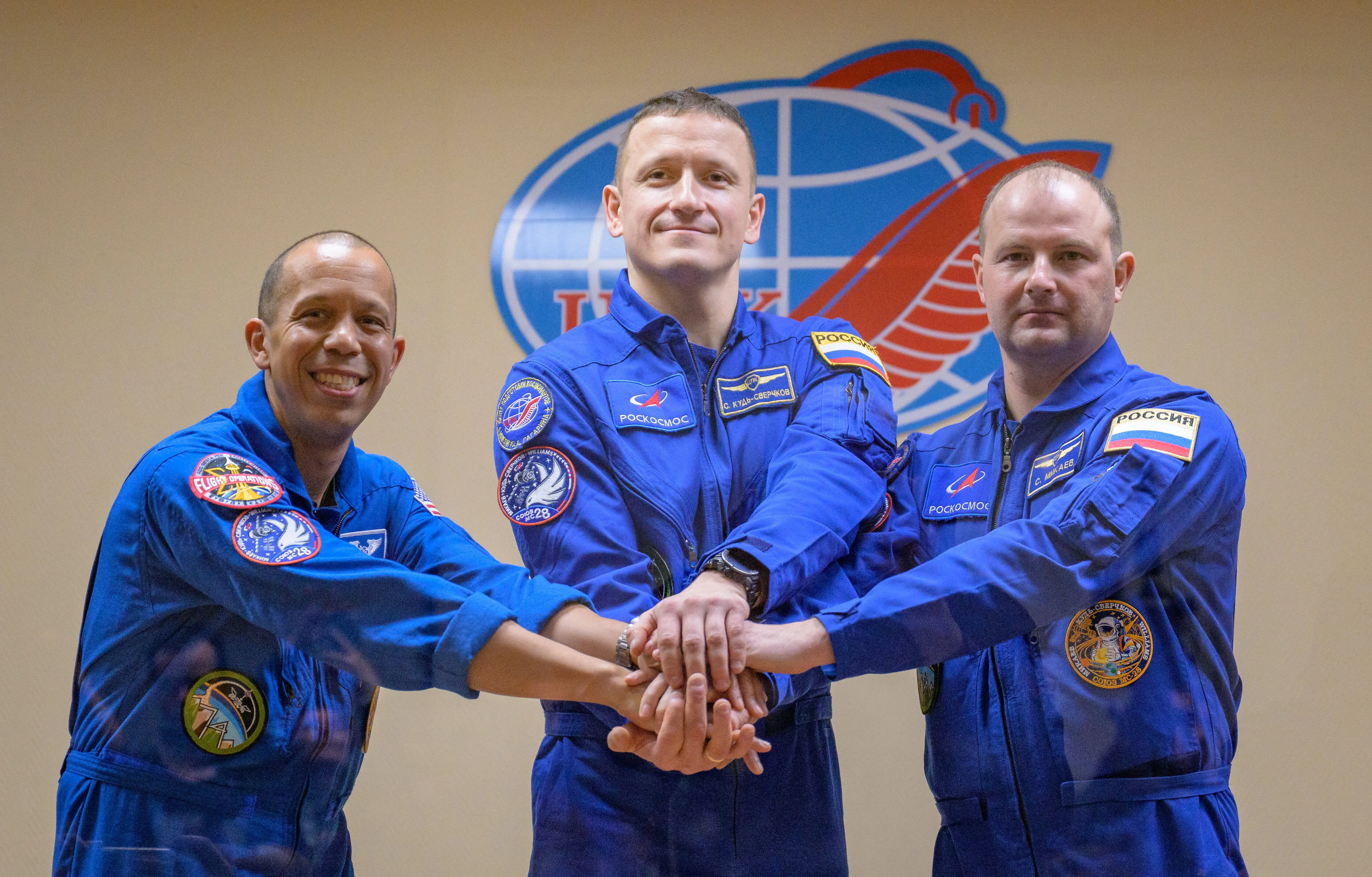 BAIKONUR, KAZAKHSTAN - NOVEMBER 26: (EDITOR’S NOTE: This Handout image was provided by a third-party organization and may not adhere to Getty Images’ editorial policy.) In this handout image provided by NASA, astronaut Chris Williams, left, and Roscosmos cosmonauts Sergey Kud-Sverchkov, and Sergei Mikaev, right, are seen in quarantine, behind glass, during a press conference at the Cosmonaut Hotel on November 26, 2025 in Baikonur, Kazakhstan. Expedition 74 crewmembers: NASA astronaut Chris Williams, Roscosmos cosmonauts Sergey Kud-Sverchkov and Sergei Mikaev, are scheduled to launch aboard their Soyuz MS-28 spacecraft on November 27. (Photo by Bill Ingalls/NASA via Getty Images)
The Expedition 74 crew aboard the International Space Station continued research in stem cell production, materials exposure and technology demonstrations while maintaining station systems and preparing for upcoming rack transfers.
NASA Flight Engineer Zena Cardman processed stem cells for the StemCellEx-IP1 investigation, observing them under a microscope in the Destiny laboratory module.
According to NASA, the study aims to demonstrate the production of stem cells in microgravity, which may differ from those produced on Earth.
Concurrently, the crew conducted maintenance tasks including gas analyzer replacement, cargo loading and air filter swaps to support ongoing experiments and station operations.
Stem cell research operations
Cardman focused on processing stem cell samples and preparing them for storage in a science freezer for eventual return to Earth next year.
The investigation aims to inform regenerative medicine and pharmaceutical manufacturing by comparing space-grown cells to Earth-grown counterparts.
She also measured air flow within U.S. modules and printed updated checklists for upcoming spacewalks.
NASA reported that the crew members assisted in related lab work, including powering on fluorescent microscopes and collecting atmospheric carbon dioxide samples for analysis.
Materials exposure and technology demonstrations
JAXA Flight Engineer Kimiya Yui installed materials exposure hardware in the Kibo laboratory module’s airlock to expose various materials to the vacuum of space, temperature extremes, and radiation.
The experiment is designed to gather data relevant to both the Earth and space industries. Yui also installed an experimental carbon dioxide removal device in Kibo and added soundproof insulation to reduce operational noise.
NASA Flight Engineer Chris Williams, assisted by Cardman and Yui, loaded cargo inside JAXA’s HTV-X1 for a planned departure from the Harmony module’s Earth-facing port in late January.
Williams additionally replaced an air filter, powered on a fluorescent microscope, and swapped hardware on a portable computer tablet, according to NASA.
Rack transfers and life support maintenance
Commander Mike Fincke led preparations for upcoming rack transfers, deconfiguring hardware from a science rack scheduled for installation inside HTV-X1.
Fincke also participated in a circadian rhythm study, measuring sleep patterns in microgravity and performed a leak check on a recycle tank in the Tranquility module.
Roscosmos cosmonaut Oleg Platonov measured his mass using a device based on Newton’s Second Law and conducted life support maintenance, including inspection of cables and removal of European robotic arm hardware.
Cosmonauts Sergey Kud-Sverchkov and Sergei Mikaev completed life support maintenance tasks, installed Earth observation hardware, and sanitized surfaces to control microbial growth.
As reported by NASA, crew members reviewed rack removal and reinstallation procedures, particularly within the U.S. segment of the station, to ensure smooth execution over the following days.
Fincke, Cardman, Williams and Yui coordinated their efforts to manage cargo, laboratory equipment, and experimental devices during these transitions.
Among the tasks were the changing of the plumbing parts in the waste and hygiene compartment, the management of the science racks, and the preparation of the equipment for the transport and installation in the orbital outpost.
The crew of Expedition 74 took over after the three members of Expedition 73, which consisted of NASA astronaut Jonny Kim and Roscosmos cosmonauts Sergey Ryzhikov and Alexey Zubritsky, returned to Earth after 245 days of continuous stay in orbit.
There are six flight engineers on board the current mission who are performing a wide range of experiments in the fields of life sciences, materials, and technology, along with carrying out the regular maintenance of the station systems.
Updates on Expedition 74 activities are available through NASA’s space station blog, Twitter account @space_station, Facebook and Instagram pages.
Stay tuned for more updates.
TOPICS: Expedition 74, International Space Station research, ISS life support maintenance, ISS stem cell experiments, Microgravity research, NASA, NASA space science, Regenerative medicine in space