
New 3I/ATLAS picture from ESA’s Juice probe reveals the comet looking extremely active on November 4
-
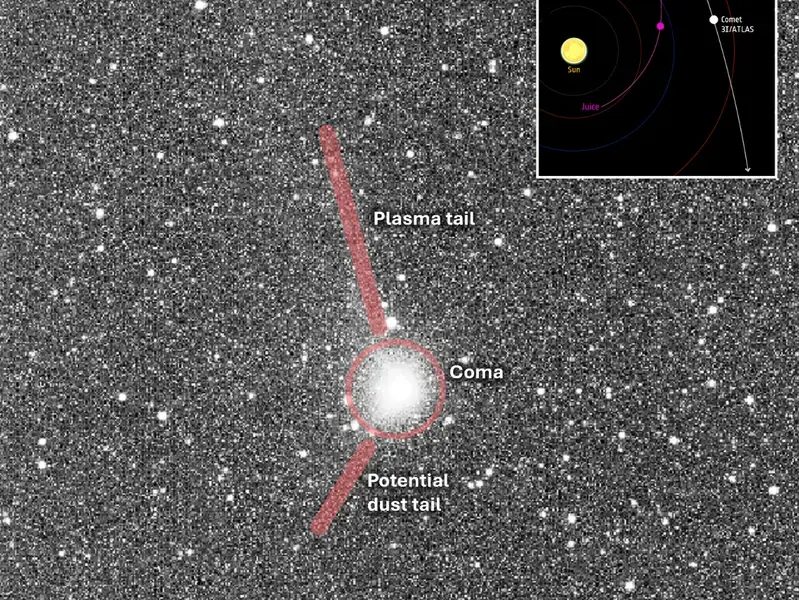 Image sourced via (ESA)
The European Space Agency (ESA) has shared a new picture of the interstellar comet 3I/ATLAS, and it has made many people curious again. The picture was taken by ESA’s Juice probe, a spacecraft that is on its long journey to Jupiter.
Juice captured this image on November 4, just a week after the comet passed closest to the Sun. This is an important time because comets usually become more active when they come near the Sun.
Even though Juice collected a lot of information, ESA has only shared a small part of one photo for now. It is just one-fourth of a Navigation Camera (NavCam) image.
The full picture will be released in February. Still, even this small part shows something very interesting. You can clearly see a bright glow around the comet, called the coma.
ESA also pointed out two faint tails starting to appear behind the comet. This shows that 3I/ATLAS is in a very active state.
How Juice took the photo
The Juice probe is currently using its large antenna as a shield to protect itself from the Sun’s heat and radiation.
Because of this, it must use its smaller antenna to send pictures back to Earth. This means the photos arrive slowly and at lower quality.
The camera used for this image, the NavCam, is not a high-power science camera. It was mainly made to help Juice navigate around Jupiter’s icy moons when it reaches them in 2031.
Still, even with a basic camera, Juice managed to capture a clear and helpful image of the comet.
What Juice saw on November 4
ESA explained that the picture shows two types of tails. One is a plasma tail, which is made of electrically charged gas. It stretches upward in the image. The second one is a dust tail, made of tiny solid particles.
Both tails are faint, but they confirm that the comet is releasing material as it travels.
Juice took this picture when the comet was about 66 million kilometers away. This was actually farther than the distance between the comet and the Mars orbiter earlier in October.
But Juice had a better view because it saw the comet right after its closest approach to the Sun. At that time, the comet was much more active, making the picture more detailed and interesting.
Scientists believe the new image will help them better understand how interstellar comets behave.
Since 3I/ATLAS comes from outside our solar system, every new photo gives researchers more clues about how different these objects can be.
For now, this new picture is just the beginning, and more information will arrive when ESA releases the full image in February.
TOPICS: 3I/ATLAS, 3I/ATLAS observations, 3i/ATLAS recent updates
- Harvard scientist claims 3i/Atlas’ tail may be a swarm of unknown objects, adding to growing mystery
- All eyes on NASA tonight as new photos of interstellar visitor 3I/Atlas are about to be revealed
- NASA confirms 3I/ATLAS is a natural comet after weeks of speculation and online theories
- New radio signals and “Heartbeat-Like” jets from 3i/Atlas spark curiosity as some viewers say they notice a repeating pattern