
Harvard scientist claims 3i/Atlas’ tail may be a swarm of unknown objects, adding to growing mystery
-
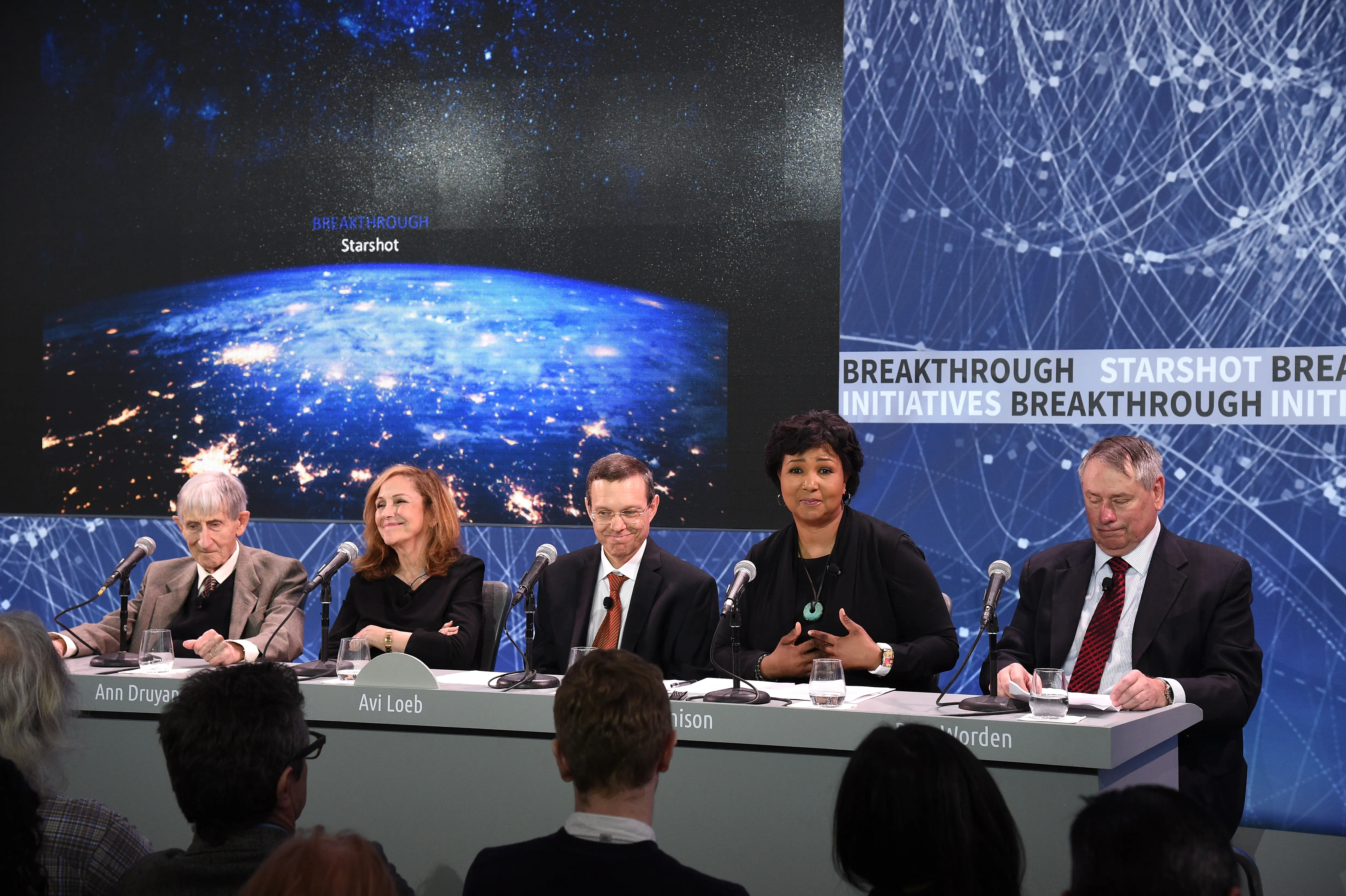 NEW YORK, NEW YORK - APRIL 12: (L-R) Freeman Dyson, Emeritus Professor, Princeton Institute for Advanced Study; Ann Druyan, Producer, Co-Founder and CEO of Cosmos Studios; Avi Loeb, Frank B. Baird, Jr. Professor of Science at Harvard University; Mae Jamison, Nasa Astronaut, Principal 100 Year Starship Foundation; and Peter Worden, Chairman, Breaktrough Prize Foundation, Former NASA Director attend the panel as Yuri Milner And Stephen Hawking host press conference to announce Breakthrough Starshot, a new space exploration initiative, at One World Observatory on April 12, 2016 in New York City. (Photo by Bryan Bedder/Getty Images for Breakthrough Prize Foundation)
The strange behavior of interstellar object 3I/ATLAS has once again caught everyone’s attention. For months, scientists have noticed unusual things about this comet-like visitor — its path, its speed, and the shape of its tail.
Now, Harvard scientist Avi Loeb has added a new and surprising idea: the tail of 3I/ATLAS may not be a normal tail at all. Instead, he thinks it could be made up of a swarm of unknown objects traveling with it.
This idea comes from photos taken in November, after 3I/ATLAS passed close to the Sun. Loeb noticed that the glow around the comet — called the coma — had a teardrop shape that was pointing toward the Sun.
Usually, a comet’s tail points away from the Sun because sunlight pushes dust backward. Seeing a tail or glow pointing forward is unusual, and this is why Loeb calls it an “anti-tail.”
What could these unknown objects be?
Loeb wrote that if this anti-tail is made of a swarm of objects, the next question is very simple:
- What are these things?
- Are they small pieces of rock?
- Are they broken fragments from the comet?
- Or could they be something scientists have never seen before?
He explained that if these objects do not react to sunlight the same way the comet does, they may appear in a different position in photos. This could make them look as if they are sitting in front of the comet rather than behind it.
Loeb also said that this swarm could reflect a lot of sunlight. Even if the objects are light and small, a group of them together could create a bright glow that makes the comet look different from normal comets.
Right now, scientists do not know whether these objects are natural or something unusual. Loeb repeated the question in his post:
“Are they rocky fragments or something else?”
Other strange ideas that came before
Earlier this month, Loeb also suggested that the anti-tail could be from a beam of light coming from the object. He said such a beam could clear tiny space particles from the comet’s path. Most scientists do not agree with this idea, but it has sparked a lot of discussion online.
What NASA says
NASA still believes that 3I/ATLAS is a natural comet from another star system. Scientists even found signs of ice volcanoes on its surface, similar to icy objects far beyond Neptune in our own Solar System.
This discovery surprised many researchers because 3I/ATLAS formed in a completely different place, yet it shares traits with objects near us.
As new images come in, the mystery around 3I/ATLAS keeps growing. Scientists around the world are watching closely, hoping the next set of data will help explain what this unusual visitor really is.
TOPICS: 3I/ATLAS, 3I/ATLAS alien contact, 3I/ATLAS observations, 3i/ATLAS recent updates, Avi Loeb 3I/ATLAS theory
- All eyes on NASA tonight as new photos of interstellar visitor 3I/Atlas are about to be revealed
- NASA confirms 3I/ATLAS is a natural comet after weeks of speculation and online theories
- New radio signals and “Heartbeat-Like” jets from 3i/Atlas spark curiosity as some viewers say they notice a repeating pattern
- Examining 3I/ATLAS within the broader conversation on science and society