
Faster time flow on Mars adds complexity to future missions
-
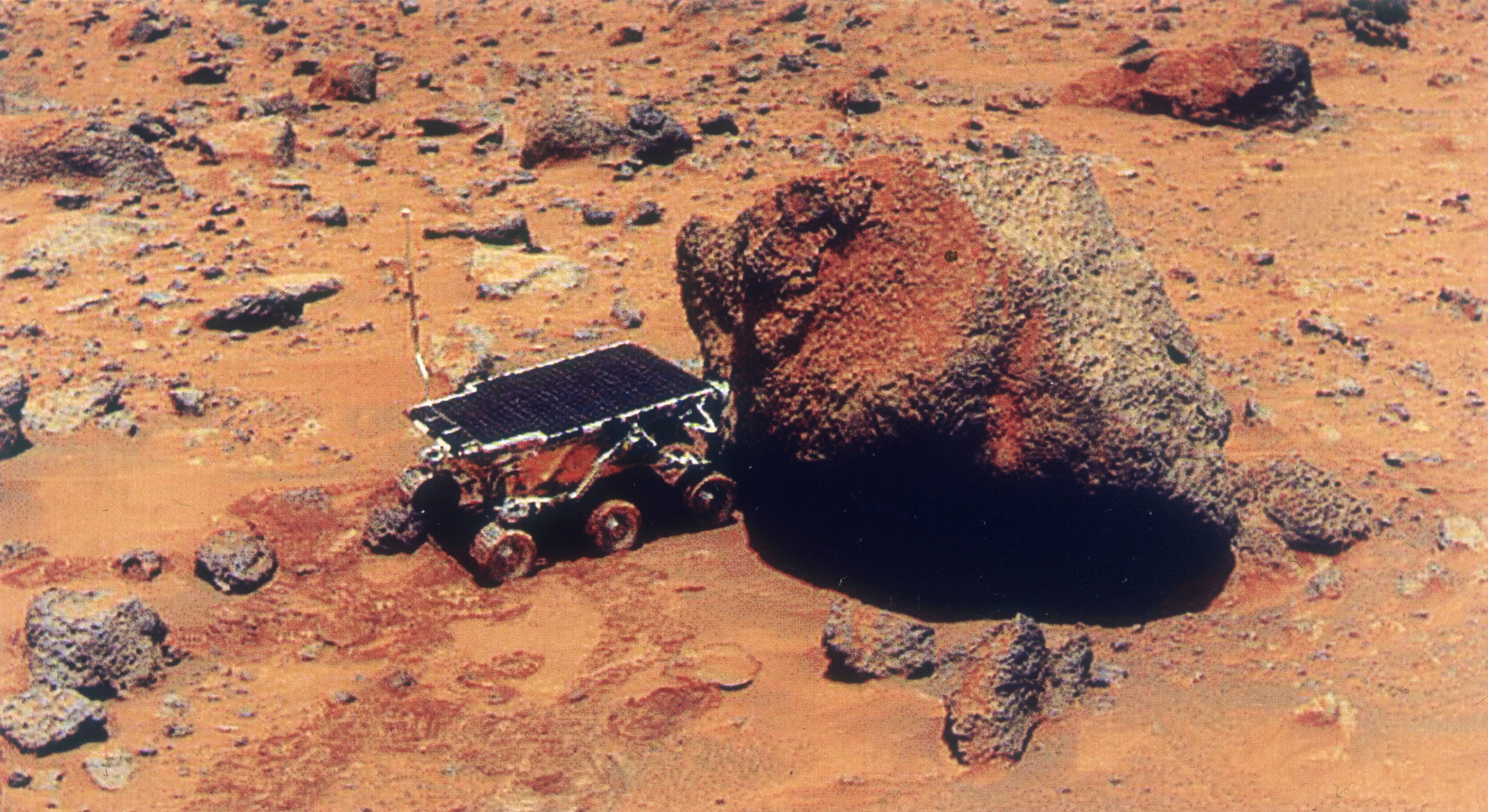 The Sojourner Rover uses its Alpha Proton X-Ray Spectrometer (APXS) to analyse the Yogi Rock on the surface of Mars, during the Mars Pathfinder exploratory mission, July 1997 (Image via Getty)
Scientists in a new study discovered that time on Mars moved faster than on Earth.
Neil Ashby and Bijunath Patla, physicists from the National Institute of Standards and Technology in Boulder, Colorado, in December 2025, published their findings in The Astronomical Journal, in which they calculated that time on the Red Planet moves 477 microseconds faster than on Earth daily, meaning Mars’ time is a millionth of a second ahead of that on Earth.
According to the researchers, it will add another layer to space exploration, helping the subsequent Mars missions synchronize their time with the planet and allowing scientists to improve space navigation and get more details about their neighbor.
Figuring out what the clock will say on Mars expands on Albert Einstein’s theories of relativity.
In a statement published on the official website of the National Institute of Standards and Technology, Bijunath Patla said that figuring out the time on Mars and the moon has been a step forward in understanding the “science fiction vision of expanding across the solar system.”
More insights on the latest study on the passage of time on Mars
The discovery of the passage of time on Mars is significant for scientists, as NASA plans to build permanent settlements on the moon and other places in the solar system.
Understanding time will play a crucial role in space exploration and in the study of the world beyond Earth.
According to Einstein’s theory of relativity, time is not constant but relative, meaning it varies depending on space, motion, and gravity.
Places with a high gravitational force will have a slower passage of time, and vice versa. Moreover, velocity also affects time, which is why time slows down for objects moving at a faster rate.
On Mars, the gravitational force is five times weaker than that on Earth, which impacts its time. Additionally, the Red Planet revolves around the sun at a slower speed, which then slows down the speed of Mars compared to Earth.
However, Mars has a more elliptical orbit than Earth, causing it to move more slowly when farther from the sun and faster as it approaches the sun.
On the other hand, the impact of the sun’s gravitational fields on Mars also changes time. With all these factors in play, Mars’ time in relation to Earth becomes slightly faster overall.
In simpler terms, one second to an astronaut on Mars will feel like a second. However, to someone on Earth, that second will pass slightly quicker than usual.
On average, the time difference between Earth and Mars is 477 microseconds, but that is also subject to some change depending on where Mars stands “relative to Earth and our moon.”
While the difference in time may seem negligible, it will significantly impact navigation and communication around Mars.
“It may be decades before the surface of Mars is covered by the tracks of wandering rovers, but it is useful now to study the issues involved in establishing navigation systems on other planets and moons,” Neil Ashby said.
Ashby continued explaining that, like GPS on Earth, an “accurate” understanding of time on Mars will help to improve the transmission of information.
Ashby and Patla previously worked together to determine the time on the moon in relation to Earth, and discovered that the moon’s clock ticked 56 microseconds faster than the time on Earth.
Stay tuned for more updates.
TOPICS: Time on Mars, Mars ahead of Earth in time, Mars exploration