
Why interstellar comet 3I/ATLAS could reshape what we know about planet formation
-
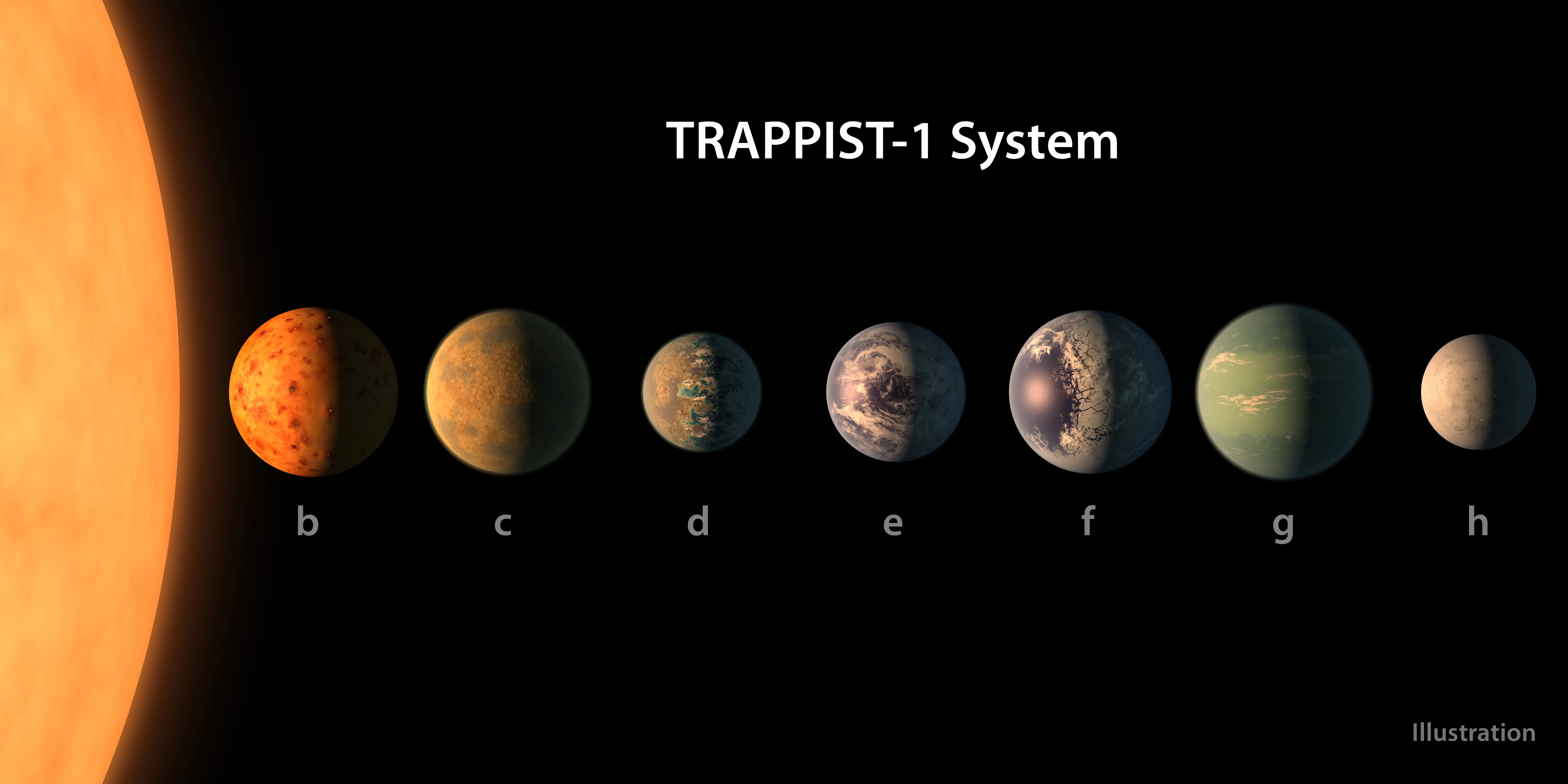 TRAPPIST-1 planetary system (Image via Getty)
Space.com reports on interstellar comet 3I/ATLAS, the third known object discovered passing through the solar system from beyond it. The comet is going to be at its nearest point to the Earth on Dec. 19, 2025, just a few days before Christmas.
This moment provides a very rare opportunity for astronomers to have a close-up study of an interstellar object through both ground-based and space telescopes.
During this time, it would be much easier to detect the light that the comet reflects, hence permitting scientists to probe its formation and its physical structure. Probably, Comet 3I/ATLAS was originally made in a star other than ours in a gas and dust disk where planets were being created.
After being expelled from its parental system by a giant planet, it has been roaming the Milky Way for quite a long time, about a billion years.
Its approach to the sun is supposed to be the first time it gets close to a star in its entire life. Furthermore, the article compares 3I/ATLAS with the discoveries that came before it, such as 1I/Oumuamua in 2017 and 2I/Borisov in 2019.
These objects, in fact, constitute a completely new set of the only known interstellar visitors. For only a short time, they are accessible; therefore, the data that is there is very limited, although still valuable, and it is this which allows scientists to compare star formation in other stellar systems with that of the Solar System.
Close approach and observation plans of 3I/Atlas
December 19 will mark the closest Earth approach of 3I/ATLAS that will ever occur. Astronomer Darryl Seligman notes,
“When 3I/ATLAS is closest to the Earth, all the features that we are looking for will be easier to detect with our telescopes.”
This proximity allows both professional and amateur astronomers to observe the comet using small telescopes or strong binoculars.
Because interstellar objects follow hyperbolic paths, they enter the solar system once and then leave permanently. This makes timing critical. Observations made during this short window can provide information about surface ices, gases released as the comet warms, and how these materials compare with those found in solar system comets.
Space-based instruments, including the James Webb Space Telescope, have already detected carbon dioxide in 3I/ATLAS. Seligman states, “We have been monitoring it since we discovered it.” These early measurements help scientists plan follow-up observations during the close approach.
The article also highlights that spacecraft near Mars and Jupiter may collect additional data as the comet passes through the inner solar system. Together, these observations will improve understanding of the comet’s origin, motion, and physical properties during its brief visit.
What 3I/ATLAS reveals about comet formation
According to the experts, the composition of comet 3I/ATLAS provides clues about where it formed. In the solar system, most comets contain more water ice than other frozen gases, suggesting formation near the region of Jupiter.
In contrast, 2I/Borisov showed high levels of carbon monoxide, indicating formation farther from its star. Early observations suggest that 3I/ATLAS is rich in carbon dioxide.
“The ices we see in a comet can tell us something about the conditions in which they formed,” Seligman explains.
Carbon dioxide and carbon monoxide freeze at lower temperatures than water, pointing to colder and more distant formation zones. This supports the idea that some planetary systems form comets much farther out than previously inferred from the solar system alone.
Astronomers also say that the solar system likely ejected large amounts of material during the migration of giant planets.
Computer models suggest that many comet-sized objects were thrown into interstellar space. Given how common planets are around other stars, similar processes likely occurred elsewhere.
Seligman notes that 3I/ATLAS offers “a new window to put our solar system into its cosmic context.” Whether the solar system is typical or unusual, data from this comet will help refine models of planet and comet formation across the galaxy.
_____________________________________________________________
Stay tuned for more updates.TOPICS: Astronomy, 1I/ʻOumuamua and 3I/ATLAS, 2I/Borisov, 3I/ATLAS, 3I/ATLAS comet, 3i/ATLAS recent updates
- NASA tests show ultra-thin material can shield spacecraft components from extreme vibration
- SpaceX beats bad weather to deploy 29 Starlink satellites in predawn Florida launch
- Can lower-cost missions deliver big science? NASA's ESCAPADE aims to find out
- Atlas V to launch 27 Amazon Leo satellites in early morning liftoff