
Viewing 3I/ATLAS up close on December 19 – Which telescopes can help
-
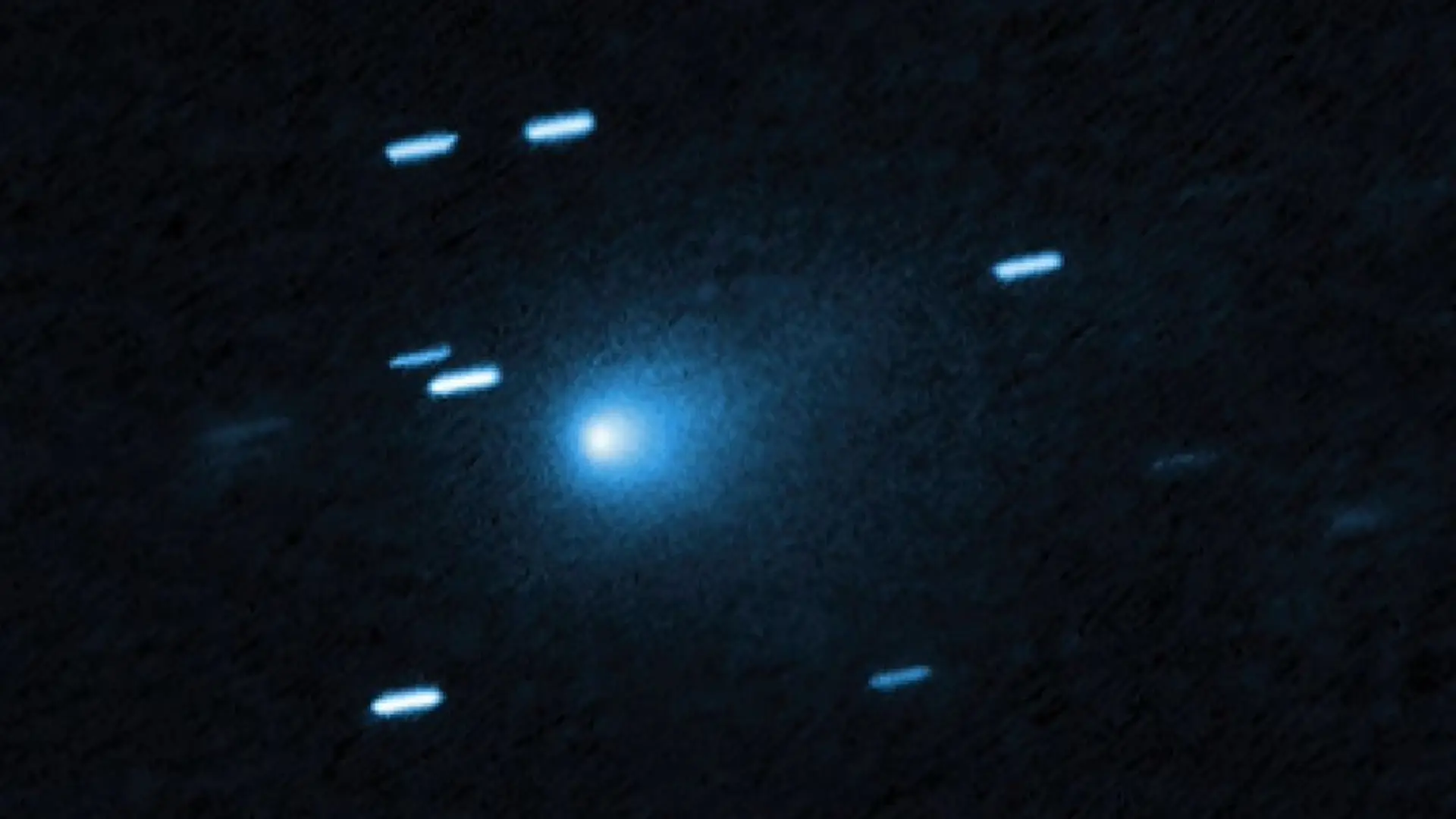 Interstellar object 3I/ATLAS (Image via NASA)
Interstellar object 3I/ATLAS was first reported on July 1, 2025, and since then, it has sparked quite a buzz in the astronomy community.
On December 19, 2025, the visitor from interstellar space will fly by Earth at a safe distance of 1.8 astronomical units or approximately 269 million kilometers.
It was initially called C/2025 N1 and observed by the NASA-funded ATLAS survey telescope in Rio Hurtado, Chile.
Since its discovery, the interstellar object has been an active topic of discussion, with astronomers from different parts of the globe studying its trajectory and other behavioral aspects.
Scientists have debated the origin of the object with each research paper published and observation noted. While one half of the space community claim it is a natural object, others like Harvard Professor Avi Loeb speculates that it may be technological.
Now that 3I/ATLAS prepares to fly past Earth, it will provide researches will a golden opportunity to get a close-up of the object.
3I/ATLAS home observation: Key information to remember
On December 14, 2025, the interstellar object was spotted in the constellation Leo, as it remained visible through telescopes during the wee hours of dawn.
Latest observations of the interstellar object show that it is somewhat dim and has an unclear cloud of gas and dust around it.
It still displays a tail; however, it is only visible on long-exposure images. Recent studies determined that the interstellar object is active as it ejects dust and a combination of gases like carbon dioxide.
As the day of its closest approach nears, enthusiasts look forward to observing the visitor.
However, 3I/ATLAS will not be visible without the help of an optical aid, meaning the naked eye, without the assistance of any instrument, will not be able to spot the visitor. Even binoculars will fail to observe it due to its brightness level.
The human eye can only see objects down to magnitude 6 under favorable conditions.
Amateur astronomers and enthusiasts can see 3I/ATLAS from their backyards or their homes with the following telescopic properties.
The first requirement that can help detect the object is a minimum aperture. An aperture of approximately 6 to 8 inches, or 150 to 200 mm, is required for a clean observation.
Instruments like the Dobsonian reflectors or the Schmidt-Cassegrain telescopes can be helpful in terms of aperture, providing a fuzzy-patch image of 3I/ATLAS.
However, larger aperture instruments of 250 mm or more can provide a better image of the interstellar object.
These can help astronomers have a magnitude of approximately 10 to 11 and even assist in long-term observations.
Smaller telescopes, like those with an 80 mm to 150 mm aperture, are crucial for detecting objects in extremely dark conditions.
However, the image will not be as clear as those with larger apertures, as they will provide astronomers with a faint observation.
Computerized GoTo models, called “smart” telescopes, can be helpful in these cases.
That said, there are a few conditional requirements that can help researchers improve their observations.
The first requirement is locating a site with minimal light pollution. The second requirement is that astronomers track the visitor in the early hours of morning when the interstellar object will be at its highest point in the sky, making for an easy detection.
Low to medium magnification will also help in obtaining clearer images of 3I/ATLAS.
Stay tuned for more updates.
TOPICS: 3I/ATLAS, 3I/ATLAS observations
- IAWN uses interstellar object 3I/ATLAS as a test case for future comet exploration
- Why interstellar comet 3I/ATLAS could reshape what we know about planet formation
- What happens if 3i/Atlas is not a comet? Avi Loeb warns there is no human protocol for such a visit
- Interstellar object 3I/ATLAS continues to display a Sun-facing anti-tail