
Features
New analysis presents unusual features documented in the 3I/ATLAS trajectory and activity
Neutral summary of 3I/ATLAS anomalies, detailing unusual trajectory, mass, jets, gas composition, and non-gravitational acceleration, with observations documented via JPL Horizons, HiRISE, and spectroscopic studies.
-
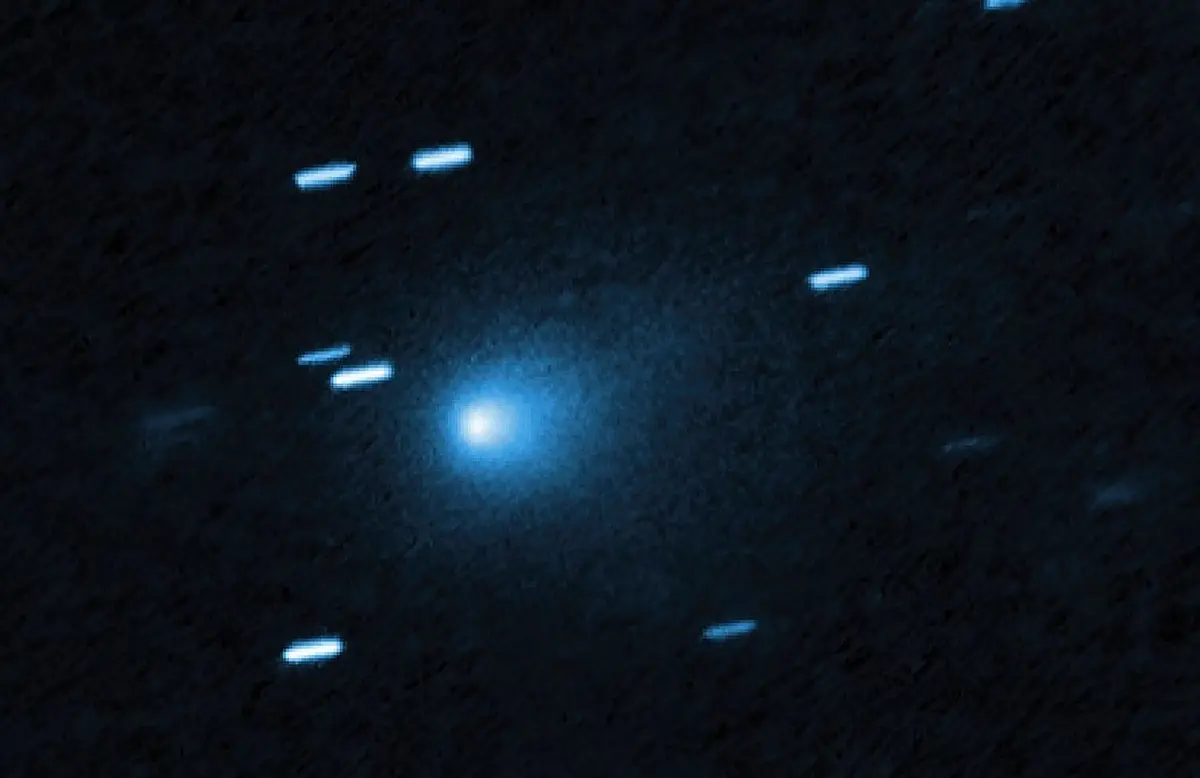 Comet 3I/ATLAS (Image via NASA)
The interstellar object 3I/ATLAS has exhibited a series of unusual features in its trajectory and physical behavior as it passed through the inner solar system.
Recent analyses, including a summary by Harvard Professor Avi Loeb, have identified anomalies across several categories, ranging from highly unlikely to minor deviations from expected cometary behavior.
These anomalies include its perijove distance during the 2026 Jupiter encounter, its nucleus mass, sunward jets, and unusual gas composition.
Available data suggest these features are not consistent with previously observed comets, prompting detailed documentation of each anomaly. The objective of this report is to present these features as recorded.
Major anomalies with no simple explanation
One significant anomaly is the forecasted perijove distance of 3I/ATLAS during its approach to Jupiter on March 16, 2026.
The predicted distance is 53.445 million kilometers, nearly identical to Jupiter’s Hill radius of 53.502 million kilometers. This alignment is facilitated by the non-gravitational acceleration observed near perihelion.
Another feature involves the timing of the object’s arrival, which positioned 3I/ATLAS within tens of millions of kilometers from Mars, Venus, and Jupiter while remaining unobservable from Earth at perihelion.
The nucleus of 3I/ATLAS is approximately a million times more massive than 1I/`Oumuamua and a thousand times more massive than 2I/Borisov, while traveling at a higher velocity than both objects.
Observations indicate that during July, August, and November 2025, the object displayed a sunward jet or anti-tail, which was confirmed by HiRISE images taken near Mars.
The gas plume around 3I/ATLAS contains higher nickel concentrations relative to iron and an elevated nickel-to-cyanide ratio compared with thousands of known comets, including 2I/Borisov.
Additionally, the retrograde trajectory of 3I/ATLAS is aligned within 5 degrees of the ecliptic plane of the planets around the Sun.
These features have been documented in sources including JPL Horizons data, HiRISE imaging, and spectroscopic studies.
Medium anomalies and statistical occurrences
A number of medium-level anomalies have been detected. The arrival direction of 3I/ATLAS aligns within nine degrees of the source of the radio "Wow! Signal," as documented in earlier observational records.
Polarimetric measurements also show extreme negative polarization for 3I/ATLAS, a pattern not observed in prior interstellar comets, including 2I/Borisov.
Both the arrival direction and polarization data have been reported in peer-reviewed analyses of interstellar objects and cometary surveys.
Additionally, these anomalies are considered statistically unusual among known comet populations, indicating that 3I/ATLAS exhibits features not commonly observed in either solar system or interstellar objects.
Minor anomalies potentially linked to origin
Minor anomalies relate to the composition, brightness, and activity of 3I/ATLAS. The gas plume contains only 4 percent water by mass, significantly lower than typical solar system comets.
Near perihelion, the object exhibited rapid brightening and a color spectrum bluer than the Sun.
Observed jets extend in both sunward and anti-solar directions, requiring substantial surface area if explained by sublimation alone, and maintain orientation across distances of approximately one million kilometers.
Non-gravitational acceleration was observed near perihelion without evidence of structural disruption, based on sequential imaging data.
These measurements have been recorded in observational reports and preliminary data analyses.
The dataset on 3I/ATLAS presents a comprehensive inventory of anomalies categorized by probability and significance.
Major, medium, and minor anomalies encompass trajectory, mass, composition, and activity, with sources including JPL Horizons, HiRISE imaging, and spectroscopic surveys providing the primary documentation.
Continued observation of the object will enable refinement of these measurements and further classification of its unusual features.
Stay tuned for more updates.
TOPICS: 3I/ATLAS, 3I/ATLAS observations, 3I/ATLAS path alteration, 3i/ATLAS recent updates, 3I/ATLAS trajectory, Avi Loeb 3I/ATLAS, comet 3I/ATLAS NASA update
More 3I/ATLAS
on Primetimer:
- Periodic light variability in interstellar object 3I/ATLAS linked to jet activity
- What we know so far about 3I/ATLAS: Everything understood to date
- Is Earth at risk from 3i/Atlas? Strange chemical linked to WWI found in interstellar comet, says Avi Loeb
- Is the interstellar visitor 3I/ATLAS back again? Hubble’s new image and viewing times explained in one place