
Interstellar comet 3I/ATLAS: From 2025 discovery to global sensation – now heading beyond Earth
-
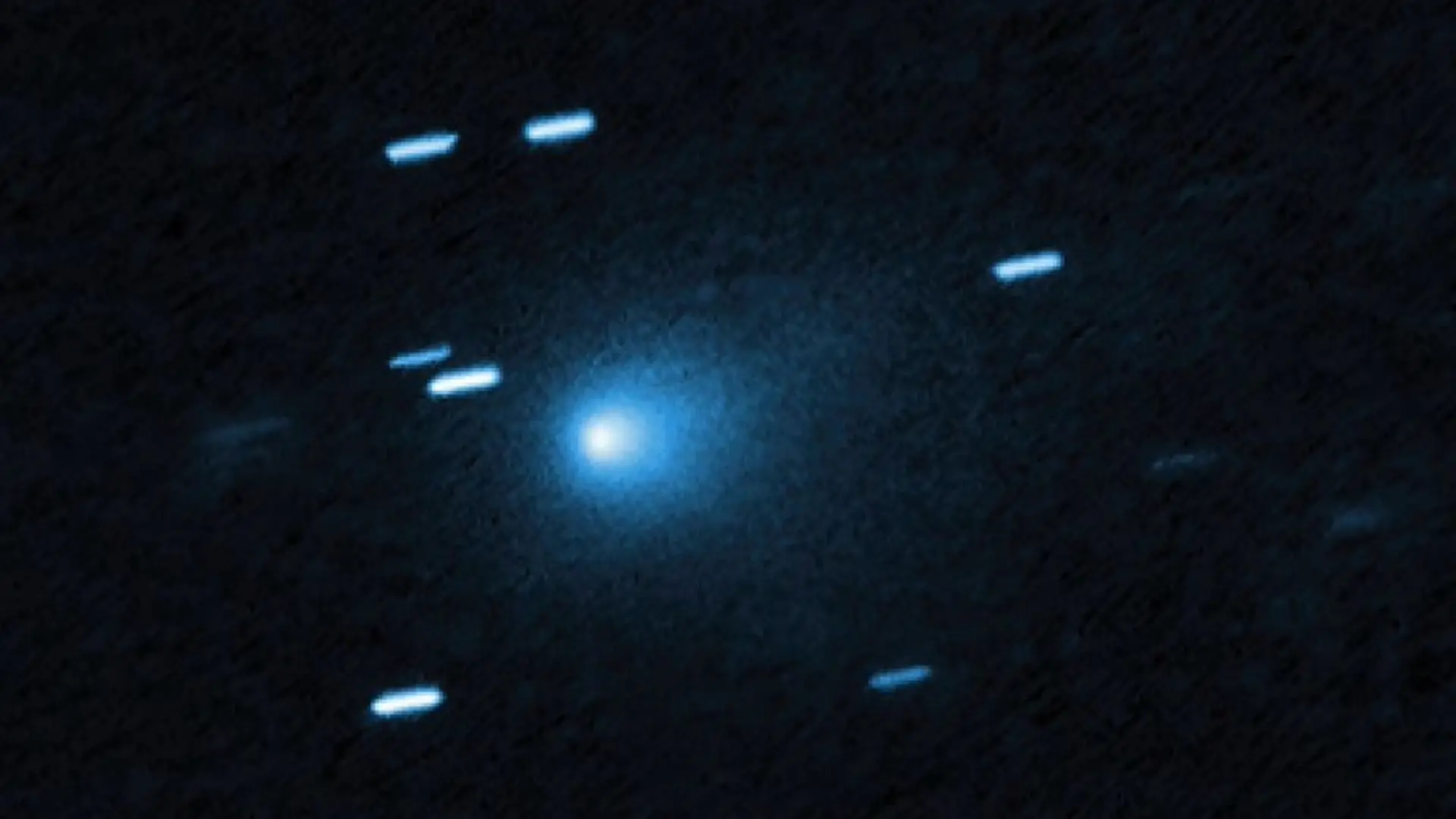 Interstellar comet 3I/ATLAS (Image via NASA)
Interstellar comet 3I/ATLAS made its closest approach to Earth on Friday, December 19, 2025, as it came within 168 million miles of the planet at 1 a.m. EST.
Having flown past Earth, the interstellar visitor is now traveling to the outer solar system, making its way back into interstellar space.
3I/ATLAS, which was observed in July 2025, is the first interstellar object to come this close to Earth.
Ever since its discovery, the comet captured the attention of scientists, space enthusiasts, the government, and the public, sparking a variety of theories about its origin.
What was a routine discovery on July 1 turned into a topic of significant impetus, spreading like wildfire on social media as popular news and gossip.
However, with the rapid dissemination of news came the spread of misinformation and AI-generated reports, which fueled people’s concerns about the interstellar comet.
As 3I/ATLAS transformed into a global sensation, Harvard physicist Avi Loeb published multiple essays, claiming that the object might be alien.
Although he did not confirm his claim with certainty, his observations contributed to keeping 3I/ATLAS a consistent topic of discussion, as enthusiasts from across the globe debated its origin.
Looking back on its journey, scientists have identified the factors that helped make 3I/ATLAS a viral topic.
Exploring the journey of the interstellar comet 3I/ATLAS and why it caught people’s attention
Soon after 3I/ATLAS was discovered, it began circulating on the internet, mainly due to claims that it was an alien spacecraft.
It became so viral that it even caught Kim Kardashian’s attention as she posted on X, asking NASA administrator Sean Duffy to share the “tea” about the visitor.
With that, NASA started receiving multiple requests to reveal everything they knew about the comet.
According to Qicheng Zhang, a postdoctoral fellow at the Lowell Observatory in Arizona, the buzz around the comet escalated because it was discovered shortly before it was due to fly past the sun and Earth.
“That seems to have given it a whole lot of extra time for conspiracy theorists to run wild and drum up attention before their unsubstantiated predictions are disproven to the extent they can ever be, and people lose interest,” Zhang said in a statement to Space.com.
The government’s shutdown from October 1 to November 12, 2025, added to the chaos, as NASA paused much of its activities during that period, leaving people confused and seeking answers to their doubts.
In the meantime, rumors and baseless news about 3I/ATLAS began to circulate, making the object a matter of global concern.
“Unfortunately, it all came during the shutdown. And so that created its own complications, because the folks out there, who, you know, are conspiracy bent, thought NASA was trying to hide something,” Larry Denneau, the scientist who discovered the comet, told Space.com.
However, he noted the contribution of one person who helped turn 3I/ATLAS into a mainstream topic: Harvard professor Avi Loeb.
Ever since the comet’s discovery, Loeb has consistently written about it on his blog on Medium, often claiming that the HiRISE images of 3I/ATLAS were intentionally kept concealed from the public for “bureaucratic reasons at NASA.”
Due to such claims that 3I/ATLAS might be an alien spacecraft, it gained significant traction in popular media.
Denneau criticized Loeb for preaching “all of this weird stuff,” adding that it complicated the situation since he is a professor from an esteemed university.
Mik West, a science writer, felt the same, as he expressed that Loeb’s “unremitting push combined with the gravitas of his Harvard professorship” prompted popular media to pick up the news immediately.
Even after NASA released the HiRISE images and additional information on 3I/ATLAS, stating that the interstellar object “definitely behaves like a comet,” Loeb remained unconvinced.
Despite later observations that studied its gases and movements and said that they were not unusual, Loeb believed otherwise.
He criticized the experts for having a narrow vision and not being open-minded about the comet.
Now that the comet has made its closest approach to Earth, scientists believe the comet is unlikely to attract as much attention again, since all the speculation emerged from the alien technology claims.
Regardless, Denneau told Space.com that they will continue observing the comet scientifically even after the buzz settles.
Stay tuned for more updates.
TOPICS: 3I/ATLAS, Avi Loeb, 3I/ATLAS closest approach to Earth, 3I/ATLAS distance from Earth, 3I/ATLAS shutdown, Avi Loeb 3I/ATLAS
- Europa Clipper spends seven hours watching 3I/ATLAS as NASA studies elements in its surrounding plume
- Harvard Professor Avi Loeb weighs evidence and interpretation surrounding anomalies in 3I/ATLAS
- Erratic rotation detected as MAVEN Mars probe remains silent
- Why 3i/Atlas’ alignment is raising questions: Avi Loeb breaks down the 1 in 40,000 odds