
Features
Harvard Professor Avi Loeb weighs evidence and interpretation surrounding anomalies in 3I/ATLAS
-
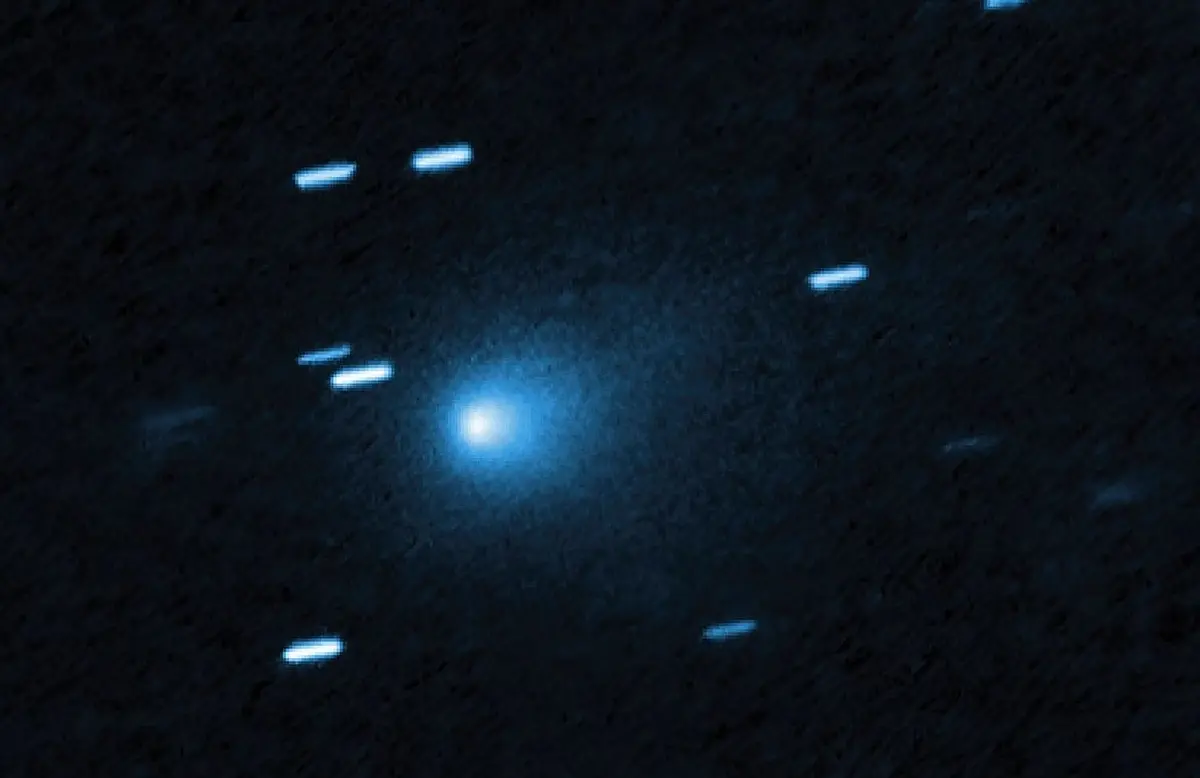 Comet 3I/ATLAS (Image via NASA)
The interstellar object 3I/ATLAS has drawn attention due to its trajectory and physical properties, which differ from typical solar system comets.
Harvard Professor Avi Loeb has discussed 15 specific anomalies associated with 3I/ATLAS and highlighted the importance of examining them without prior expectations.
According to Loeb, anomalies are by definition unexpected, and their relevance does not depend on whether they were predicted.
He emphasizes that the presence of unusual nickel without iron, and other chemical or physical traits, represents measurable deviations from previously observed cometary behavior.
This approach frames the discussion of 3I/ATLAS’s anomalies in purely empirical terms while remaining open to multiple explanations.
Discovery and trajectory
Comet 3I/ATLAS was first reported to the Minor Planet Center by the ATLAS survey telescope in Rio Hurtado, Chile, on July 1, 2025.
Pre-discovery observations were subsequently identified in archives of other ATLAS telescopes and Caltech’s Zwicky Transient Facility at the Palomar Observatory, extending back to June 14, 2025.
The designation “3I” indicates it is the third known interstellar object, with “I” denoting interstellar origin. Its orbital path is hyperbolic, demonstrating that it is not bound to the Sun and originated outside the solar system.
According to NASA, the comet’s closest approach to Earth is approximately 1.8 astronomical units, and it will reach perihelion around October 30, 2025, at 1.4 astronomical units from the Sun.
The object’s trajectory has been analyzed for its orientation relative to the solar system’s plane.
Loeb notes that some features, such as close approaches to certain planets and specific orbital angles, are unusual compared to typical cometary orbits.
Such phenomena were observed via various telescopes, among which is the Hubble Space Telescope of NASA that got the image of the comet's nucleus surrounded by the dust cocoon in the shape of a teardrop on July 21, 2025.
The comet's extraordinary speed has been followed by means of telescopes placed on the ground. Its speed being hyperbolic, the comet is a foreign guest in the solar system.
Moreover, the researches on its movement give the possibility to scientists to determine the way leading to them and to have a look at the solar system models with the trajectories of objects farther in the past refined.
Observational evidence
NASA’s ongoing observations of 3I/ATLAS involve instruments including Hubble, Webb, TESS, Swift, SPHEREx, the Perseverance rover, Mars Reconnaissance Orbiter, MAVEN, Europa Clipper, Lucy, Psyche, Parker Solar Probe, PUNCH, and ESA/NASA’s SOHO.
These assets have enabled measurements of the comet’s nucleus size, currently estimated between 440 meters and 5.6 kilometers.
Observations from Hubble and other instruments provide data on dust emissions, trajectory, and chemical composition.
Loeb’s assessment of anomalies includes noting the chemical signature of nickel without iron, the appearance of jets along specific directions, and trajectory characteristics not typically observed in solar system objects.
He frames these anomalies as measurable deviations rather than predictions, emphasizing the need for systematic observation to confirm or refute potential explanations.
Scientific discussion
In correspondence with Princeton Professor Josh Winn, Loeb addressed the methodological question of how to interpret anomalies that were not predicted.
Winn highlighted that hypotheses about technological origin require testable predictions to validate claims, while Loeb responded that the anomalies themselves are empirical observations.
Loeb’s position stresses that unexpected deviations in physical or chemical behavior should be documented regardless of prior forecasting.
Galitchy cites the example of hot Jupiters, whose existence was not predicted but confirmed through observation.
Loeb concludes that the anomalies of 3I/ATLAS do not necessarily point to a technological origin, but the anomalies should be documented and explored in detail.
Such an approach is consistent with the founding principles of science which dictate that one should observe unexpected phenomena without giving one's own interpretation or demanding a prediction.
Stay tuned for more updates.
TOPICS: 3I/ATLAS, 3I/ATLAS comet, 3I/ATLAS observation, 3i/ATLAS recent updates, Avi Loeb 3I/ATLAS, comet 3I/ATLAS NASA update
More 3I/ATLAS
on Primetimer:
- Europa Clipper spends seven hours watching 3I/ATLAS as NASA studies elements in its surrounding plume
- Erratic rotation detected as MAVEN Mars probe remains silent
- Why 3i/Atlas’ alignment is raising questions: Avi Loeb breaks down the 1 in 40,000 odds
- Swift telescope uncovers unexpected water activity in interstellar comet 3I/ATLAS