
Europa Clipper spends seven hours watching 3I/ATLAS as NASA studies elements in its surrounding plume
-
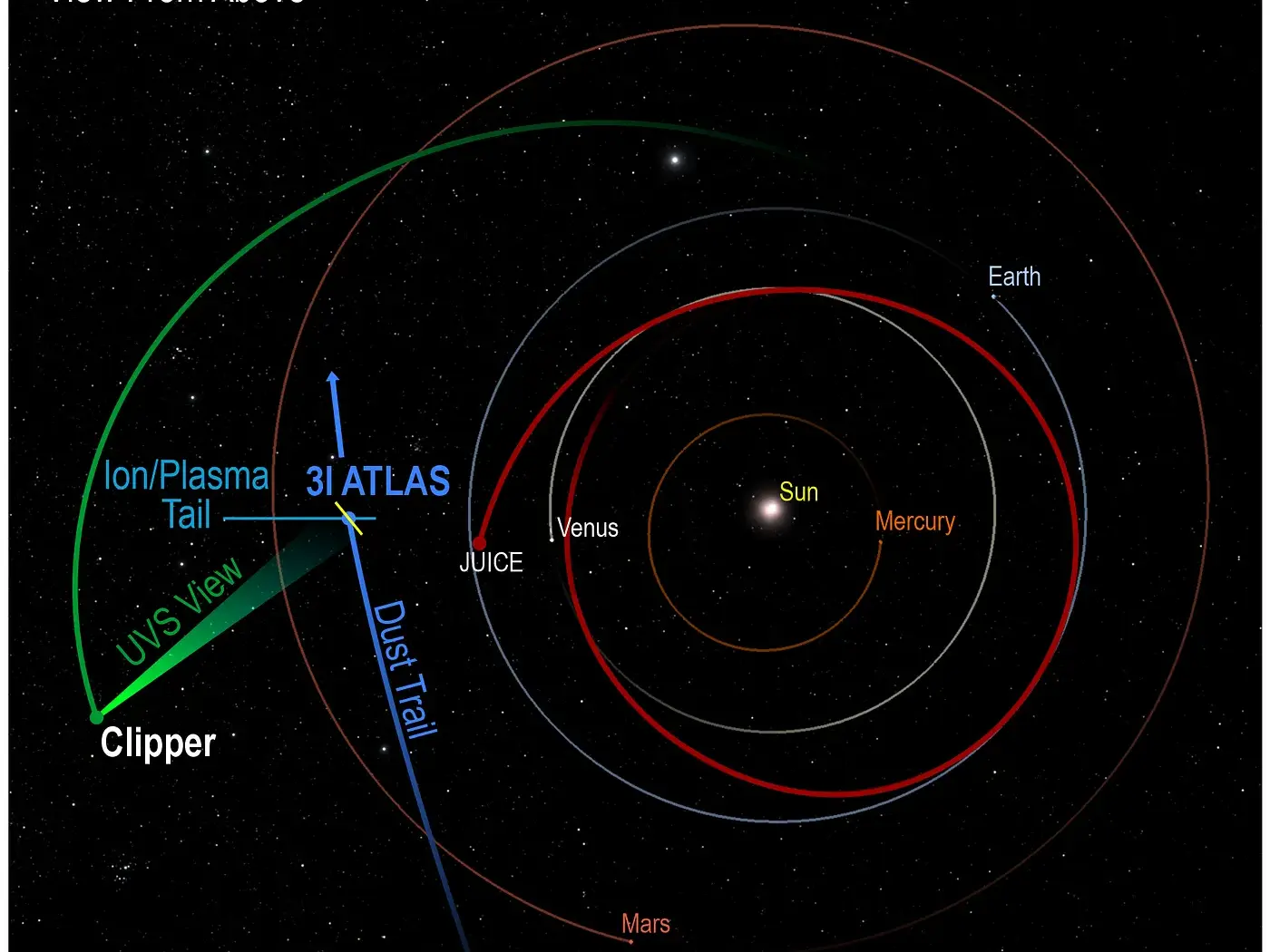 Image sourced via Avi Loeb Medium Blog
The NASA spacecraft, named the Europa Clipper, just spent seven hours observing a rare object orbiting our solar system named 3I/ATLAS. This object is unique since it originated from outside our solar system.
This is the third object ever to have been discovered, making this encounter very rare. The observation was conducted on November 6, 2025. At that moment, Europa Clipper was 164 million kilometers away from 3I/ATLAS.
Even at such a great distance, it was still possible for it to gather valuable information about gas and dust surrounding it.
Why Europa Clipper had a better view than earth
When the Europa Clipper spacecraft observed 3I/ATLAS, Earth-based telescopes could not observe it clearly. It was difficult for scientists on Earth because the Sun was in the way. Europa Clipper did not have that problem.
The object came between the spacecraft and the Sun, offering scientists a unique view to observe the object. This made Europa Clipper view the areas on the object that were normally hidden.
Because of this angle, scientists are able to examine both the tail of this comet and what is known as an anti-tail. As mentioned, comets’ tails are supposed to point away from the Sun. However, an anti-tail can be identified if it is somehow directing towards the Sun.
What scientists found around 3I/ATLAS
The Europa Clipper mission employed a sensor called the Ultraviolet Spectrograph, or UVS, to investigate the cloud around 3I/ATLAS. This cloud results when the object is warmed by the Sun, causing gas and dust to be released into space.
During the seven-hour observation period, the UVS technique was able to detect the presence of hydrogen, oxygen, and dust particles. This data assists in discovering what the asteroid consists of, as well as its reaction to sunlight.
NASA has also produced a specific picture by merging different ultraviolet values. The resultant picture assisted the scientists in understanding the shape and motion of gas as well as dust that was emanating from the object.
Why this observation is important
This short observation gave scientists information they could not get from Earth. It helped them learn how objects from outside our solar system behave when they come close to the Sun.
The data also showed how fast 3I/ATLAS is moving. After passing Europa Clipper, the object is expected to come closest to Jupiter in March 2026, showing how quickly it travels through space.
Europa Clipper’s main mission
Europa Clipper was launched in October 2024. Its main job is to study Europa, a frozen moon of Jupiter that may have an ocean under its ice.
The spacecraft is expected to reach Jupiter in 2030 and will make 49 close flybys of Europa. While watching 3I/ATLAS was not part of its main mission, this rare observation gave scientists a valuable chance to study a visitor from deep space before it moves on forever.
TOPICS: 3I/ATLAS, 3i/ATLAS recent updates
- Harvard Professor Avi Loeb weighs evidence and interpretation surrounding anomalies in 3I/ATLAS
- Erratic rotation detected as MAVEN Mars probe remains silent
- Why 3i/Atlas’ alignment is raising questions: Avi Loeb breaks down the 1 in 40,000 odds
- Swift telescope uncovers unexpected water activity in interstellar comet 3I/ATLAS