
Culinary Class Wars Season 2 sets up a quiet showdown between Hu Deok-juk's legacy and Sam Kim's restraint
-
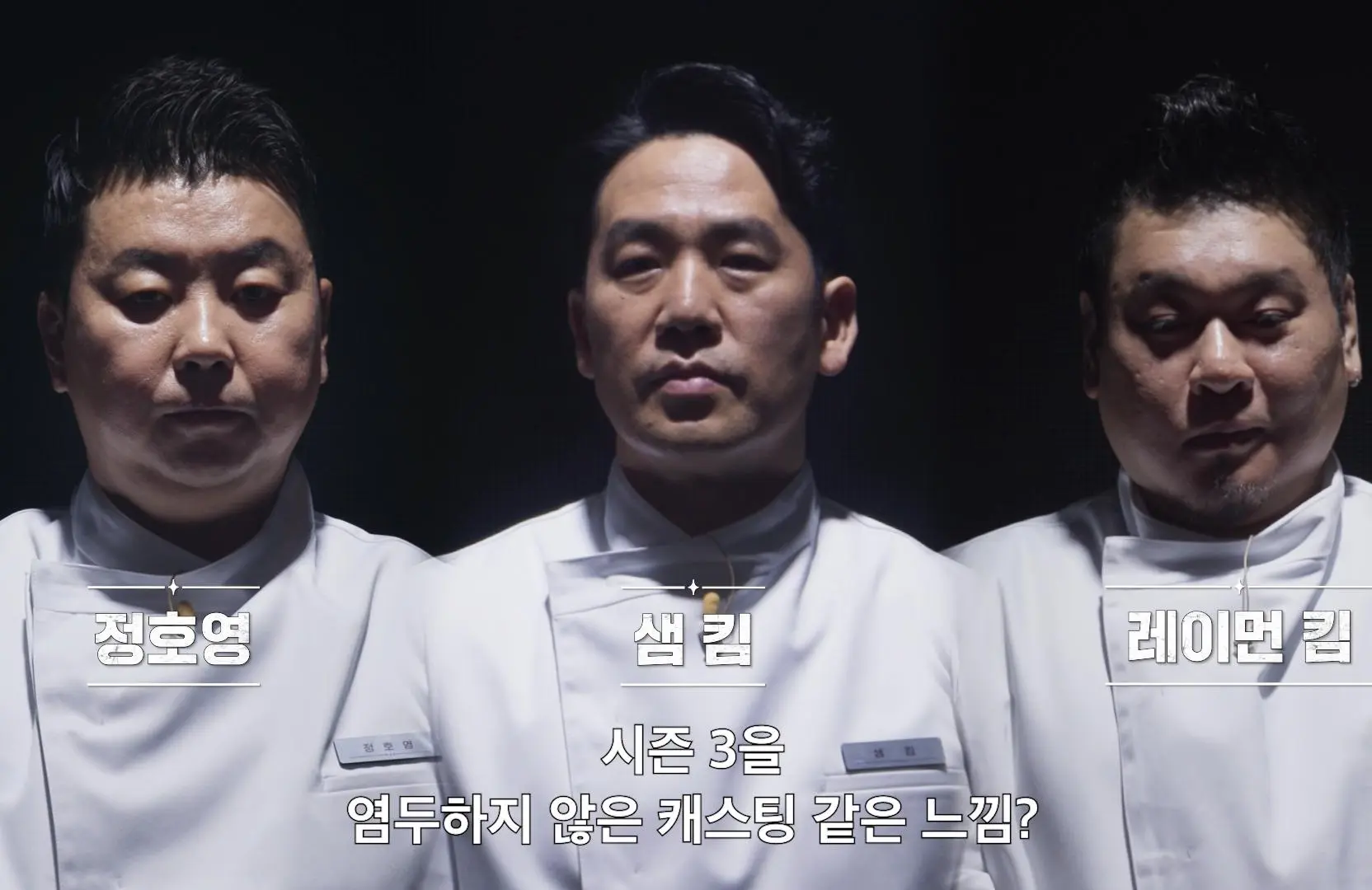 Jung Ho-young, Sam Kim and Raymon Kim (Image via Netflix)
Netflix’s Culinary Class Wars Season 2 has set up a quiet showdown between Hu Deok‑juk’s towering legacy in Korean Chinese cuisine and Sam Kim’s disciplined, almost meditative approach to Italian cooking, a contrast that now plays out in the show’s high‑stakes kitchen.
Hu Deok‑juk, appearing as a White Spoon contestant, is widely regarded as a benchmark in Korean Chinese fine dining, a chef whose career has shaped how high‑end Chinese food is understood in Korea.
Sam Kim, also a White Spoon, is known to the public as the real‑life inspiration behind the drama Pasta and as a long‑time cast member of tvN’s Chef & My Fridge, but his restaurant reveals a far more restrained, technically precise side.
Culinary Class Wars Season 2 and the White Spoon duel
In Culinary Class Wars Season 2, the White Spoons (Baek Sujeori) are established star chefs, while the Black Spoons (Heuk Sujeori) are underground masters challenging the hierarchy.
Hu Deok‑juk and Sam Kim both appear in this elite White Spoon lineup, their presence immediately drawing attention not just for their fame but for the very different philosophies they represent.
Hu Deok‑juk, born in 1949 in Seoul’s Sogong‑dong, grew up in a Chinese‑Korean household where food was a way of life.
He joined The Shilla Seoul’s Chinese restaurant Palsun in 1977, and within three years elevated it to the top tier of Korea’s fine‑dining scene.
In 1987, he introduced Buddha Jumps Over the Wall to Korean diners for the first time, a labor‑intensive Cantonese banquet dish made by slowly simmering abalone, sea cucumber, fish maw, and poultry for hours.
At Hobin, the Chinese restaurant he now presides over at The Ambassador Seoul — A Pullman Hotel, Hu’s cooking is defined by restraint.
A weekday “Gung” course begins with cold appetizers: jellyfish lightly dressed in vinegar, abalone with chili sauce, and shrimp paired with whole‑grain mustard, all offering clean, precise flavors.
Warm dishes follow with similar clarity: crab meat with egg white, served sealed inside a crab shell and opened tableside, is delicate, almost porridge‑like, emphasizing texture over richness.
Fried sea cucumber rolls stuffed with shrimp maintain the prized elasticity of the ingredient, while vegetables provide contrast without distraction.
Noodles or fried rice, offered as a final savory course, are refreshingly restrained, and dessert — a purple sweet potato pudding paired with blueberry syrup — keeps sweetness in check.
Sam Kim’s kitchen in Culinary Class Wars Season 2
Sam Kim, in contrast, is best known for his Italian restaurant Trattoria Sam Kim in Apgujeong, where the open kitchen reveals a chef deeply involved in every plate that leaves the pass.
The restaurant’s bar seating faces the kitchen, allowing diners to observe a quiet, almost meditative workflow.
The pasta tasting lunch menu begins with naturally fermented sourdough and grissini, served alongside olive oil, followed by a thoughtful series of amuse‑bouches.
A persimmon wrapped in gorgonzola balances sweetness and umami, while a beet ravioli‑shaped bite offers acidity softened by cream. Mushroom tartlets and lightly cured, fried cod complete the set.
Sam Kim’s cooking favors clean lines and subtle layering. Sea bream, lightly cured with sugar and salt, is paired with a bright yuzu‑green chili sauce and finished with scallion‑smoked oil; the fish is firm, fresh, and aromatic.
Warm dishes include sous‑vide scallops with peas and prosciutto, where salinity is carefully moderated, and grilled octopus served with mashed potatoes that temper the dish’s natural intensity.
A scampi risotto arrives al dente, enriched with Parmigiano Reggiano, while undercooked sweet shrimp add sweetness rather than weight.
Despite a full dining room at lunchtime, pacing remains deliberate; Kim is visibly present, checking plates until serving.
A beef‑tail tagliatelle showcases a pasta texture that is unusually firm for fresh noodles, followed by a dessert of chestnut ice cream encased in a white chocolate dome, layered with citrus compote to close the meal on a light note.
The judges’ perspective on Culinary Class Wars Season 2
Culinary Class Wars Season 2 is judged by celebrity restaurateur Paik Jong‑won and Michelin three‑star chef Anh Sung‑jae, whose strict, blindfolded judging in the early rounds is designed to ensure impartiality.
Food is discarded after tasting so that crew and contestants cannot influence the decisions, a system meant to focus purely on the dish, not the chef’s reputation.
In the press briefing for Culinary Class Wars Season 2, chef Son Jong‑won, another White Spoon, said of the experience:
“On the show, I acted confident, but during the actual competition, I was nervous and tense. I’m glad I survived. It was a challenge for me. Culinary Class Wars was a big challenge, and I joined because I thought it would be an opportunity for growth. The food industry was in a slump in the past, but Season 1 created a lot of buzz. I hope Season 2 will also help the food industry.”
Together, Hu Deok‑juk and Sam Kim represent two ends of a spectrum that Culinary Class Wars Season 2 brings into conversation: one rooted in legacy and preservation, the other in contemporary technique shaped by experience rather than spectacle.
Their restaurants, like their careers, are less about competition than about continuity — proof that mastery, in any cuisine, is built quietly over time.
Stay tuned for more updates.
TOPICS: Culinary Class Wars season 2 , Culinary Class Wars season 2 Chef Hu Deok-juk, Culinary Class Wars 2 Chef Sam Kim
- Culinary Class Wars Season 2 storms non-drama charts with first-week buzz surge
- Who is Sam Kim from Culinary Class Wars season 2? Here's everything to know about the chef
- Culinary Class Wars season 2 episode guide and complete schedule: What days do the new episode drop?
- Who survived the showdown? Inside Culinary Class Wars season 2’s final Black Spoon lineup