
When is Festivus celebrated? Details analyzed on how to celebrate the holiday
-
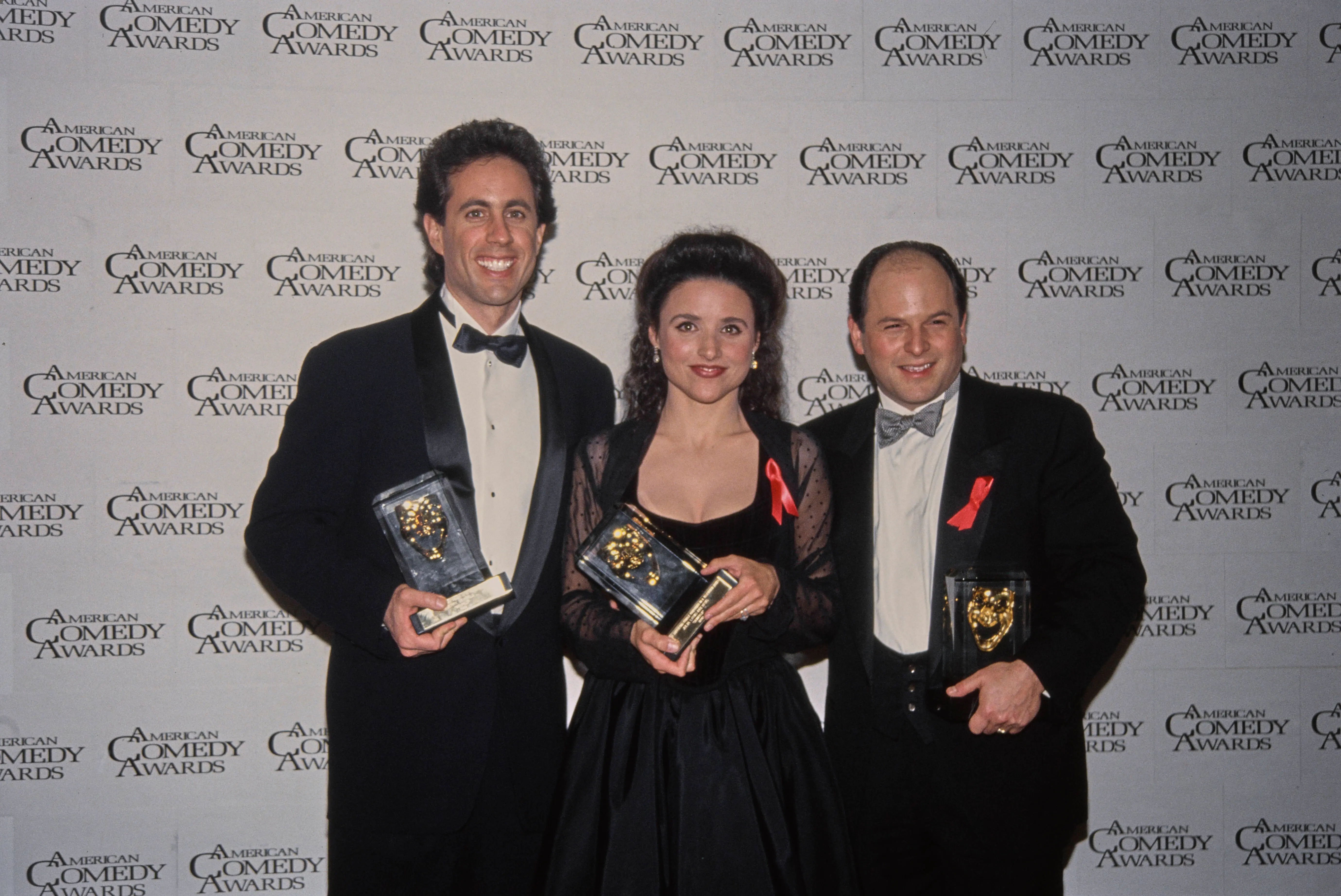 American comedian and actor Jerry Seinfeld, wearing a tuxedo and bow tie, American actress and comedian Julia Louis-Dreyfus, who wears a black evening gown with sheer black sleeves, and American actor and comedian Jason Alexander, also in a tuxedo and bow tie, in the 7th Annual American Comedy Awards press room, at the Shrine Exposition Center in Los Angeles, California, 28th February 1993. Seinfeld holds his 'Funniest Male Performer in a TV Series (Network, Cable or Syndication),' Louis-Dreyfuss has her 'Funniest Supporting Female Performer in a TV Series' award, and Alexander his 'Funniest Supporting Male Performer in a TV Series' award, all received for their NBC sitcom 'Seinfeld'. (Photo by Vinnie Zuffante/Getty Images)
Festivus is celebrated on December 23 each year, and it is best understood as a deliberately secular holiday that pokes fun at the stress and forced cheer of late December. The tradition became widely known through Seinfeld, when the Season 9 episode The Strike aired in 1997 and introduced it as an anti-commercial alternative to the Christmas rush.
The idea behind the holiday also has real-world roots as a family tradition that existed before it reached TV. For the audience, the modern celebration is usually a playful get-together with a simple dinner, a deliberately plain pole, a structured moment to vent complaints, and a goofy strength challenge to end the night.
The point is a low-pressure reset, not a perfect ceremony. Because it is not tied to any faith calendar, it often works for mixed friend groups and workplaces that want an inclusive seasonal hang. People tend to keep the grievances section roast-light and consent-based, then end with something silly so everyone leaves laughing.
When is Festivus celebrated, and what exactly is it?
The core date is December 23. Time reports that in the Seinfeld version, Frank Costanza chose the timing because he wanted “to get a leg up on Christmas.” Festivus is meant to be secular and flexible, with the joke being that it strips the season down to its basics. That comes through in the most visible symbol, the aluminium pole. Frank Costanza said the pole,
“requires no decoration.”
In practice, many celebrations borrow the episode’s structure. People gather for a low-key meal first, then move into the airing of grievances, and end with a challenge that acts as a clean closing beat. The key guardrail is tone. If everyone is not on board, the “grievances” part can land as mean instead of funny, so hosts often set boundaries and allow people to pass.
The episode frames the holiday as a response to holiday shopping pressure, and Frank uses a story about trying to buy a toy as the origin point. As he begins explaining why he wanted an alternative, Frank Costanza said,
“Many Christmases ago, I went to buy a doll for my son,”
He then describes the moment that turns shopping into a brawl and, in the show’s logic, into a new holiday. Frank Costanza said,
“I reached for the last one they had, but so did another man. As I rained blows upon him, I realized there had to be another way.”
Festivus becomes that “other way,” with a venting ritual and a physical challenge replacing forced cheer. To keep it social instead of sharp, many groups treat the last step, feats of strength, as deliberately silly. Wrestling is the episode’s version, but a safer stand-in works fine, like push-ups, arm wrestling, or a short game tournament. The point is to end on a reset, not to “win” the night.
The lore and origin story: from a family tradition to a TV phenomenon
Most people know Festivus from Seinfeld, while the concept existed as a family tradition connected to writer Dan O’Keefe. O’Keefe’s father invented it when O’Keefe was a child, and the tradition included airing grievances and feats of strength, even before the TV version added the now-famous pole.
That detail matters for accuracy because what people now copy is largely the standardized sitcom version. Outlets also point readers to O’Keefe’s book The Real Festivus for more on the earlier family history.
How to celebrate it today without starting a family fight
A modern Festivus night works best when the host sets expectations up front. Keep the meal simple, keep the pole minimal, and make sure everyone agrees the night is comedy-first and not cruel. Then set rules for grievances before anyone speaks.
Make it one turn each, keep it brief, allow people to pass, and focus on situations rather than personal attacks. Ending with a safe feats-of-strength challenge helps the group leave on a clear final beat. Celebrated this way, Festivus stays what the episode sells: a secular December 23 gathering built around a shared laugh when the season feels too loud.
Stay tuned for more updates.
TOPICS: Festivus, Secular Christmas, Seinfeld