
Space News reports that satellite operators are beginning to look below traditional low Earth orbit as congestion increases. Around 15,000 satellites currently circle Earth, many operating up to about 1,200 miles above the surface.
Features
Satellites flying closer to Earth could reshape communications and climate science
Satellites are moving closer to Earth as very low Earth orbit gains attention. This article explains the benefits, technical challenges, and research behind VLEO satellite operations and future use
-
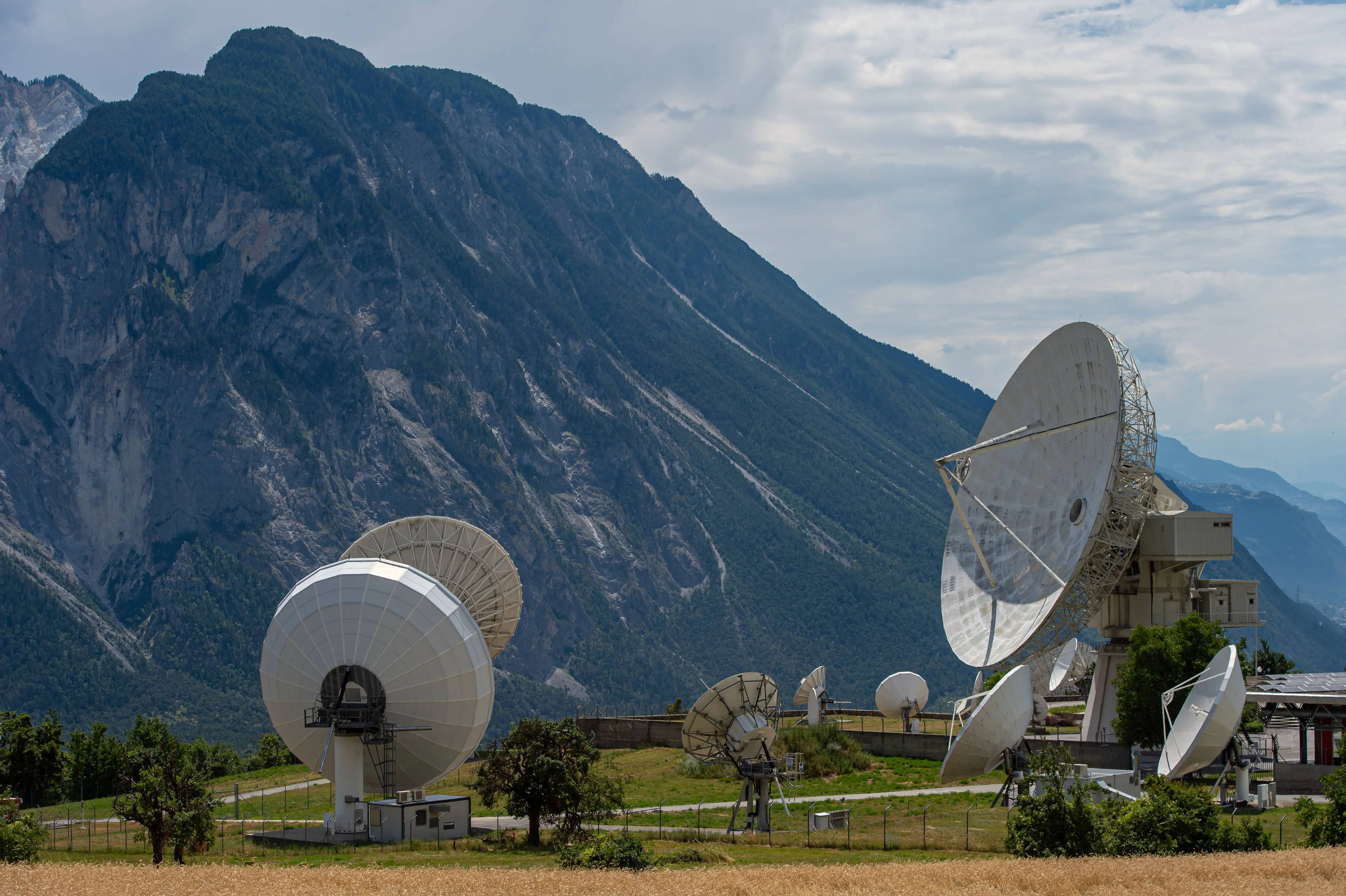 Satellite dishes belonging to local communications provider Leuk Teleport and Data Centre AG stand on a mountainside in Wallis canton (Image via Getty)
As more spacecraft are launched for communications, imaging, and research, engineers are examining very low Earth orbit, known as VLEO. This region ranges from about 60 to 250 miles above Earth.
The article explains that satellites in VLEO travel closer to the atmosphere, which creates both opportunities and limits. Operating closer to Earth can improve image quality, reduce communication delays, and increase the detail of weather data. At the same time, satellites face stronger atmospheric drag, which slows them down and causes them to lose altitude.
The discussion draws on research from university and government projects focused on propulsion systems that allow satellites to stay in orbit longer. Some systems use the thin atmosphere itself as part of the propulsion process. Others explore mechanical solutions such as tethers.
The article also outlines environmental and engineering challenges, including heat and exposure to atomic oxygen. Together, these factors shape how VLEO satellites may be designed and used in the coming years.
Benefits of operating in very low Earth orbit
Satellites in very low Earth orbit provide clearer views of Earth because of their shorter distance from the surface. According to the article, “the images from very low Earth orbit satellites are sharper” since sensors operate closer to the ground. This allows more detailed data for agriculture, disaster monitoring, and mapping.
Communication systems also benefit from reduced distance. Signals still travel at the same speed, but the shorter path lowers the delay.
The article notes that this can support “real-time communications, like phone and internet service.” Weather observation also improves because cloud images captured closer to Earth contain more usable detail.
The article states that government agencies and private companies are developing systems for this region due to these technical gains.
Research groups are testing designs that can function for longer periods despite drag. Investment estimates cited in the article suggest large spending commitments in the near term.
These advantages explain why interest in VLEO continues to grow, even though satellites in this region face limits not found at higher altitudes.
Technical challenges and current research
The main challenge in very low Earth orbit is atmospheric drag. The article explains that satellites at lower altitudes can fall out of orbit “in weeks or even days” without constant propulsion. Traditional fuel-based thrusters are not efficient enough for continuous use at these heights.
Researchers are testing systems that collect atmospheric gases and use them as fuel. One project described uses a scoop and microwave energy to heat the collected air and push it out through a nozzle. The article describes this as an “air-breathing microwave plasma thruster.” Laboratory tests have shown the concept can work under simulated conditions.
Other approaches include different air-breathing engines and tether systems connecting satellites at different altitudes. Beyond propulsion, satellites must handle atomic oxygen exposure and extreme heat. The article states that friction can raise temperatures above “2,732 degrees Fahrenheit.”
These challenges define the limits of VLEO operations, but ongoing research continues to test whether long-term missions in this region are practical.
Additional research focuses on materials that can survive constant exposure to atomic oxygen. Engineers are also testing heat-resistant surfaces to manage friction during flight.According to the article, these conditions “quickly corrode most substances,” shaping how satellites are built and operated.
Stay tuned for more updates.
TOPICS: Astronomy, Geostationary Satellites, Geosynchronous satellites, Planet Earth, VLEO Satellites
More Astronomy
on Primetimer:
- Earth’s natural calendar is far more fragmented than scientists expected
- Trump shifts US space focus back to the Moon, delaying Mars ambitions
- NASA names international four-member crew for upcoming SpaceX space station mission
- Astronomers trace powerful blue cosmic flashes to stars being torn apart by black holes