
Space.com reports on new research that explains the source of rare, short-lived blue light events seen far beyond the Milky Way.
Features
Astronomers trace powerful blue cosmic flashes to stars being torn apart by black holes
Scientists explain how rare bright blue cosmic flashes form when black holes tear apart massive stars, based on new observations of the event AT 2024wpp and similar fast blue optical transients
-
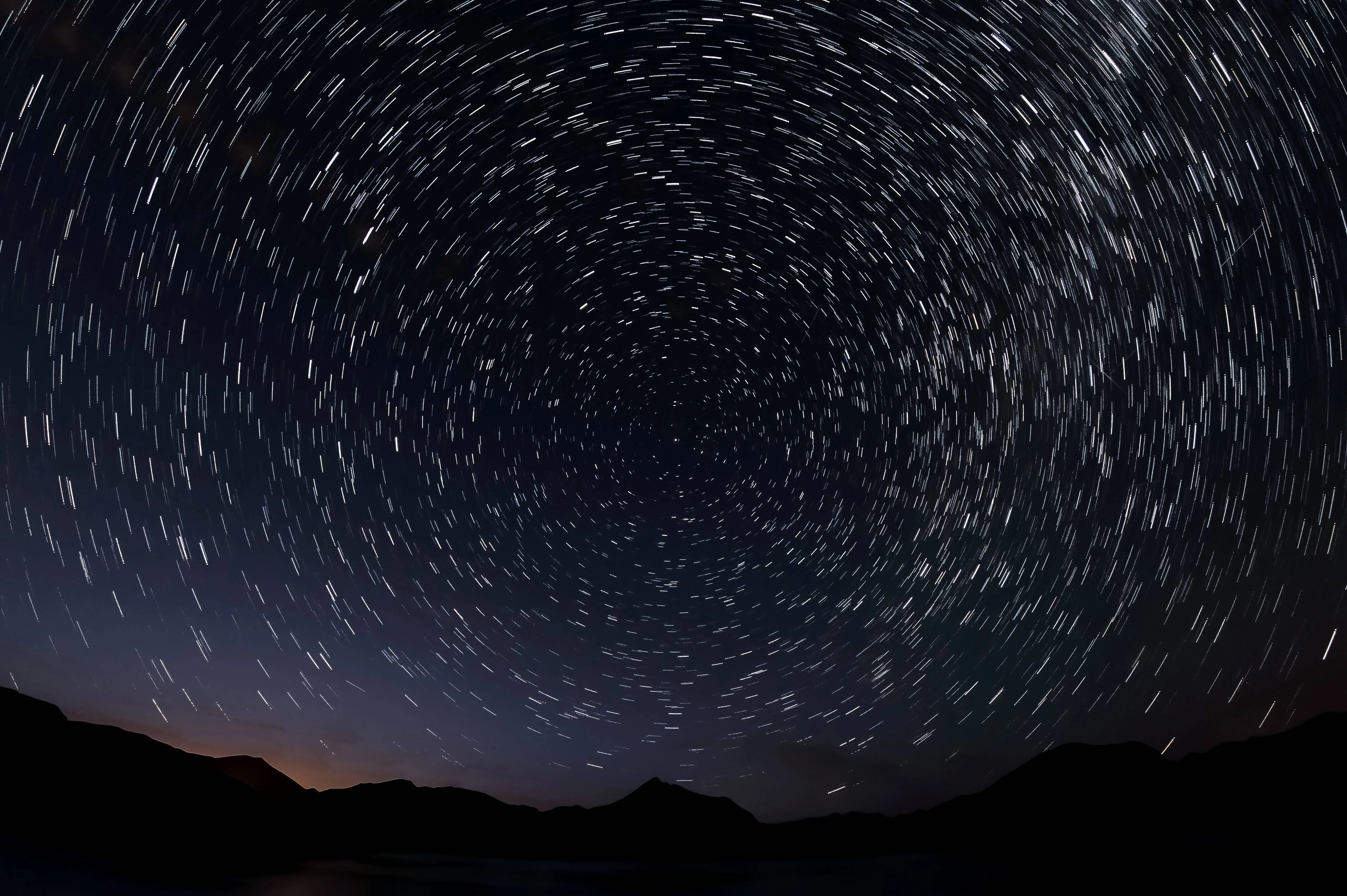 Meteors along the Milky Way (Image via Getty)
Scientists studying a signal known as AT 2024wpp say these flashes are caused by black holes destroying nearby stars, rather than by stellar explosions.
The finding comes after years of uncertainty about a class of events called luminous fast blue optical transients, or LFBOTs.
AT 2024wpp was detected in 2024 and is the brightest example of its kind observed so far. It appeared at the edge of a distant galaxy around 1.1 billion light-years from Earth.
The event released far more energy than typical supernovae and faded within days. Its unusual brightness and short duration led researchers to question earlier explanations.
Using data from X-ray, ultraviolet, optical, infrared, and radio observations, the team concluded that AT 2024wpp was produced during an extreme tidal disruption event.
In such events, a black hole pulls a star apart as it passes too close.
The results suggest that some LFBOTs form under very specific conditions involving smaller black holes and massive companion stars.
The research helps narrow down the physical processes behind these rare signals and places limits on models that rely on standard stellar explosions.
Black hole encounter explains the energy output
Observations showed that AT 2024wpp released around 100 times more energy than a typical supernova.
This level of output led scientists to rule out normal stellar explosions. As researcher Natalie LeBaron said,
“The sheer amount of radiated energy from these bursts is so large that you can't power them with a core collapse stellar explosion, or any other type of normal stellar explosion.”
The data point refers to a tidal disruption event involving a black hole with a mass up to about 100 times that of the Sun.
In this scenario, the black hole had been pulling material from a companion star over a long period, forming a surrounding shell of gas.
When the star finally moved close enough, it was torn apart. The incoming debris collided with the older material, producing intense light across several wavelengths.
Near-infrared light detected from AT 2024wpp had previously only been seen in one other LFBOT, AT 2018cow. This signal is not associated with standard supernovas. According to LeBaron,
“The main message from AT 2024wpp is that the model that we started off with is wrong. It's definitely not just an exploding star.” These findings support a black hole-driven origin.
Star type and environment behind AT 2024wpp
Further analysis suggests the destroyed star had a mass about 10 times that of the Sun and was likely a Wolf-Rayet star, a late-stage object with little hydrogen left. This explains the weak hydrogen signals observed around AT 2024wpp.
Such stars are common in galaxies where star formation is active, matching the properties of the host galaxy.
Radio data show that some of the material near the black hole was redirected toward its poles and expelled as jets. These jets were estimated to move at about 40% of the speed of light.
This process produced radio waves detected after the initial flash. Similar behavior has been observed in other tidal disruption events, though not all produce LFBOTs.
The researchers used the Gemini South Observatory to collect part of the dataset.
Their work has been accepted for publication in The Astrophysical Journal Letters and is available as a preprint on arXiv. As the team notes,
“Not all tidal disruption events create an LFBOT,” showing that specific conditions are required.
The study helps define those conditions and guides future observations.
_______________________________________________
Stay tuned for more updates.
TOPICS: Astronomy, Black Holes, Blue Cosmic Flashes, Milky Way, Milky Way black hole
More Astronomy
on Primetimer: