
Features
NASA’s PUNCH mission observes comet Lemmon during its solar pass
NASA’s PUNCH mission observed comet Lemmon (C/2025 A6) during its solar pass, capturing images of the comet’s tail and movement from October to November 2025, revealing solar wind effects.
-
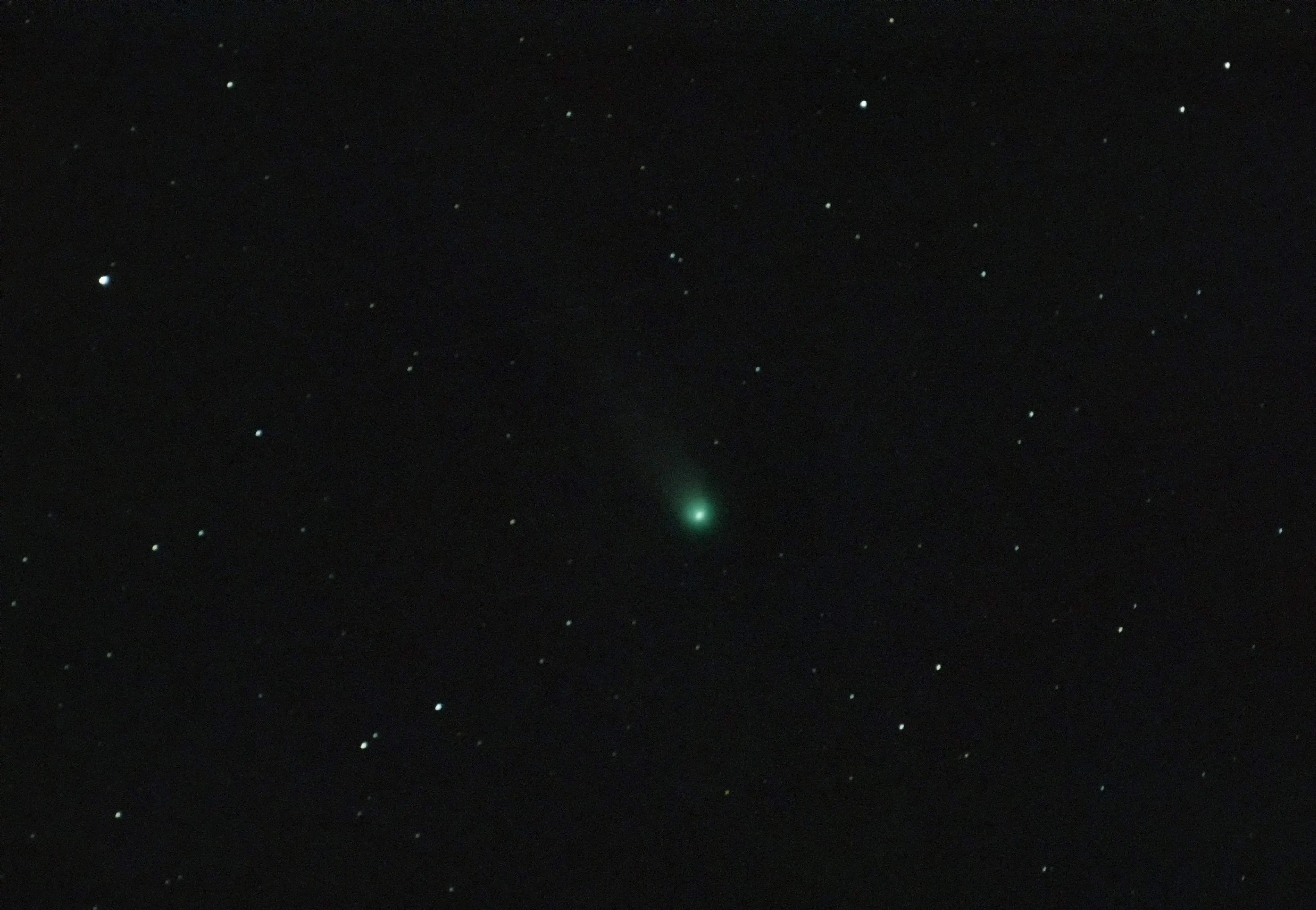 Comet C/2025 A6 (Lemmon) appears in the sky above Molfetta, Italy, on October 11, 2025, around 6:00 AM to the right of the Big Dipper, before dawn. Comet C/2025 A6 (Lemmon), discovered at the beginning of the year, experiences an unexpected and sudden increase in brightness during the summer, quickly becoming one of the most interesting celestial objects of 2025. It is dubbed the most beautiful comet of autumn (Image via Getty)
NASA’s PUNCH (Polarimeter to Unify the Corona and Heliosphere) mission observed comet Lemmon (C/2025 A6) as it passed near the Sun and brightened in Earth’s night sky.
The comet, which was discovered in January 2025, first came into view of PUNCH's field in October, such a placement being the result of a NASA-funded survey telescope on Mount Lemmon, Arizona.
From October 22 to November 12, PUNCH got the opportunity to take the comet pictures and trail its movement against the stars and the solar activity-induced variations in its tail.
The mission has been keeping track of the solar events' short-term tail fluctuations on November 1 and November 4; furthermore, the comet’s departure from PUNCH view is predicted to be around mid-January 2026.
The mission is led by Southwest Research Institute in San Antonio, and the spacecraft is operated from Boulder, Colorado, while NASA's Goddard Space Flight Center carries out mission management activities.
Observing Comet Lemmon with PUNCH
The PUNCH mission is composed of four Earth-orbiting spacecraft that work together to study the Sun’s outer atmosphere and solar wind.
One spacecraft carries a Narrow Field Imager, functioning as a coronagraph to block sunlight and reveal the Sun’s faint corona.
The other three spacecraft each carry Wide Field Imagers that capture the outer corona and solar wind.
The combined data from these instruments provide a wide-field mosaic that can track space weather events and solar activity across the inner solar system.
Comet Lemmon appeared within this observational field, allowing PUNCH to record the interaction between the comet’s tail and solar wind variations.
Comet tail response to solar activity
The images released by NASA show how the solar wind and solar outbursts affected comet Lemmon’s tail.
According to the observations, occasional bursts of solar particles caused the tail to shorten briefly before regrowing over subsequent days.
On November 1 and November 4, solar activity led to temporary wavers and breaks in the tail’s structure. These observations demonstrate the comet’s tail as a natural tracer for solar wind and other solar phenomena.
PUNCH continues to monitor the comet, though its brightness diminishes as it moves away from both the Sun and Earth.
The mission’s continuous imaging allows scientists to analyze tail changes over time and correlate them with specific solar events.
PUNCH mission operations and data release
Southwest Research Institute manages the PUNCH spacecraft and operates the mission from Boulder, Colorado. The mission is led scientifically by principal investigator Craig DeForest.
NASA’s Space Science Mission Operations at Goddard Space Flight Center handles overall mission management.
PUNCH’s images are processed in multiple levels, from Level 0 to Level 3, with Level 3 representing fully processed data.
These processed images are used to track solar events such as coronal mass ejections (CMEs) and other interplanetary phenomena, as well as to observe objects passing through the inner solar system, including comet Lemmon.
The Level 3 images from October 22 to November 12 are available for download from NASA’s Solar Data Analysis Center and the Southwest Research Institute’s data access page.
The PUNCH mission provides continuous, unobstructed views of the Sun along Earth’s day-night boundary.
Its observations complement other NASA and ESA missions, including Parker Solar Probe, Solar Orbiter, STEREO, SOHO, CODEX, and IMAP.
By combining data from multiple spacecraft, PUNCH contributes to a detailed mapping of the solar corona, solar wind, and interactions with objects such as comet Lemmon.
Stay tuned for more updates.
TOPICS: NASA PUNCH mission, Comet Lemmon C/2025 A6, comet solar pass observation, NASA, NASA Goddard Space Flight Center, NASA updates, PUNCH comet tail study, PUNCH spacecraft images, space weather events tracking
More NASA PUNCH mission
on Primetimer: