
Features
NASA's PUNCH Spacecraft captures detailed views of Sun’s coronal mass ejections
NASA’s PUNCH mission captured detailed images of solar coronal mass ejections, tracking their movement from the Sun’s corona through interplanetary space, supporting space weather monitoring and scientific research.
-
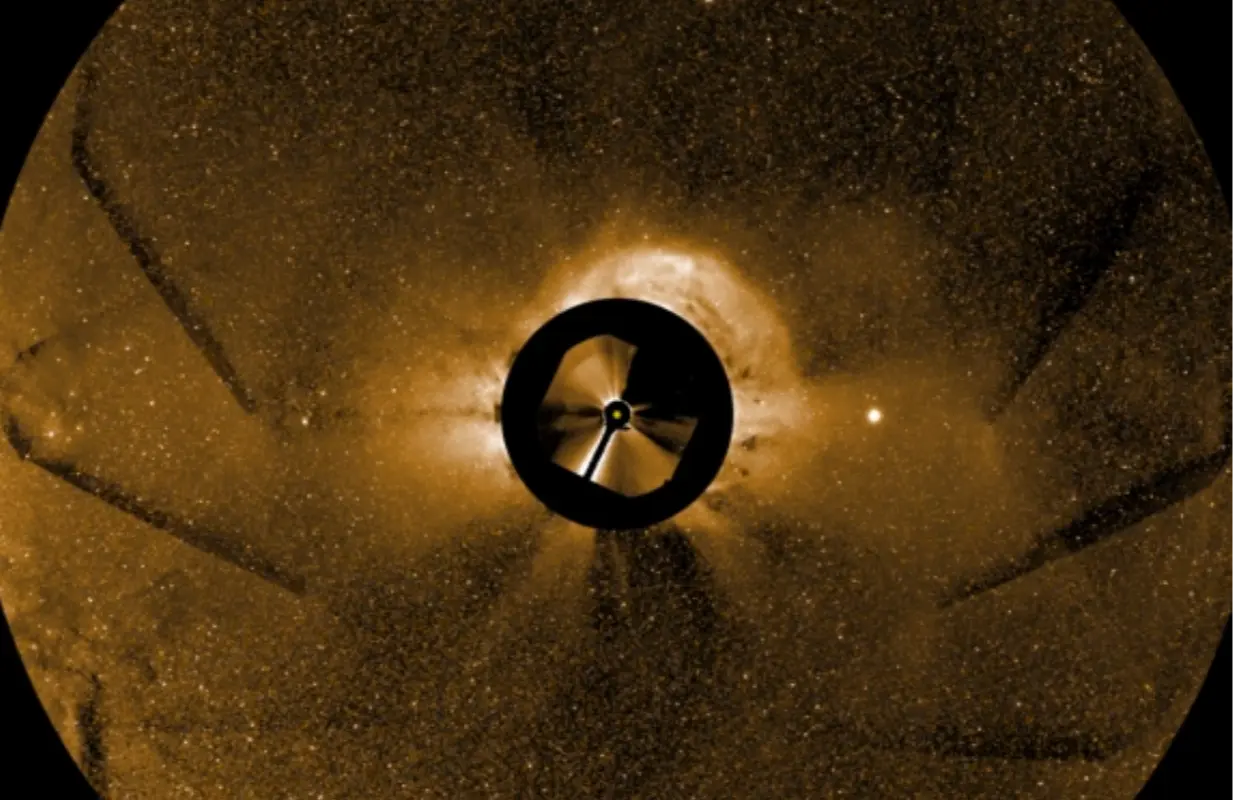 Several coronal mass ejections (CMEs) erupting from the Sun’s surface (Image via NASA)
NASA’s PUNCH (Polarimeter to Unify the Corona and Heliosphere) mission has captured detailed images of coronal mass ejections (CMEs) from the Sun, showing their progression from the Sun’s outer atmosphere into interplanetary space.
The mission released processed images of eruptions that occurred from October 21 to November 12, 2025, marking the first time PUNCH observations can continuously track solar eruptions through the corona and heliosphere.
The four spacecraft, managed by the Southwest Research Institute in Boulder, Colorado, are equipped with complementary imaging instruments that create a continuous view of the Sun’s outer atmosphere and solar wind.
This data is available for download from NASA’s Solar Data Analysis Center.
PUNCH spacecraft Imaging and tracking capabilities
The PUNCH mission consists of four suitcase-sized spacecraft positioned along Earth’s day-night boundary to provide an unobstructed view of the Sun.
One spacecraft carries a Narrow Field Imager, a coronagraph that blocks the Sun’s bright disk to reveal the outer corona, while the other three carry Wide Field Imagers that observe the outer corona and solar wind.
Combined, these instruments produce wide-field mosaics that allow CMEs to be tracked from their origin at the Sun to their movement through interplanetary space.
The Level 3 processed images released by the PUNCH team show eruptions in the corona with sufficient detail for direct tracking.
Additional reprocessing of prior images is ongoing to improve data quality, according to Craig DeForest, principal investigator of PUNCH at the Southwest Research Institute in Boulder, Colorado.
Observations of coronal mass ejections and space weather impacts
From the video released by NASA on December 18, 2025, PUNCH captured multiple CMEs erupting from the Sun over several weeks.
These eruptions corresponded with geomagnetic storms on Earth, including one on November 11, 2025, rated as G4 or severe by NOAA’s Space Weather Prediction Center.
Such geomagnetic activity can impact satellites, power systems and radiation levels. The November 11 storm generated auroras visible in regions of the United States, including Arizona, New Mexico, Texas and Florida.
The observations from PUNCH allow scientists to monitor the formation and evolution of CMEs and other energetic solar events, providing data for potential space weather forecasting and the study of solar wind interactions.
Additional observations and mission coordination
Besides tracking CMEs, PUNCH is also following objects that pass through the inner solar system.
In fact, the spacecraft recorded comet Lemmon (C/2025 A6) and comet 2025 R2 (SWAN) as they passed close to Earth, providing high-frequency observations of their motion and interactions with the solar wind.
Comet SWAN was imaged from August through October 2025, with pictures being taken every few minutes; thus, uninterrupted observation of its tail changes due to solar wind was possible.
PUNCH is a choreographer for the heliophysics band of NASA and international missions, such as Parker Solar Probe, STEREO, IMAP, Solar Orbiter and SOHO.
Southwest Research Institute leads the mission and operates the four spacecraft from Boulder, Colorado. At the same time, NASA’s Goddard Space Flight Center manages mission operations.
The PUNCH mission continually issues and enhances the images, and the Level 3 data products are available to the public through NASA’s Solar Data Analysis Center and the Southwest Research Institute's data access page, thereby facilitating scientific community access and operational space weather forecasting.
Stay tuned for more updates.
TOPICS: NASA PUNCH mission, coronal mass ejections 2025, Level 3 PUNCH data, NASA, NASA solar data analysis, solar eruptions tracking, Sun’s corona observations