
New study shows magnetic signals trigger intense Aurora substorm activity
-
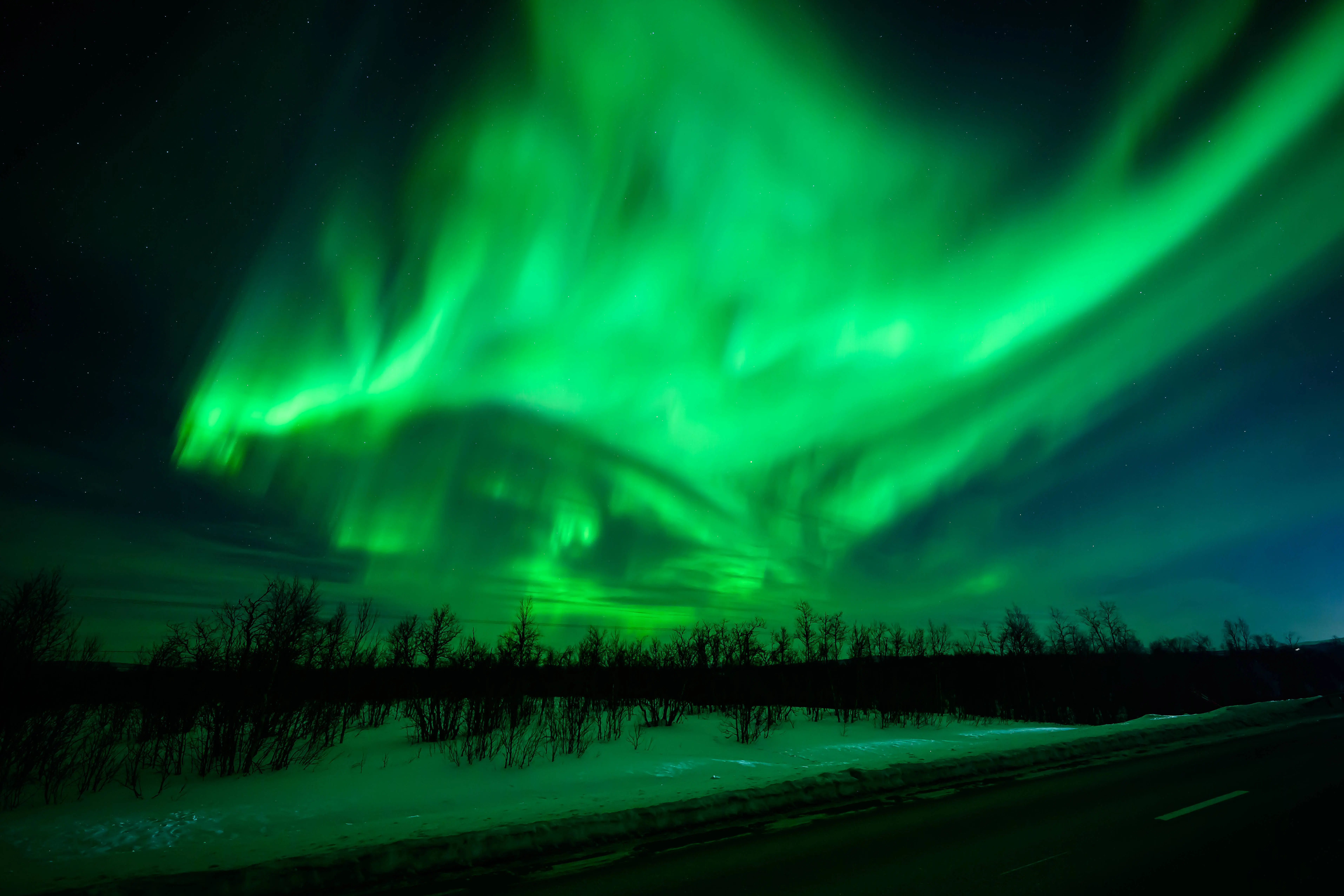 The Aurora Borealis, commonly known as the Northern Lights, are seen in the sky above Kiruna on March 7, 2024 in Kiruna, Sweden. The area is widely regarded as one of the best places in the world to see the phenomenon, which occurs when energized particles from the sun hit the Earth's upper atmosphere (Image via Getty)
Researchers have identified a specific magnetic signal that occurs immediately before intense aurora substorms, providing measurable insight into the timing of these events.
According to a University of Southampton study reported by Universe Today on December 15, 2025, auroral substorms often begin with the appearance of “auroral beads,” small luminous points arranged in a necklace-like pattern across the sky.
These beads coincide with bursts in auroral kilometric radiation, naturally occurring radio emissions detected above the aurora.
Data from ground-based observatories in Finnish Lapland, imaging satellites, and spacecraft, including NASA’s Polar and Japan’s Arase missions, were analyzed to confirm this connection.
Magnetic signals and Auroral beads reveal timing of intense substorm activity
Auroral beads and radio emissions
Auroral displays typically start gradually and then rapidly increase in intensity during substorms. Observations show that auroral beads appear just before the onset of these events.
These beads correspond to small-scale electric potential structures along magnetic field lines connected to the aurora.
The Southampton team examined auroral kilometric radiation, identifying bursts that align precisely with the appearance of auroral beads.
Lead author Siyuan Wu reported that the periodicity and propagation speed of these emissions were consistent across multiple independent datasets.
The simultaneous occurrence of beads and radio bursts indicates a direct link between magnetic structures in space and substorm initiation.
The study also confirmed that these bursts can be detected by multiple spacecraft simultaneously. Ground based optical measurements showed that bead patterns develop consistently prior to substorm onset.
Researchers noted that the intensity of radio bursts correlates with the speed of auroral brightening during substorms.
Magnetic energy accumulation
According to Dr. Daniel Whiter from the University of Southampton, Auroral substorms are the consequence of the buildup and abrupt release of magnetic energy that is being saved in the Earth's magnetosphere during the interactions with the solar wind.
The research discovered that impulsive radio emissions locate the substorm onset, and thus the detachment of the stored energy from the source along the magnetic field lines.
The small-scale structures moving along the lines at the same speeds as the auroral bead formation, as figures demonstrate, are also in agreement with the idea that these are the ones causing the beads to appear.
This energy release manifests as rapid increases in auroral brightness and motion, producing substorm activity visible from ground-based locations.
Implications for planetary magnetospheres
Similar auroral processes may occur on other planets. Jupiter and Saturn generate auroras, and magnetic structures similar to those observed on Earth could produce substorm activity in their magnetospheres.
The Southampton team suggested that auroral kilometric radiation could serve as a measurable signal for substorm onset beyond Earth.
While the mechanism triggering energy release is still under study, the detection of radio bursts provides a reproducible indicator of substorm initiation.
Observations of these signals on other planets could improve understanding of magnetospheric processes and auroral dynamics in diverse planetary environments.
Potential effects on Earth
Intense auroral substorms result from interactions between the solar wind and Earth’s magnetic field. BBC reports from December 7, 2025, indicate that solar storms producing auroras can affect infrastructure.
Disruptions include satellites, GPS systems, aviation electronics, and electricity grids.
On October 30, 2025, a JetBlue Airbus A320 experienced a sudden altitude drop due to corrupted data in the elevator aileron computer, causing passenger injuries and the temporary grounding of over 6,000 planes.
In March 1989, geomagnetic activity caused a power outage in Quebec, affecting millions.
Historical data, including the Carrington Event of 1859 and Miyake events, show that solar storms can produce strong geomagnetic effects impacting modern technologies.
Researchers have also observed that increased solar activity can expand Earth's atmosphere slightly, increasing drag on satellites.
Solar storms can interfere with radio communications for several days, affecting both aviation and ground-based navigation systems.
Monitoring auroral substorms can help predict the timing and potential severity of these space weather effects.
Stay tuned for more updates.
TOPICS: aurora borealis 2025, auroral beads, aurora substorms, magnetic signals Earth, northern lights 2025