
Astronomers find supermassive black holes are rare in dwarf galaxies
-
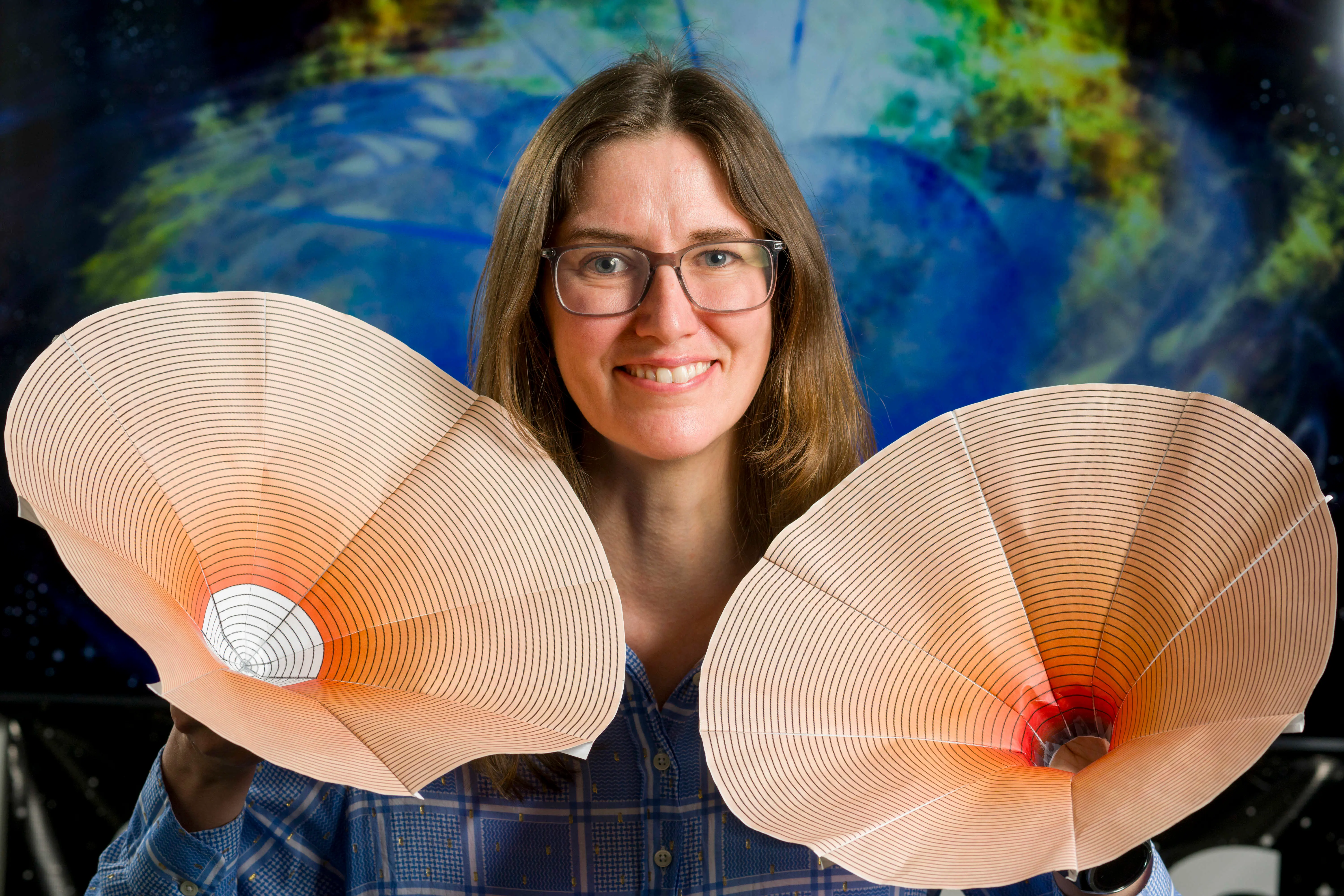 Jocelyn Read, a professor of Physics at California State University Fullerton displays model of the space-time around a neutron star, left, and black hole, right (Image via Getty)
Universe Today reports on new research that closely investigates if dwarf galaxies commonly have massive central black holes.
Scientists have known for a long time that large galaxies, such as the Milky Way, have supermassive black holes at their centers. As a consequence of this, many researchers thought that smaller galaxies also developed in the same manner and therefore had black holes, even if they were less active or more difficult to detect.
In order to verify this hypothesis, a worldwide team of researchers looked at X-ray data from NASA's Chandra X-ray Observatory. The data represent a time span of about 20 years and contain more than 1,600 observations of nearby galaxies.
The researchers concentrated on X-ray emissions since matter that is going to a black hole heats up, and the energy that is released can be detected at X-ray wavelengths.
Comparing big galaxies with small ones, the scientists came to a stark conclusion.
While in a majority of large galaxies the presence of central black holes was indicated, in most dwarf galaxies such signs were absent.
The researchers, after dissecting various possible interpretations, decided that the majority of dwarf galaxies probably do not harbor massive black holes.
The paper “Central Massive Black Holes Are Not Ubiquitous in Local Low-Mass Galaxies,” by The Astrophysical Journal, presents the study.
The findings constitute additional observations in the debate on the origin of black holes and their frequency in different kinds of galaxies.
__________________________________________________What does the Chandra data reveal?
The researchers used Chandra’s X-ray observations to search for black hole activity in galaxy centers.
When material falls toward a black hole, it heats up and emits X-rays. This makes X-ray emission one of the main tools astronomers use to identify active black holes.
The study included galaxies with a wide range of masses. In large galaxies, the results followed existing expectations.
More than 90% of these galaxies showed bright X-ray sources near their centers, consistent with the presence of supermassive black holes.
In dwarf galaxies, the pattern was different. Most of them showed no central X-ray source.
The team first considered whether black holes might still be present but too faint to detect. Smaller black holes pull in less gas, which would reduce their X-ray output and make them harder to see.
After accounting for this effect, the researchers still found fewer X-ray signals than expected. This pointed to a real shortage of black holes rather than a detection problem.
Co-author Elena Gallo explained the result by saying, “We think, based on our analysis of the Chandra data, that there really are fewer black holes in these smaller galaxies than in their larger counterparts.”
Based on the full sample, the team estimated that only about 30% of dwarf galaxies host massive black holes. The remaining galaxies appear to lack them entirely, at least at levels detectable with current instruments.
____________________________________________________________What does this mean for black hole formation?
The findings are important for understanding how supermassive black holes first formed. Scientists currently consider two main models. One is known as the Direct Collapse Black Hole model.
In this scenario, large clouds of gas collapsed directly into black holes early in the universe, forming objects that were already very massive.
The second model is the Stellar Collapse Seed model. This idea suggests that black holes are formed from the deaths of massive stars.
These smaller black holes then grew larger through mergers and by pulling in gas over long periods of time.
If the stellar collapse model were dominant, dwarf galaxies would be expected to contain black holes at rates similar to larger galaxies. The new study does not support that pattern.
Lead author Fan Zou highlighted why this matters, saying, “It’s important to get an accurate black hole head count in these smaller galaxies.”
He also noted, “Our study gives clues about how supermassive black holes are born.”
The results may also affect future observations. If fewer dwarf galaxies contain massive black holes, then fewer black hole mergers involving these galaxies should occur.
This would influence predictions for gravitational wave detections. Future missions such as the Laser Interferometer Space Antenna (LISA) will rely on these predictions when planning observations.
________________________________________________
Stay tuned for more updates.TOPICS: Astronomy, Black Holes, Comet X-ray emission, Galaxy clusters, NASA, X-Rays
- Rocket Lab successfully delivers JAXA’s RAISE-4 technology test satellite to orbit
- The primaeval atom and the early origins of Big Bang theory
- Can robots help astronauts survive in space? Inside Sydney’s National Space Industry Hub
- Astronomers detect radio waves from a rare helium-rich supernova for the first time