
Universe Today begins this series by asking readers to imagine a time before modern science, instruments, or equations. In this setting, people still observe the same sky, land, and life that we do today.
NASA advisor Paul Sutter examines how ancient creation myths and modern cosmology address the same fundamental questions about the universe.
Features
The primaeval atom and the early origins of Big Bang theory
Paul Sutter explores how ancient creation myths and modern cosmology answer the same questions, framing the Big Bang as a scientific creation story rooted in observation and theory
-
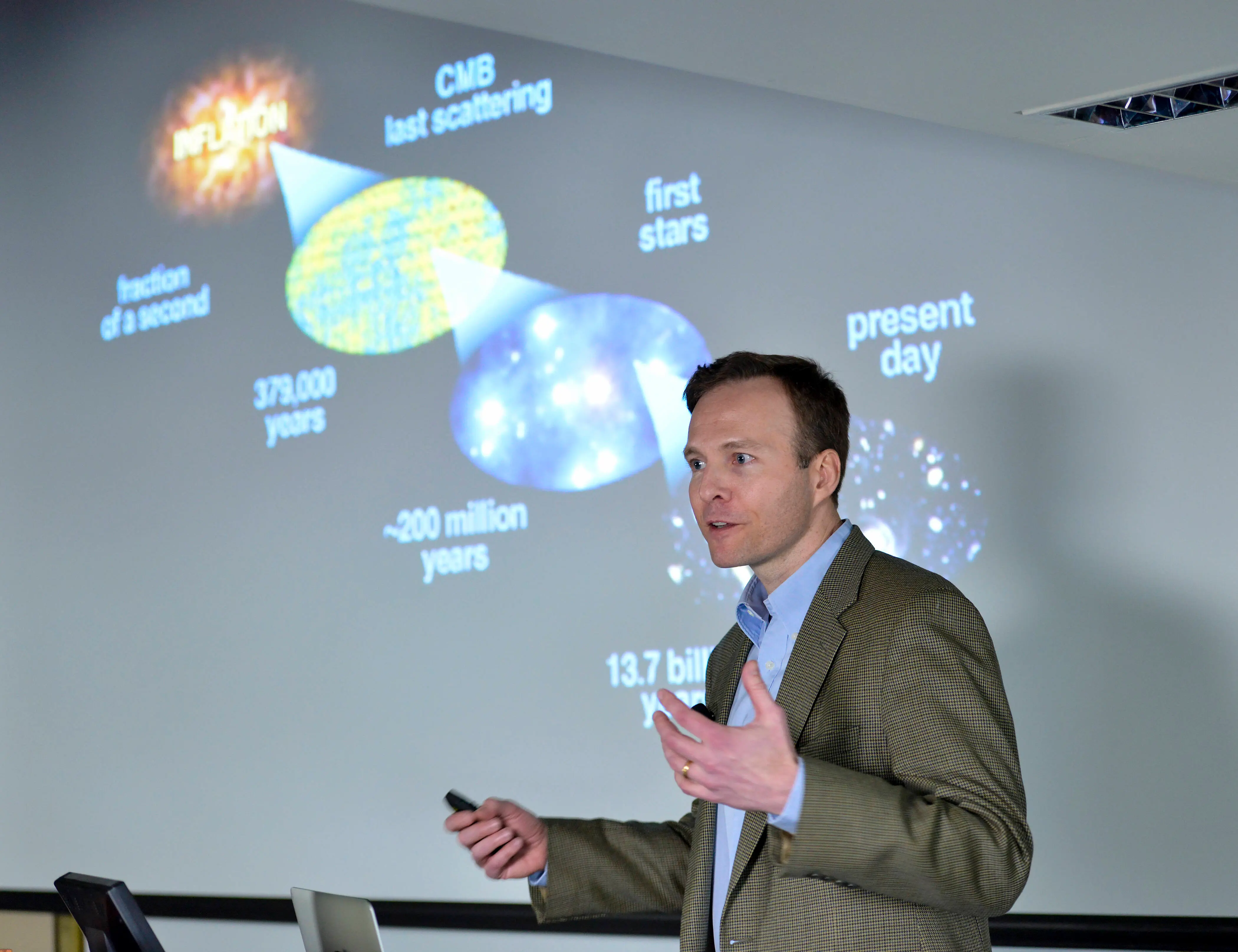 Professor John Kovac speaking about a new discovery of the Big Bang Theory (Image via Getty)
They see the Sun and Moon move across the sky, stars appear each night, and natural features shape their daily lives. Like all human societies, they ask basic questions: what is the universe, where did it come from, and why are we here?
The article frames these questions through a thought experiment. The reader is placed in the role of a priest, shaman, or teacher, asked to explain the universe using only observation, memory, tradition, and belief.
With no modern tools, the task becomes one of storytelling. These stories must explain origins, structure, and meaning.
The article argues that every culture has faced this task and answered it through creation myths.
These myths are not presented as falsehoods, but as structured explanations shaped by available knowledge and cultural needs.
The introduction sets the stage for comparing ancient creation stories with the modern scientific account known as the Big Bang.
The role of creation myths across cultures
The article explains that creation myths serve several functions within a society. They explain where the universe came from, how it is structured, and what role humans play within it.
These stories rely on available tools such as direct observation, simple mathematics, philosophy, history, and theology. Sacred traditions and divine beings often play a role in explaining why the universe exists and how it began.
These myths must fit the culture that tells them. They help people understand daily experiences, such as why the sky is above and the ground below, why stars appear at certain times, and why people live where they do.
As the article states, myths allow people to say, “oh, yeah, I get it, that’s why the stars come out every night.” In this sense, myths also guide behavior and identity, explaining relationships between groups and their environment.
The article emphasizes that myths are not random stories. They are organized explanations built from limited evidence and shared memory.
Every society, regardless of size or complexity, has created such stories to answer the same fundamental questions about existence, origin, and purpose.
The Big Bang as a modern creation story
This theory then turns to modern cosmology and introduces the Big Bang theory as a creation story of its own kind. It explains that although the Big Bang is based on mathematics, observation, and testing, it still serves the same basic purpose as older myths.
It explains where the universe came from, when it began, how it developed, and what our place is within it.
The article notes that “our modern theory of the evolution of the universe…is a story.”
Anthropologists have grouped traditional creation myths into five broad categories. These include creation ex nihilo, where the universe is made from nothing; creation from chaos, where order emerges from a formless state; world parent myths, where a being becomes the universe; emergence myths, where the universe changes form over time; and earth-diver myths, where the world is built piece by piece.
The theory suggests that the Big Bang shares elements with several of these categories. By framing modern cosmology in this way, Part 1 prepares readers to examine the Big Bang not only as a scientific model, but also as a human attempt to explain origins.
This perspective leads directly into Part 2, which explores Georges Lemaître and the idea of the primaeval atom.
_________________________________________________________________________
Stay tuned for more updates.
TOPICS: Astronomy, Paul Sutter, Big Bang, Cosmology, NASA
More Astronomy
on Primetimer:
- Astronomers find supermassive black holes are rare in dwarf galaxies
- Can robots help astronauts survive in space? Inside Sydney’s National Space Industry Hub
- Astronomers detect radio waves from a rare helium-rich supernova for the first time
- Geostationary satellites pose limited risk to radio astronomy, study says