
Geostationary satellites pose limited risk to radio astronomy, study says
-
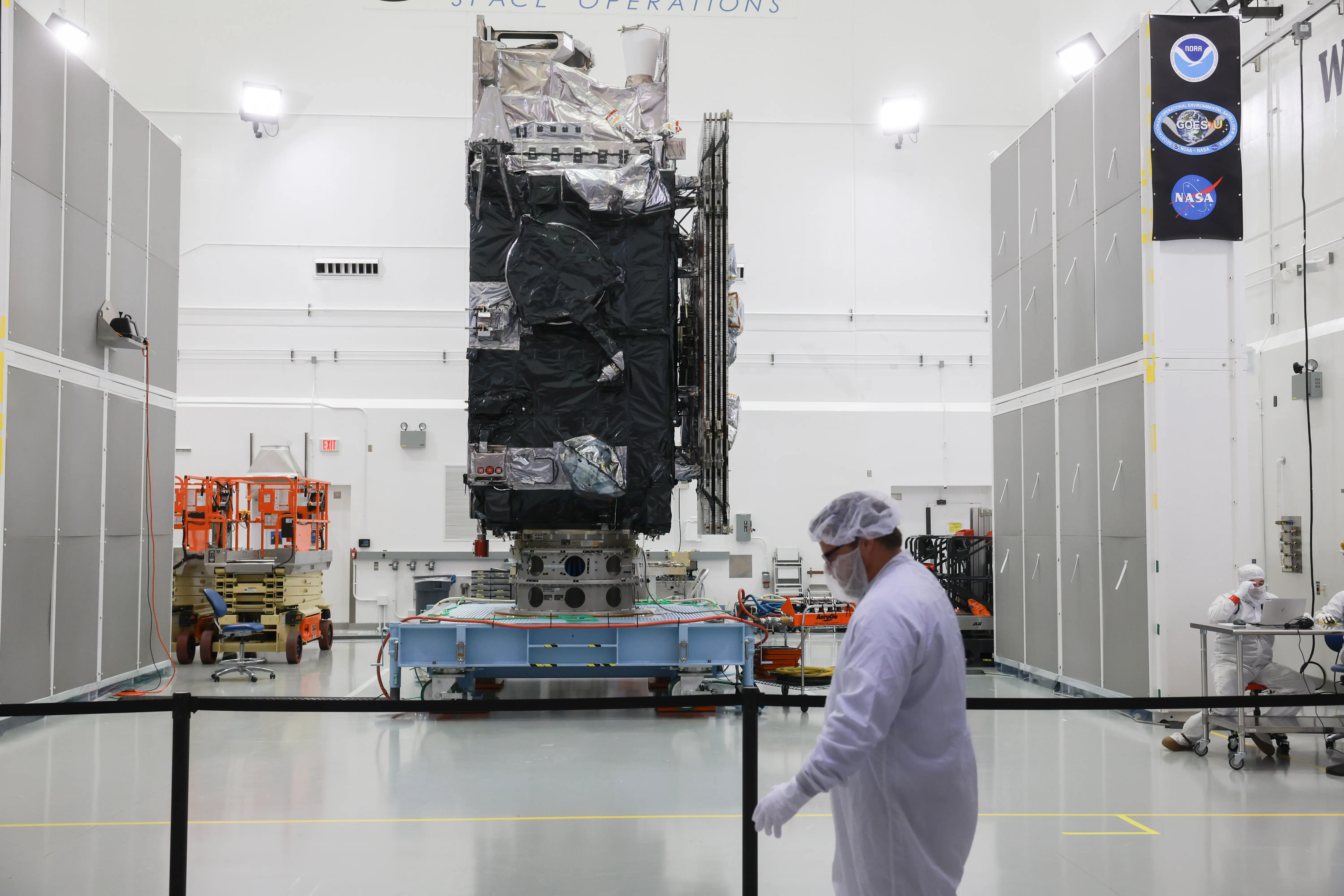 A Geostationary Operational Environmental Satellite (GOES) – R (Image via Getty)
Universe Today reports on new research examining whether geostationary and geosynchronous satellites produce unintended radio signals that could interfere with radio astronomy.
Radio telescopes rely on very weak signals from space, and human-made transmissions can affect observations. Much recent concern has focused on low Earth orbit satellite constellations, which move quickly across the sky and often pass through telescope fields of view. Far less attention has been paid to satellites much farther away.
Geostationary satellites orbit at an altitude of about 36,000 kilometres and move at the same rate as Earth’s rotation. From the ground, they appear fixed in one position.
These satellites support television, weather monitoring, navigation, and military communications. Because they remain in view for long periods, any unintended emissions could have ongoing effects on observations.
Researchers from CSIRO’s Astronomy and Space Science division analysed existing radio telescope data to test whether these distant satellites emit detectable signals in frequency ranges used for astronomy.
The study focused on low radio frequencies that will be central to future instruments, including the Square Kilometre Array. The findings provide measurements that can be used as reference data for planning future observations and managing radio interference as satellite numbers increase.
Measurements from existing radio survey data
The team behind the research took records of the GLEAM-X survey, which were collected in 2020 by the Murchison Widefield Array in Western Australia.
The data included frequencies from 72 to 231 megahertz that partially match the range that the low-frequency component of the Square Kilometre Array is going to be used.
The team, by using satellite location data, was able to follow 162 geostationary and geosynchronous satellites at most during a single night of observations.
The researchers combined multiple images taken when each satellite was in the telescope’s field of view. This stacking method increased sensitivity to weak signals.
According to the study, “the majority of satellites were not detected above the noise level.” For most objects, the team set upper limits on unintended emission of less than 1 milliwatt of equivalent isotropic radiated power across a 30.72 megahertz bandwidth. Some limits reached as low as 0.3 milliwatts.
One satellite, Intelsat 10-02, showed a possible signal at around 0.8 milliwatts. The researchers noted that this was still much lower than emissions reported from some low Earth orbit satellites. As the paper states, “the detected level remains well below values previously measured for nearer spacecraft.”
Implications for future radio astronomy
Distance plays a key role in reducing the impact of geostationary satellites. At roughly ten times the altitude of the International Space Station, radio signals weaken significantly before reaching Earth-based telescopes.
In addition, the observation strategy used in the study kept satellites within the telescope’s wide field of view for long periods, allowing weak or intermittent emissions to be identified if present.
The results are relevant for the Square Kilometre Array, which will be more sensitive than current instruments. Signals that are undetectable today could affect future observations.
The researchers explain that “these measurements provide a baseline for predicting interference in next-generation telescopes.” Such baseline data can support planning, regulation, and coordination between astronomers and satellite operators.
The study also notes that even satellites designed to avoid protected radio bands can produce unintended emissions from onboard electronics, power systems, or other components.
While current measurements show limited impact from geostationary satellites at low frequencies, the situation may change as satellite technology and traffic evolve. As the authors conclude, “continued monitoring will be required as new systems are launched and telescope sensitivity increases.”
Stay tuned for more updates.TOPICS: Astronomy, Geostationary Satellites, Geosynchronous satellites, Radio Telescope
- Astronomers detect radio waves from a rare helium-rich supernova for the first time
- Starlink satellite narrowly avoids close encounter with spacecraft from Chinese launch
- Scientists observe a black hole dragging space and time as it consumes a star
- Expedition 74 completes first full week aboard the International Space Station