
Features
NASA's TRACERS Spacecraft starts early science measurements in Earth’s polar cusp
NASA’s TRACERS mission begins early science measurements in Earth’s southern polar cusp, tracking magnetic reconnection and particle inflow with two spacecrafts, Space Vehicle 1 and Space Vehicle 2.
-
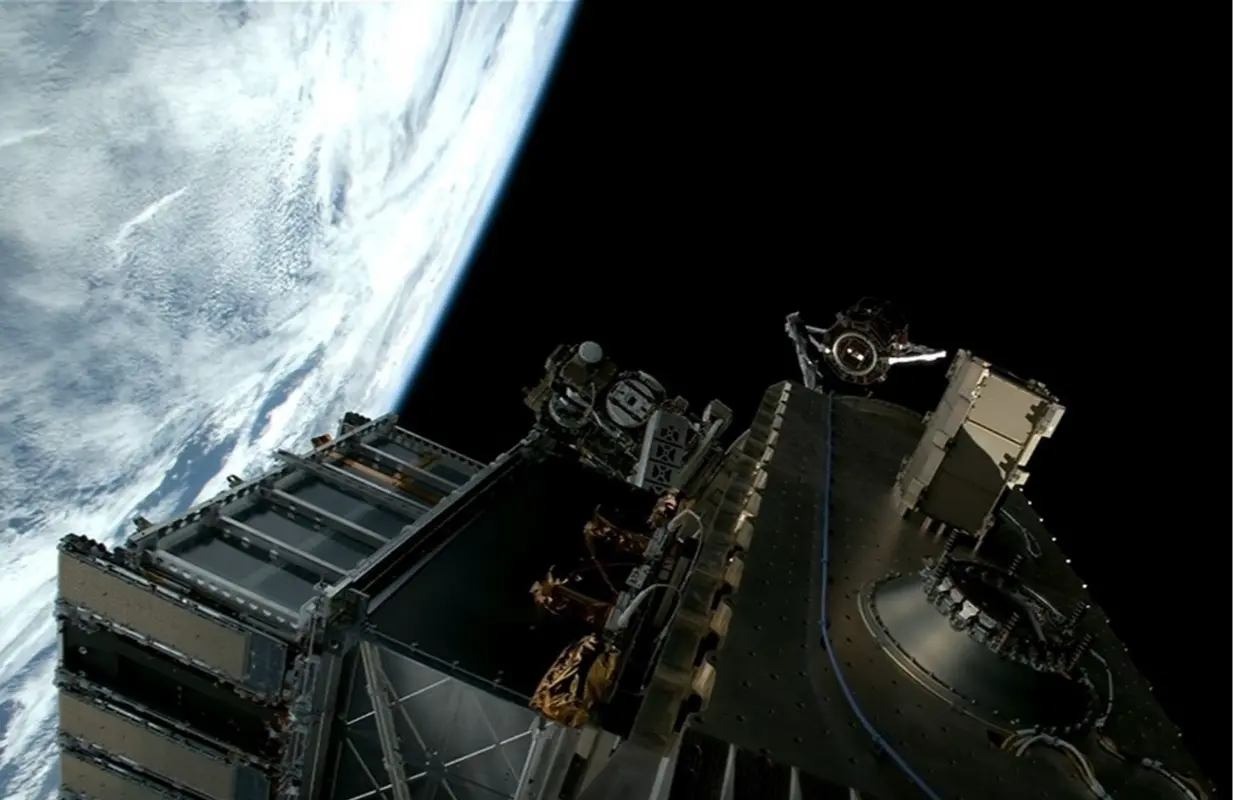 NASA's TRACERS (Tandem Reconnection and Cusp Electrodynamics Reconnaissance Satellites) (Image via NASA)
NASA’s TRACERS mission, which stands for Tandem Reconnection and Cusp Electrodynamics Reconnaissance Satellites, has begun early science data collection in Earth’s southern polar cusp.
The mission consists of two spacecraft, Space Vehicle 1 and Space Vehicle 2. Space Vehicle 2 has completed its commissioning and is fully operational.
Space Vehicle 1 experienced an issue earlier this year that caused intermittent communication, but it has since resumed operations with limited functionality.
Both satellites are now conducting tandem measurements to study the dynamics of magnetic reconnection and the behavior of charged particles entering Earth’s atmosphere, according to NASA updates from December 12, 2025.
Launch and commissioning of TRACERS
The TRACERS mission launched on July 23, 2025, from Vandenberg Space Force Base in California.
Following the launch, Space Vehicle 2 underwent a commissioning period to confirm system health, proper communication, and correct orbital positioning.
Space Vehicle 1 experienced a power subsystem issue on July 25, 2025, resulting in intermittent communication loss.
Recovery efforts included reorienting the spacecraft to increase solar panel exposure and provide sufficient power for operation.
After communication was restored, Space Vehicle 1 required direct sunlight to maintain active science data collection due to a malfunctioning battery.
Early science measurements
With operational constraints on Space Vehicle 1, NASA directed the mission to focus on Earth’s southern polar cusp to allow adequate sunlight for the spacecraft to function during orbits.
Both TRACERS spacecraft now perform routine tandem measurements using multiple instruments.
These measurements track the movement of charged particles from space into Earth’s atmosphere during space weather events.
The data collected will contribute to understanding the process of magnetic reconnection, which occurs when solar wind interacts with Earth’s magnetic field, causing magnetic field lines to snap and eject particles at high speeds into the atmosphere.
Reinhard Friedel, TRACERS program scientist at NASA Headquarters, stated that the mission team successfully initiated science data collection with Space Vehicle 1, ensuring that the tandem measurements continue despite earlier technical challenges.
The mission team is also assessing the impact of the power limitations on the overall science goals and is developing operational plans to commission instruments on Space Vehicle 1 within these constraints.
Mission objectives and research teams
The primary objective of the TRACERS mission is to study magnetic reconnection and its impact on Earth’s atmosphere.
Magnetic reconnection contributes to space weather phenomena, including geomagnetic storms, which can affect communication systems, power grids, and the safety of astronauts.
Data from the TRACERS mission will provide scientists with measurements of the behavior of Earth’s magnetic and electric fields during these events.
The mission is led by David Miles at the University of Iowa, with support from the Southwest Research Institute in San Antonio.
NASA’s Heliophysics Explorers Program Office at Goddard Space Flight Center manages the mission.
Instrument on TRACERS are managed by people from University of Iowa, Southwest Research Institute, University of California, Los Angeles, and University of California, Berkeley.
These are the changes in Earth's magnetic field, the electric field, and the particle activity in the polar cusp regions that the instruments are meant to study.
NASA updates on the TRACERS' mission, including changes in data analysis and operations, will be continued through its science blog.
The objective of the mission is to have complete tandem scientific measurements when all limitations due to operations on Space Vehicle 1 have been lifted.
Stay tuned for more updates.
TOPICS: NASA TRACERS mission, Earth polar cusp, NASA, NASA updates, TRACERS early science data, TRACERS spacecraft