
Features
"Dozen such coincidences" - Harvard Professor Avi Loeb says 3I/ATLAS and gamma-ray burst alignments are statistically expected
Harvard Professor Avi Loeb explains that alignments between interstellar object 3I/ATLAS and gamma-ray bursts are statistically expected, with a dozen coincidences occurring over 8,000 years of Solar System transit.
-
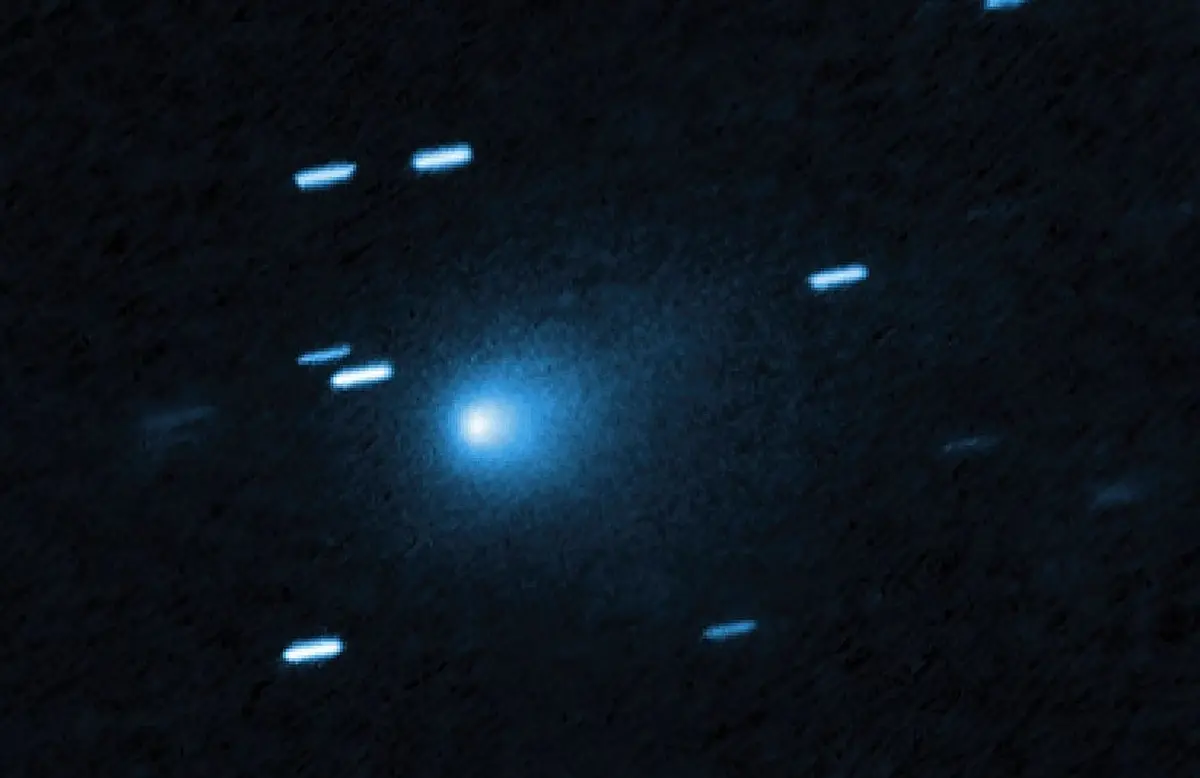 Comet 3I/ATLAS (Image via NASA)
The titled question asks whether reported alignments between interstellar object 3I/ATLAS and gamma-ray bursts are statistically expected.
According to Harvard Professor Avi Loeb, the answer is yes, based on event rates, sky coverage, and the object’s long transit time through the Solar system.
In explaining the context of recent observations, Loeb stated,
"Altogether, there had been a dozen such coincidences while 3I/ATLAS was traveling inside the Solar system over the past 8,000 years and the latest one happened to occur this year."
His explanation addresses both the imaging results of 3I/ATLAS and calculations involving gamma-ray burst frequencies and angular separations.
Post-perihelion observations of 3I/ATLAS
Four weeks after perihelion, on November 26, 2025, 3I/ATLAS was observed with the Gemini Multi-Object Spectrograph on the 8.1-meter Gemini North telescope at Maunakea, Hawaii.
The observatory is funded by the U.S. National Science Foundation and operated by NOIRLab.
The image combined exposures through blue, green, orange, and red filters, with peak brightness centered on the nucleus.
The surrounding halo appeared green, consistent with emission from diatomic carbon molecules that radiate at green wavelengths.
A pre-perihelion image taken on September 4, 2025, by the 8.1-meter Gemini South telescope in Chile showed a red glow around the object.
The difference between pre- and post-perihelion colors indicates a change in the molecular composition of gas released as the object passed near the Sun.
These imaging results document physical conditions of the coma at different solar distances without implying a link to external astrophysical events.
Arrival directions and angular separation
After it was reported that the arrival direction of 3I/ATLAS at discovery on July 1, 2025, was close to the arrival direction of the longest-duration gamma-ray burst on record, GRB 250702b, detected on July 2, 2025, questions about a connection possibly arose.
According to the report, 3I/ATLAS was at right ascension 272 degrees and declination −19 degrees, while GRB 250702b was at right ascension 285 degrees and declination −8 degrees.
The angular separation between these directions was 17 degrees on July 2, with the probability of a chance alignment being 0.02 for a single comparison.
Loeb notes that the discovery date is not physically significant for the object’s trajectory. 3I/ATLAS traversed the Oort Cloud region of the Solar System for approximately 8,000 years prior to discovery.
During that interval, the sky positions of unrelated transient events would have repeatedly aligned within comparable angular separations.
Event rates and expected coincidences
Several hundred gamma-ray bursts occur each year and are distributed across the sky. On that basis, a 0.02 chance alignment between one burst and the arrival direction of 3I/ATLAS is expected given the reported event rates.
Loeb references GRB 111209A, detected on December 9, 2011, which lasted between four and seven hours and was followed by a supernova.
That event was reported as originating from an exploding star at a luminosity distance of 13.7 billion light years, establishing an astrophysical origin unrelated to Solar System objects.
Using these rates, an ultra-long gamma-ray burst occurs approximately once every 14 years among about 4,000 total bursts.
Under those conditions, a seven-hour burst would align within 17 degrees of the arrival direction of 3I/ATLAS about once every 670 years.
Over an 8,000-year passage through the Solar System, this yields roughly a dozen such coincidences.
Loeb further states that during 2025 alone, about six normal-duration gamma-ray bursts aligned within 17 degrees of the object’s arrival direction, consistent with expectations from random sky distribution.
Stay tuned for more updates.
TOPICS: 3I/ATLAS, Avi Loeb 3I/ATLAS, gamma-ray burst alignment, Gemini North telescope, GRB 111209A, GRB 250702B, ultra-long gamma-ray burst
More 3I/ATLAS
on Primetimer:
- Avi Loeb says academia discourages big questions as 3I/ATLAS approaches Earth
- Rare interstellar comet 3i/Atlas set to fly past Earth safely on December 19, scientists confirm
- New NASA and ESA images show 3i/Atlas glowing with activity as the interstellar comet prepares for its December close flyby
- Interstellar comet 3I/ATLAS shows a growing green glow as its chemistry evolves