
Rare interstellar comet 3i/Atlas set to fly past Earth safely on December 19, scientists confirm
-
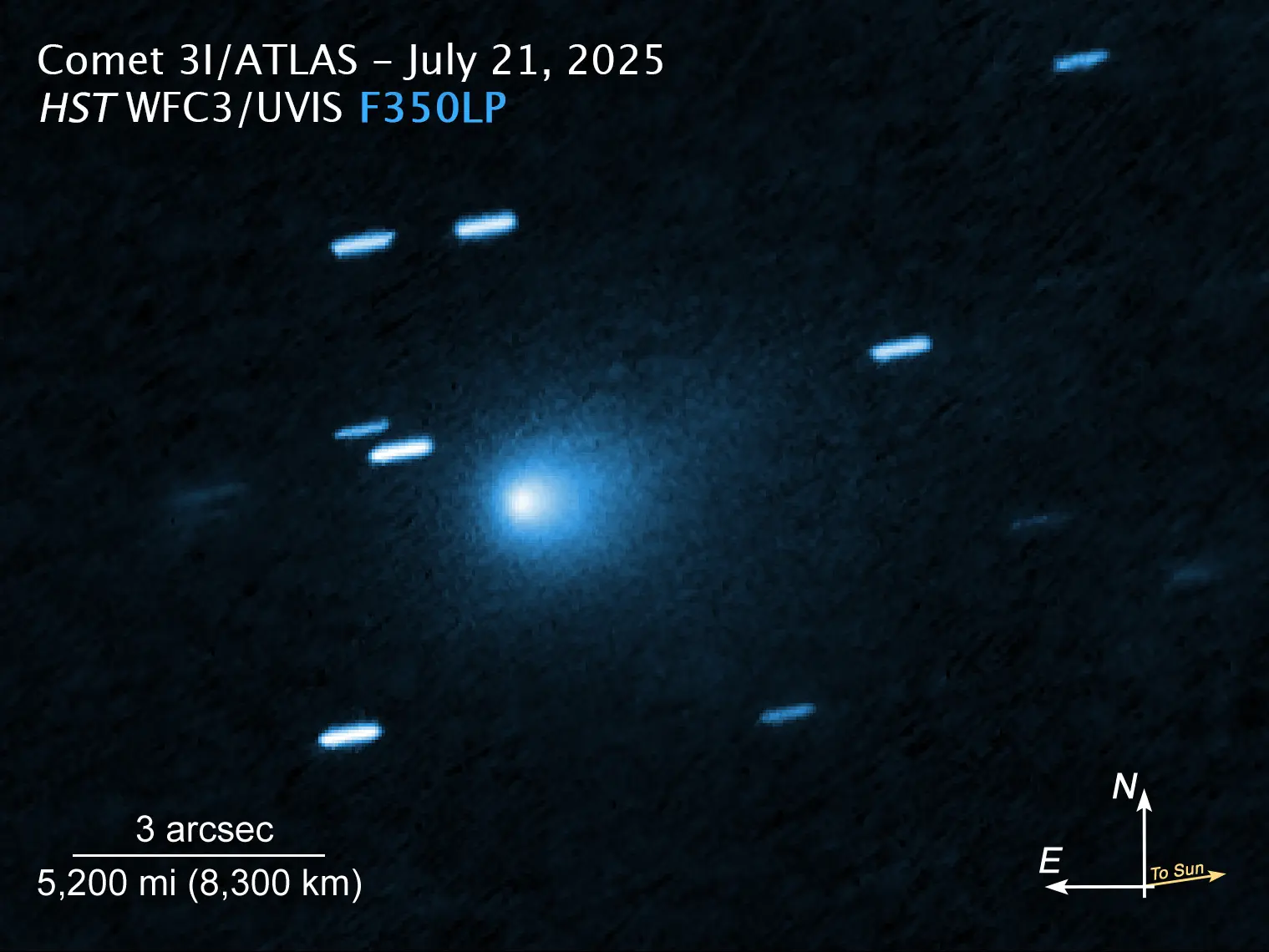 Image via science. nasa.gov
A rare comet from outside our solar system, called 3I/ATLAS, will pass by Earth on December 19. Even though this sounds scary, scientists say there is no danger at all.
The comet will stay very far away from us — around 170 million miles, which is more than twice the distance between the Earth and the Sun.
Because of this safe distance, astronomers are excited. This close pass will give them one of their best chances to study the comet before it leaves our solar system again.
How the comet was first seen
Astronomers first found 3I/ATLAS on July 1. A few weeks later, NASA’s Hubble Space Telescope took a clear photo from about 277 million miles away. The picture showed a small icy core covered with a soft, teardrop-shaped cloud of dust.
The comet stayed visible for a while, but by September it moved too close to the Sun, so telescopes could not see it. In early October, NASA’s spacecraft near Mars — MRO, MAVEN, and Perseverance — spotted it again. One camera, called HiRISE, took the clearest photo, showing the comet as a tiny bright puff in space.
Scientists believe 3I/ATLAS could be anywhere between 1,400 feet to 3.5 miles wide, but they are still studying it to learn more.
Why 3I/ATLAS is so special
3I/ATLAS is only the third interstellar object we have ever seen passing through our solar system. The first one was ‘Oumuamua in 2017, and the second was Borisov in 2019.
Unlike ‘Oumuamua, which behaved in strange ways, 3I/ATLAS looks and acts more like a normal comet. Still, some of its features have sparked questions.
Harvard professor Avi Loeb believes some of the comet’s movements are unusual and has wondered if it might be something other than a natural comet. Most scientists, however, think the comet is completely natural and simply comes from another star system far away.
New images from NASA and ESA
NASA’s Hubble Telescope took new photos on November 30, showing the comet still active as it gets closer. The European Space Agency’s JUICE spacecraft also saw strong activity in late October when sunlight heated the comet and made its gases and dust rise.
More detailed information from JUICE will come in February.
What happens after the flyby?
After passing Earth on December 19, 3I/ATLAS will keep moving outward. In spring 2026, it will pass near Jupiter, giving scientists another chance to observe it.
After that, the comet will leave our solar system and return to deep space — a place it has been traveling through for billions of years.
TOPICS: 3I/ATLAS, 3i/ATLAS recent updates
- New NASA and ESA images show 3i/Atlas glowing with activity as the interstellar comet prepares for its December close flyby
- Interstellar comet 3I/ATLAS shows a growing green glow as its chemistry evolves
- Gemini North observations show changes in Interstellar Comet 3I/ATLAS after perihelion
- "They should focus on national security": Avi Loeb critiques the government’s approach to UAPs and 3I/ATLAS data