
Space weather stirs, raising hopes for a Christmas aurora display
-
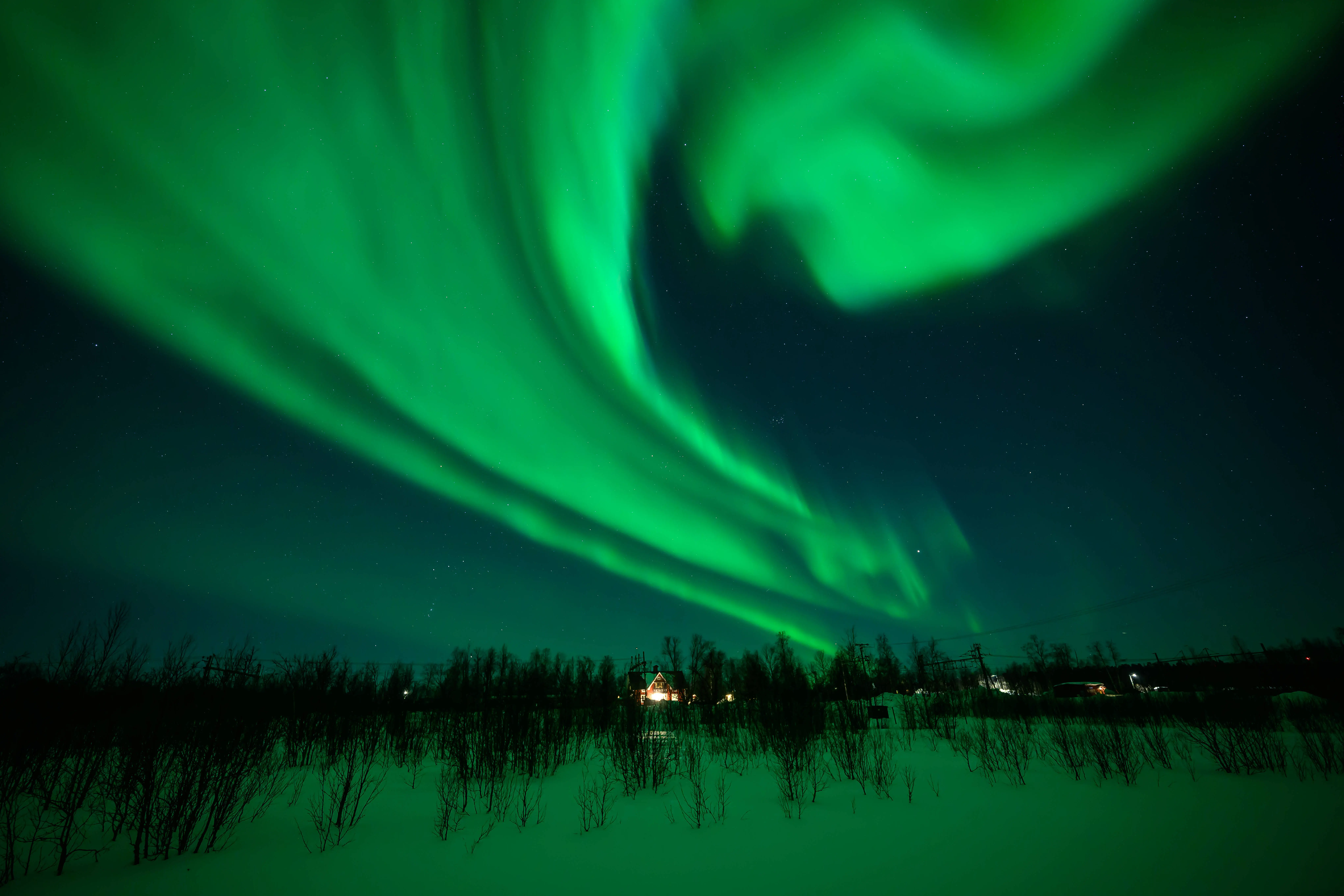 The Aurora Borealis, commonly known as the Northern Lights (Image via Getty)
Space.com reports that space weather conditions during Christmas week remain unsettled, increasing the chance of northern lights in some parts of the world. Fast solar wind coming from a large coronal hole on the sun has already caused minor geomagnetic storms.
These storms are rated at the lowest level, known as G1. Forecast centers say similar conditions could continue through Christmas Eve and Christmas Day.
Solar wind is a continuous stream of charged particles that comes from the sun. If the solar wind goes at a speed faster than usual, it can affect the magnetic field of the Earth.
Such an influence can generate auroras at the poles. So, solar wind speeds were very high and have remained high since they rose.
Experts are also monitoring a possible coronal mass ejection (CME) that occurred on Dec. 20 and that has moved away from the sun.
The solar material that was ejected in this burst is not directly aimed at Earth, but it will be passing close enough to have some effect. Even a tiny interaction could briefly increase aurora activity.
Auroras are mainly expected to be seen in high-latitude areas. These are the places such as Alaska, northern Canada, Greenland, Scandinavia, and far northern Scotland.
In the United States, it would only be possible to see auroras in the northern states. Experts in space weather are saying that the situation needs to be monitored closely as it is capable of changing quickly.
Fast solar wind keeps conditions active
The main reason for space weather at present is the fast solar wind that is moving out from a big coronal hole on the sun.
The solar wind speed almost reached 500 miles per second early in the week, according to the NOAA Space Weather Prediction Center.
Most recently, the speed has averaged close to 430 miles per second. It is still significantly faster than a normal solar wind that would have a velocity of about half that speed.
Such high speeds have already resulted in minor geomagnetic storms. A fast wind stream like this one will keep going until Dec. 24 and Dec. 25, according to NOAA. That is, the Earth's magnetic field may continue to be disturbed occasionally.
NOAA has predicted that "unsettled to active geomagnetic conditions" are probable during this time.
The UK Met Office has also reported similar expectations. It noted that storm levels may weaken at times, but that activity could remain above normal background levels.
Because this activity is caused by steady solar wind rather than a strong solar explosion, large aurora displays are not expected. However, the continued disturbance increases the chance of auroras appearing in regions close to the Arctic.
Forecasters say this type of activity can come in waves, making timing important for observers.
________________________________________________CME watch and where auroras may appear?
Along with fast solar wind, forecasters are tracking a coronal mass ejection released from the sun on Dec. 20. NOAA has said this CME could pass near Earth around Dec. 24.
While it is not directly aimed at the planet, it could deliver what NOAA describes as a “glancing blow.”
A near pass like this can briefly change space weather conditions. If the CME interacts with Earth’s magnetic field, it could add to the existing disturbance caused by fast solar wind.
Those who predict the solar storm effects emphasize that the consequences would be small and short-lived.
Even if auroras were to become more frequent, they would still, for the most part, be visible only in areas close to the poles. Thus, in the case of North America, these are locations like Alaska and northern Canada.
The potential for sighting in the lower 48 states of the US is restricted to the likes of Washington, North Dakota, and Minnesota, i.e., the regions at the extreme north. Besides that, the Northern Lights can also be observed in Greenland, Scandinavia, and the northern parts of Scotland.
Those who are into space weather recommend that one should utilize different tools and mobile apps for getting prepared. The occurrence of the Northern Lights depends on changes that happen in the short term, such as whether the sky is clear or covered with clouds, and how dark the place is.
Stay tuned for more updates.
TOPICS: Astronomy, Christmas 2025, Northern Lights, northern lights 2025, Solar wind event
- Avi Loeb reports new radio constraints and size estimates for interstellar object 3I/ATLAS
- Interstellar comet 3I/ATLAS shows rotating jets in a rare sun-facing tail
- What Europa Clipper and Parker Solar Probe discovered about interstellar comet 3I/ATLAS
- 3I/ATLAS defies easy answers as Avi Loeb sticks with rank 4 assessment