
Features
NASA's Hubble observes the largest known protoplanetary disk around a young star
NASA’s Hubble captured images of IRAS 23077+6707, the largest known protoplanetary disk, revealing its structure, asymmetry, and potential for forming multiple gas giant planets.
-
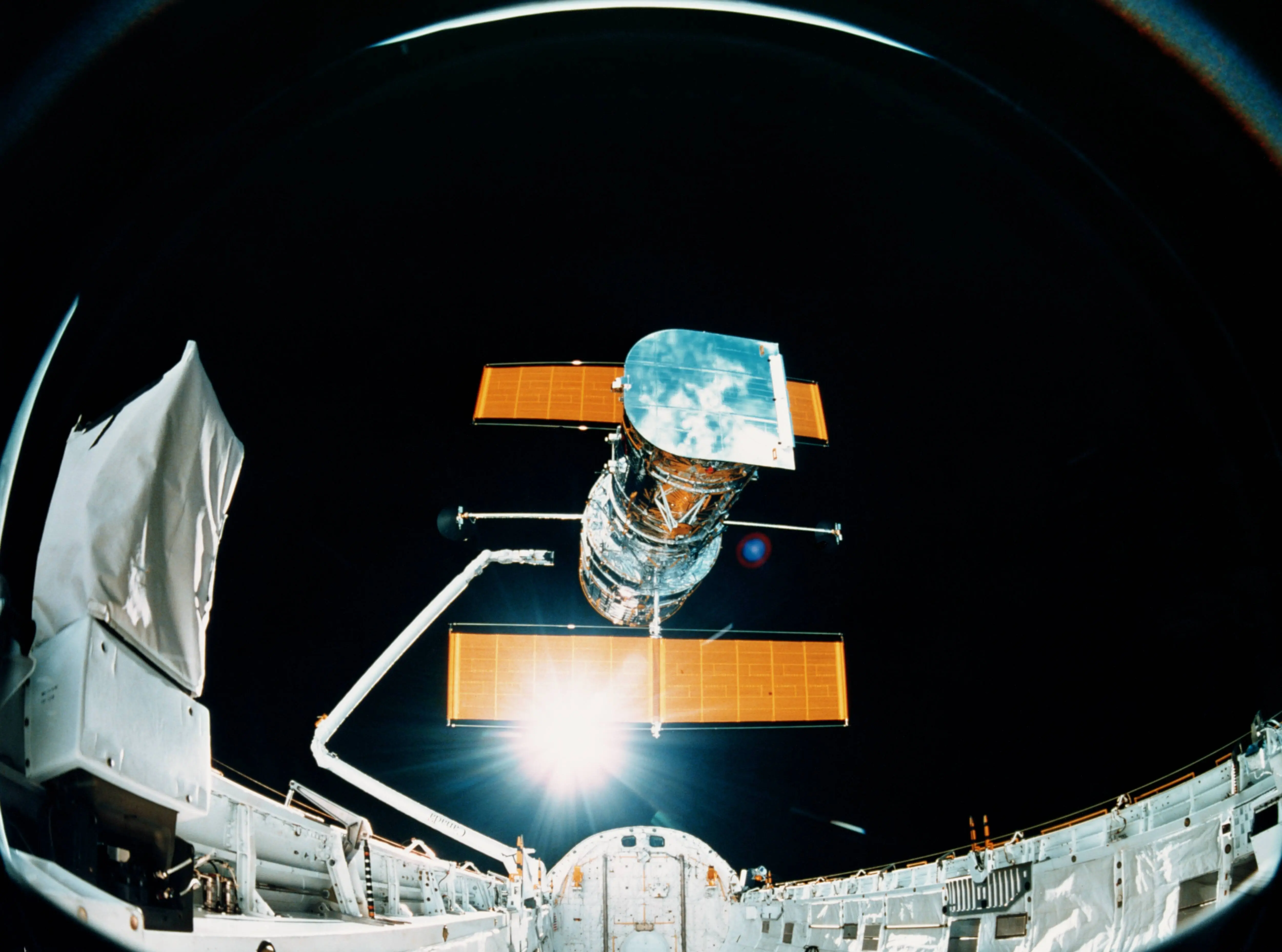 circa 1992: The Hubble Space Telescope leaving the cargo bay of a NASA space shuttle. The telescope was originally launched in 1990 but docked with Endeavour for repairs to its main mirror in 1993 (Image via Getty)
NASA’s Hubble Space Telescope has captured images of the largest protoplanetary disk ever observed, circling the young star IRAS 23077+6707.
The observations, made in visible light, reveal a disk spanning nearly 400 billion miles, approximately 40 times the diameter of the solar system.
Located about 1,000 light-years from Earth in the constellation Cepheus, the system is cataloged as “Dracula’s Chivito.”
The disk obscures the star within it, which may be a single hot star or a pair of stars. The findings were published in The Astrophysical Journal on December 23, 2025.
Structure and Composition of the Disk
The disk is tilted nearly edge-on from Earth. Near its center, a diagonal dark strip of dust runs from 1 o’clock to 7 o’clock, obscuring the central star.
Curving away from either side of this strip are glowing clouds of dust reflecting starlight. Bright blue filaments extend above and below the central plane.
A few dozen stars, some with four diffraction spikes, are visible in the surrounding background.
NASA described the appearance of the disk as resembling an edge-on hamburger, with the dark strip as the “meat patty” and the curved dust clouds as the “buns.”
The disk’s dimensions cover roughly 0.24 light-years across, corresponding to approximately 50 arcseconds in Hubble images.
Observations were taken using Hubble’s Wide Field Camera 3 (WFC3) in UVIS and IR modes, employing filters F438W, F606W, F814W, F105W, F125W, and F160W on February 8, 2025.
NASA also notes that the visible-light images provide a level of detail not previously achieved for disks of this size, revealing substructures that were only detectable in infrared observations before.
The system’s unusual asymmetry may indicate recent accretion events or interactions with nearby interstellar material.
Hubble’s long-term operational history allows it to track changes in protoplanetary disks over time, contributing to ongoing studies of disk evolution and planet formation.
Asymmetry and Filamentary Features
Images show that filament-like features appear only on one side of the disk, while the opposite side presents a sharp edge with no visible filaments.
NASA reports that this asymmetry may indicate dynamic processes affecting the disk’s structure, such as the infall of gas and dust or interactions with the surrounding environment.
Co-investigator Joshua Bennett Lovell of the Center for Astrophysics | Harvard & Smithsonian noted the presence of the asymmetric features in the observations.
Potential for Planet Formation
IRAS 23077+6707 contains a disk mass estimated at 10 to 30 times that of Jupiter. NASA indicated that such a mass provides sufficient material for forming multiple gas giant planets.
The disk represents a scaled-up analog of early solar system conditions.
Astronomers using both Hubble and NASA’s James Webb Space Telescope have identified similar structures in other disks, but IRAS 23077+6707 allows the tracing of substructures in visible light at high resolution, offering data on how planets form in massive disks.
Kristina Monsch, lead author at the Center for Astrophysics | Harvard & Smithsonian, was the first to mention that the observations made by Hubble have given detailed views of the substructures of the disk.
NASA informs that the images produced have a significant role in revealing the conditions that are suitable for the birth of planets around new stars.
For more than thirty years, Hubble has been a joint effort of NASA and the European Space Agency (ESA).
NASA’s Goddard Space Flight Center is responsible for the overall management of the telescope and its mission operations. Hubble science operations are carried out by the Space Telescope Science Institute in Baltimore.
Lockheed Martin Space supports mission operations at Goddard. The images of IRAS 23077+6707 were processed by Joseph DePasquale of STScI.
Stay tuned for more updates.
TOPICS: NASA Hubble Space Telescope, Hubble Space Telescope, Hubble telescope 2025 observations, IRAS 23077+6707
More NASA Hubble Space Telescope
on Primetimer: