
NASA's Armstrong conducts high speed and hypersonic aircraft research in 2025
-
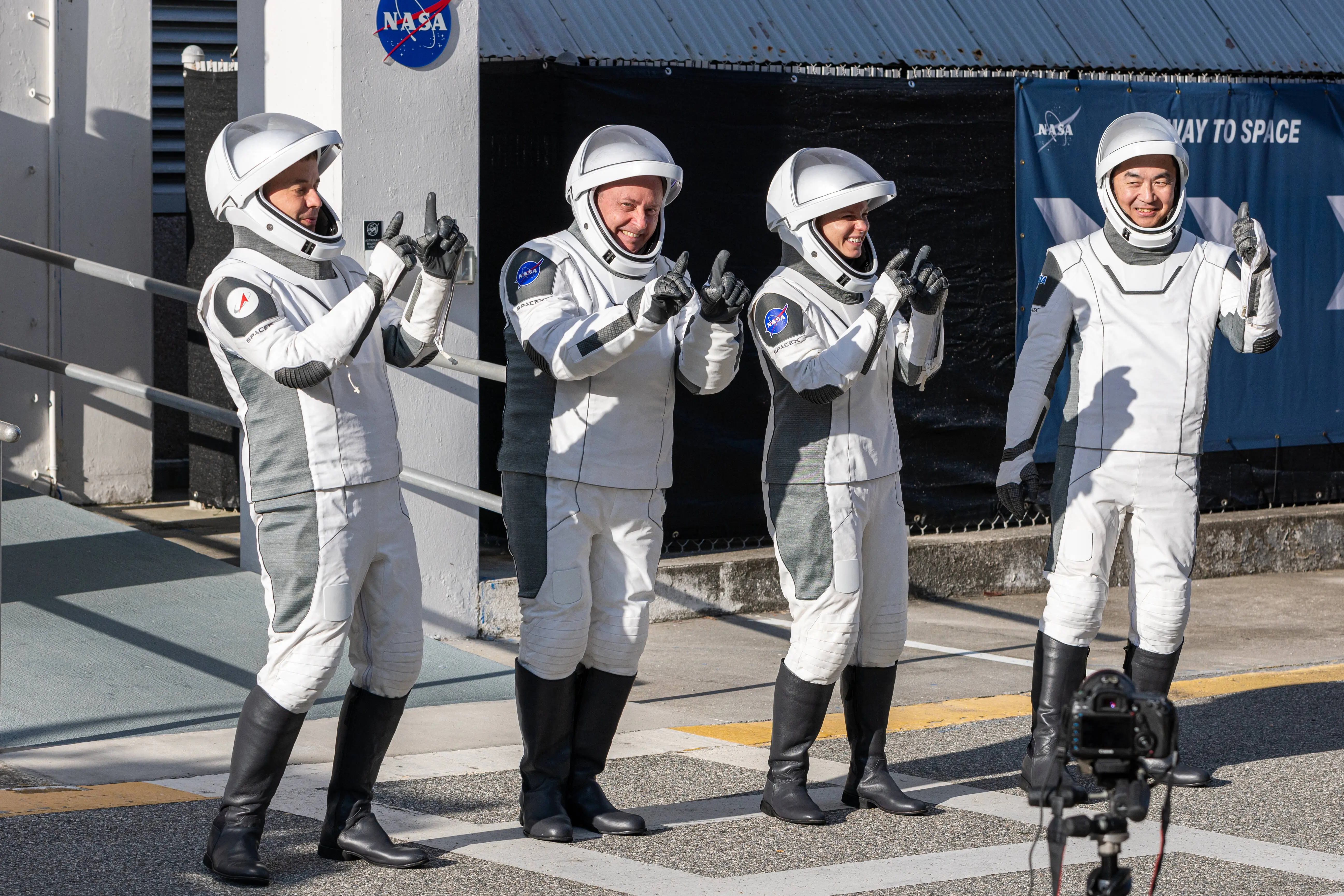 Three astronauts and one cosmonaut on the Crew-11 mission to the International Space Station board their transport vehicles to the launch pad on the second launch attempt at the Neil Armstrong Operations and Checkout Building in Kennedy Space Center, FL, on August 1, 2025 (Image via Getty)
In 2025, NASA’s Armstrong Flight Research Center in Edwards, California, conducted a series of programs focused on high-speed and hypersonic aircraft research, supporting both aeronautics and exploration objectives.
The center executed multiple flight and ground-based tests to generate data for ongoing projects, including quiet supersonic flight, ultra-efficient aircraft, and sustainable aviation technologies.
Activities included calibrating measurement instruments, evaluating aircraft performance, and conducting structural and aerodynamic tests.
These efforts contributed to the preparation and operation of experimental aircraft, such as the X-59 and X-66, and provided technical support for broader NASA missions in aviation, Earth science, and exploration technology, according to NASA on December 22, 2025.
Advancing High-Speed and Hypersonic Flight Research at NASA Armstrong
Quiet Supersonic Flight and the Quesst Mission
NASA Armstrong continued work on quiet supersonic flight through the Quesst mission.
The F-15D research aircraft conducted calibration flights of shock-sensing probes to measure the signature and strength of shock waves.
These probes were validated during dual F-15 flights and prepared for integration with the X-59 aircraft.
The X-59 team completed engine checks, electromagnetic interference tests, and low-speed taxi tests to verify system performance before its first flight.
The Commercial Supersonic Technology team performed airborne validation flights using F-15s to confirm the measurement systems required for the second phase of Quesst research.
Data collected from these tests supported the progression of X-59 toward operational flight and informed procedures for community response studies.
Ultra-Efficient and High-Speed Aircraft Research
Armstrong researchers supported the development of high-speed and hypersonic aircraft through wind tunnel tests, structural evaluations, and instrumentation installation.
The Sustainable Flight Demonstrator team measured airflow over wing surfaces to generate performance data.
Technicians installed structural floors inside the X-66 demonstrator to enable instrumentation work and evaluation.
Engineers advanced optical measurement systems to track heat and strain during hypersonic flight.
Additional experiments examined aircraft performance under high-speed and high-temperature conditions.
These activities contributed to NASA’s ability to study sustainable and efficient high-performance aircraft.
Transforming Air Mobility and New Aviation Systems
The center also researched emerging air mobility systems.
NASA Armstrong collected airflow data from experimental aircraft, tested air traffic surveillance technology for low-altitude operations, and conducted passenger comfort studies for electric air taxis.
Drone-based inspection techniques were evaluated to improve aircraft maintenance procedures.
These activities supported the integration of autonomous, electric, and hybrid aircraft into national airspace and contributed to the broader Advanced Air Mobility mission.
Earth Observation and Environmental Research
NASA Armstrong's high-altitude aircraft, such as the ER-2 and B200 King Air, have been deployed to monitor the environment and observe the Earth.
Scientists verified precision-navigation systems, obtained thermal-infrared information over regions impacted by fire, and released unmanned aircraft with 3D wind meters for taking temperature, pressure, and airflow readings.
The ER-2 also hosted the Airborne Lunar Spectral Irradiance instrument, which set an important calibration step for Earth-observing satellites by providing them with data.
Data on snowpack and melt were collected for the purpose of regional water-resource forecasting support.
All these procedures have resulted in the generation of data that can be used in environmental and climate research.
Exploration Technology and Artemis Support
Armstrong researchers supported exploration technology experiments and Artemis mission preparations. Drones were deployed for air-launch tests of parachute instrumentation experiments.
High-altitude and unmanned aircraft were used to evaluate new technologies applicable to future space missions and mission support operations.
Overall, NASA Armstrong’s work in 2025 focused on advancing high-speed, supersonic, and hypersonic aircraft research, providing data to support aeronautics, Earth observation, and exploration technology programs.
Stay tuned for more updates.
TOPICS: NASA Armstrong 2025, Advanced air mobility, High-speed flight testing, Hypersonic aircraft research, Quiet supersonic flight