
NASA prepares Artemis 2 while reflecting on the legacy of Apollo 8
-
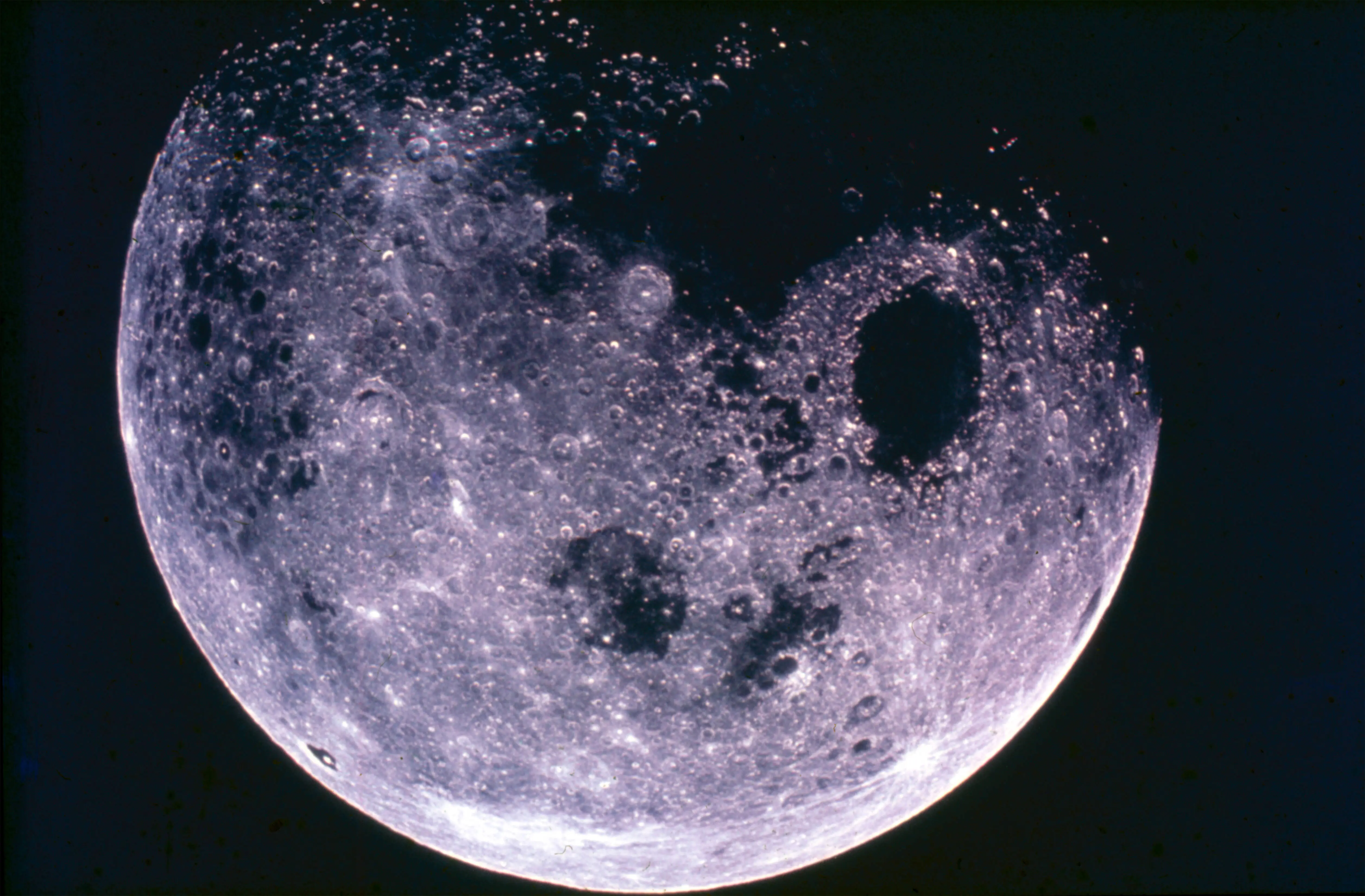 View of the Moon (from at point 70 east longitude), taken during NASA's Apollo 8 mission, December 1968 (Image via Getty)
Space.com reports that the Apollo 8 moonshot saved 1968, looking back at the first crewed mission to orbit the moon and asking if a similar mission today could have the same meaning. In December 1968, three astronauts, Frank Borman, Jim Lovell and Bill Anders, flew on Apollo 8.
They were the first humans to leave Earth’s orbit and travel to the moon. The mission occurred during a year marked by war, unrest and uncertainty, providing people with a clear goal to follow.
NASA chose to send the crew to the moon even though the lunar module was not ready. This decision carried risk but kept the space program moving forward.
The mission was completed safely and produced key moments, including a full orbit of the moon, the “Earthrise” photo and a Christmas Eve broadcast watched around the world.
Attention then turns to Artemis 2, planned for 2026, which will send four astronauts around the moon.
By placing Apollo 8 and Artemis 2 side by side, the focus is on what has changed, what remains the same and what these missions show about risk, leadership and the future of human spaceflight.
Apollo 8: a risky mission that changed 1968
Apollo 8 launched in December 1968 on the first crewed flight of the Saturn V rocket. Its task was direct: reach the moon, enter orbit, and return safely. Two hours after launch, mission control cleared the spacecraft for trans-lunar insertion, a step never taken before. Historian Dwayne A.
Day notes that “NASA wasn’t going to hold Apollo 8 on the ground,” pointing out that the lunar module delay forced a choice to move forward. After a three day journey, the crew fired a single engine to enter lunar orbit.
From about 60 miles above the surface, they observed the moon and photographed Earth rising over the horizon. That image later became known as “Earthrise.” On Christmas Eve, the astronauts broadcast live video and read from the Book of Genesis.
The moment linked a technical mission with a shared cultural event. When the crew returned safely, the public response was immediate. Time magazine named the astronauts Men of the Year.
A message sent to them summed up the reaction: “You saved 1968.” Author Andrew Chaikin later asked how such a major event could feel distant so quickly, saying, “Apollo is a chapter that feels jarringly out of sequence” in the broader space age story.
Artemis 2: returning to the moon in a different era
Artemis 2 marks the commencement of NASA's Artemis program with its launch in early 2026 and a planned duration of approximately 10 days. The mission intends to send four astronauts around the Moon using Orion and Space Launch System as a verification of these systems.
Crew members include Reid Wiseman, Victor Glover, Christina Koch, and Jeremy Hansen from Canada. For the first time since 1972, humans will fly close to the Moon.
According to Glen Swanson, a retired NASA historian, he believes previous human space flight programs have shifted from “What do I do to leave Earth” with Apollo 8, versus “How do I get there,” regarding Apollo 11.
Dwayne Day, a space historian, agrees and adds, “History doesn’t repeat, although it does rhyme,” stating that while Artemis 2 is analogous to Apollo 8, the environment will be different from what it was back then.
Currently, NASA faces various challenges, including budget limitations, transitions in administration and apprehension among its employees. Some former astronauts have warned that these issues could affect safety. In this setting, Artemis 2 is not meant to repeat Apollo 8, but to show whether clear planning and steady progress can still guide human spaceflight in a changing world.
Stay tuned for more updates.
TOPICS: Astronomy, Apollo 8, Artemis 2, Artemis II, Artemis II mission updates, NASA Artemis II mission
- NASA hunts critical tech minerals from 60,000 feet above Earth
- NASA and Artemis II crew complete full dress rehearsal for first crewed lunar flight
- Space weather stirs, raising hopes for a Christmas aurora display
- Avi Loeb reports new radio constraints and size estimates for interstellar object 3I/ATLAS