
Constraints on nucleus size of 3I/ATLAS from dust measurement
-
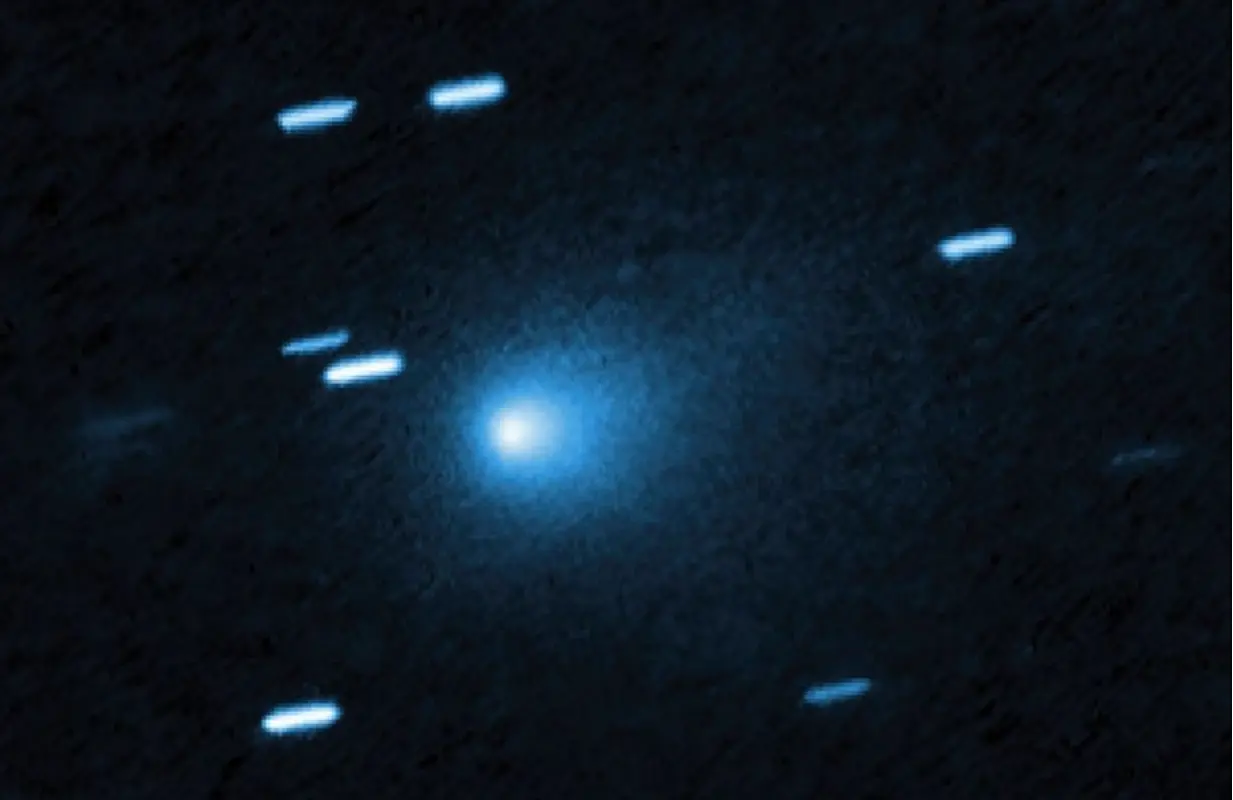 Comet 3I/Atlas (Image via NASA)
Observations of the interstellar object 3I/ATLAS have revealed a jet of dust extending from the object, providing data that allow constraints on the size of its nucleus.
Measurements indicate that the characteristic radius of dust particles in the anti-tail jet is of order ~10 microns, as reported by Avi Loeb in Medium.
Using the observed jet length and the requirement that dust particles reach the jet speed through drag on the outflowing gas, Loeb derived the mass density D of gas in the outflow at a distance d from the nucleus center as D∼(3.2∗10−8 g/cm³)∗(d/1 km)−2.
These values allow calculation of particle number density and scattering probability, which can then be used to estimate the minimum radius of the nucleus.
Dust Measurements Provide Limits on 3I/ATLAS Nucleus Size
Gas and Dust Density in the Jet
Assuming that a significant fraction of the total mass loss after perihelion is carried by ~10-micron dust particles, the mass of each 10-micron dust particle is m∼10−8g, according to Avi Loeb. The particle number per unit volume near the base of the jet can be calculated as n∼D/m=3.2 cm−3∗(d/1 km)−2.
The cross-sectional area S of each 10-micron particle for scattering sunlight is S=π∗(10−3 cm)2=3.14∗10−6 cm².
The scattering probability P of sunlight from outside down to a distance d from the nucleus center is then P=(n∗S∗d)∼1∗(d/1 km)−1.
This scattering probability represents the likelihood that sunlight is intercepted by dust particles at a given distance from the nucleus, influencing the exposure of the nucleus surface and the continuation of dust and gas release, as described by Avi Loeb.
Constraints on Nucleus Radius
The minimum value of the radial distance d corresponds to the radius of the nucleus R_n.
Loeb explains that if the scattering probability P exceeds unity, the nucleus surface of a natural comet would not be exposed to sunlight, stopping the release of gas or dust.
This implies that the radius of the nucleus for a natural comet must be larger than the value of d that yields P ~ 1, giving Rn>1 km,
which corresponds to a minimum nucleus diameter for 3I/ATLAS of ~2 kilometers. This lower limit applies if the jet results from the illumination of the nucleus of a natural comet by sunlight, as Avi Loeb states.
If the release of dust serves as a protective measure for a technological object, then a scattering probability P > 1 around the nucleus could be favored, allowing the nucleus radius R_n to be smaller than 0.7 km and remain unresolved in scattered sunlight.
Implications for Observations
The blanket of dust surrounding 3I/ATLAS is on the borderline between opaque and transparent to sunlight, as reported by Avi Loeb.
Imaging by an external camera with sub-kilometer spatial resolution would likely show a fuzzy cloud of dust rather than a sharply defined nucleus.
The coincidence of P being of order unity reflects the balance between dust release and sunlight penetration.
The measured mass loss rate and inferred dust density provide constraints for both natural and artificial scenarios.
In conclusion, dust measurements from the anti-tail jet of 3I/ATLAS allow the derivation of a minimum nucleus size of approximately 1 km in radius for a natural comet, while the nucleus could be smaller if the dust serves a protective function, as stated by Avi Loeb.
Stay tuned for more updates.
TOPICS: 3I/ATLAS, 3I/ATLAS comet, 3I/ATLAS comet observation, 3I/ATLAS observations, 3i/ATLAS recent updates
- Interstellar comet 3I/ATLAS raises new questions as Apophis approaches a historic close pass
- Observations and calculations of micron-scale dust emission from 3I/ATLAS
- Harvard astrophysicist Avi Loeb says 3I/ATLAS shows a sunward jet dominated by unusually large particles
- Breakthrough Listen focused technosignature searches on 3I/ATLAS as it neared Earth