
Interstellar comet 3I/ATLAS raises new questions as Apophis approaches a historic close pass
-
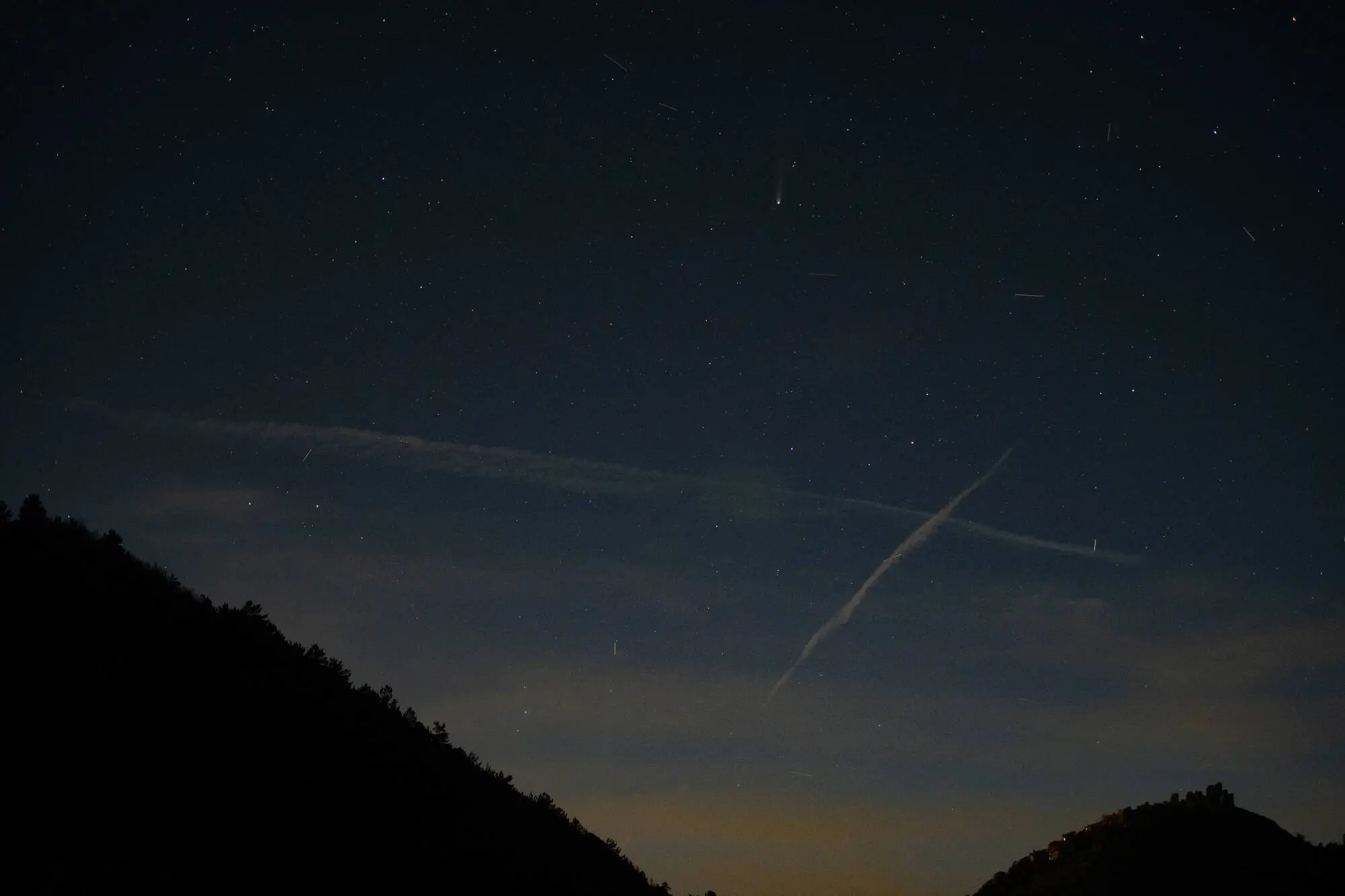 Comet C/2025 A6 (Lemmon) is seen from municipality of Calascio, Italy (Photo for reference, Image via Getty)
USA Herald reports on new findings connected to the interstellar object known as 3I/ATLAS and what those findings mean for the upcoming close Earth flyby of asteroid 99942 Apophis in 2029.
The report reviews recent image data and motion tracking collected across multiple observation platforms. Scientists looking at the data came across movement patterns that were not entirely in line with what is normally expected of small objects moving in the solar system.
Apophis will come close to Earth on April 13, 2029. The initial trajectory of the asteroid predicts that there won't be any collision.
Nevertheless, the space agencies will have a zoomed view of the asteroid since it's going to be very close.
Meanwhile, the 3I/ATLAS study is causing some doubts as to the way small objects may evolve their behavior.
The report focuses on what has been measured rather than what is predicted. It outlines how motion changes, light variations, and structural shifts were recorded in 3I/ATLAS and why those findings matter when tracking other objects.
The article places these observations within the broader context of planetary defense, long-term tracking, and preparation.
The goal is to explain what is known, what is being monitored, and what remains under study as the 2029 Apophis flyby approaches.
____________________________________________________________________How did 3I/ATLAS challenge tracking expectations?
Observations of 3I/ATLAS were collected using optical, infrared, and ultraviolet instruments. Analysts reviewing the data noted changes in motion that could not be fully explained by gravity and solar heating alone.
Frame-by-frame image comparisons showed small but measurable shifts in velocity and direction over time.
Brightness changes were also recorded. In several observation periods, these changes appeared to align with directional movement rather than distance from the Sun.
Some images showed material structures forming and fading without clear symmetry. These features were documented by multiple observers using independent data sets.
The findings were based on recorded measurements rather than projections. According to the report, even small forces acting consistently can alter an object’s path over long periods.
This finding is consistent with a statement by Harvard astrophysicist Avi Loeb, who said that interstellar objects “are a new class of objects that still need to be figured out.”
The paper notes that 3I/ATLAS represents a next step in the study of these objects by providing measured observational data rather than relying only on theoretical models.
__________________________________________________________________
What do the findings mean for Apophis and planetary defense?Apophis is not classified as an interstellar object, and its orbit has been tracked for many years. Current models show no expected collision during the 2029 flyby. NASA’s Planetary Defense Coordination Office has stated,
“Apophis poses no impact threat in 2029 based on current observations.”
The upcoming flyby will bring Apophis within about 32,000 kilometers of Earth. At that distance, Earth’s gravity may affect the asteroid’s rotation. Scientists expect to gather radar data, thermal measurements, and structural information during the approach.
The report explains that planetary defense planning relies on accurate tracking and predictable behavior.
Information from 3I/ATLAS is influencing changes in the assumptions about how the object moves, its internal structure, and how it reacts to external forces.
Besides, space agencies like NASA, the European Space Agency, and the Japan Aerospace Exploration Agency are continuously working to update the tracking data.
The time from December 2028 to April 2029 for observations is mainly referred to as the crucial period when it will be possible to gather the most important data.
The report is largely about these activities, monitoring, measurement, and being prepared, rather than drawing any conclusions.
It is expected to verify the models through the actual observations and to be sure that the response systems can be tested by using the current information, not just by simulations.
__________________________________________________________
Stay tuned for more updates.TOPICS: Astronomy, 3I/ATLAS, 3I/ATLAS comet observation, 3I/ATLAS interstellar object, Apophis asteroid 2029, NASA asteroid collisions