
Stargazing tonight, December 17: Jupiter dominates as the Geminids fade and Ursids begin
-
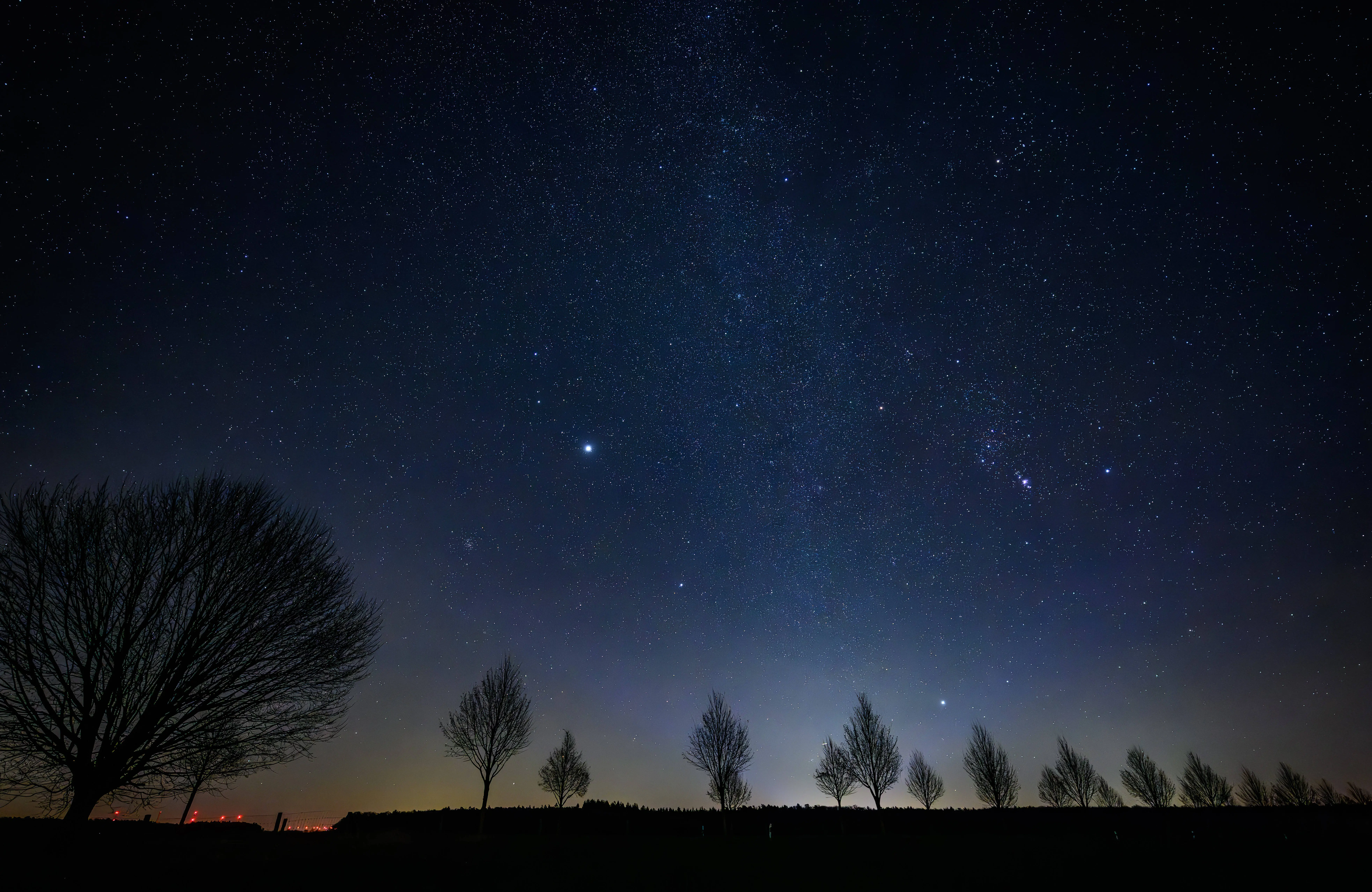 Part of the Milky Way can be seen in the starry night sky (Image via Getty)
TechStock² presents a night sky update for December 17, 2025, with a focus on observable astronomy events and recent space developments.
With the waning crescent Moon providing only a limited light interference, the conditions are very good for skywatching tonight. The Moon is going to its new phase later this week, which means that the skies will be darker for most of the night.
Depending on the time of your observation, you can see several planets. After sunset, Jupiter is visible for most of the night and, therefore, is the brightest object in the sky. Saturn sets in the western sky in the early evening.
Before sunrise, Mercury can be seen low near the eastern horizon. Besides, Uranus and Neptune, for instance, can be seen with binoculars or from a small telescope.
Meteor activity remains at a low level but is nevertheless steady. The Geminid meteor shower is ending, and the Ursid meteor shower is only just starting its active period, which will be followed by a peak later in the month. Under dark conditions, observers may witness some meteors but only very rarely.
In addition to the sky events, December 17 has seen some notable space-related developments like satellite launches, upgrades in astronomy research, and the recording of an interstellar comet. This report serves as a background for what is visible in the sky tonight and also features the main space news from today.
_______________________________________________________________Moon phase, planets, and meteor activity
On December 17, 2025, the Moon is in a waning crescent phase with minimal illumination. Time and Date inform that the Moon is a few percent lit only, and it sets earlier in the night, thus giving most of the night in darkness. EarthSky writes,
“The new moon occurs at 1:43 UTC on December 20,” which makes tonight local time very close to the new moon and therefore best for viewing the stars.”
Jupiter can be admired from evening till morning and looks like the brightest star in the sky. The Planetary Society quotes, “Jupiter is the main object in the evening sky for the whole of December.”
Saturn is visible after sunset in the west and goes down before midnight in most places. Mercury is visible before sunrise, near the horizon, and it is easier to find if your eastern view is completely free of any obstruction.
The meteor activity consists of the last hours of the Geminid shower and the very beginning of the Ursids. NASA confirms, “The Geminids peak in mid-December and fade shortly after.”
The American Meteor Society indicates that the Ursids are present until late December, with a maximum expected around December 22. The moonlight is hardly enough to interfere with observations during this time.
______________________________________________________________Space and astronomy news from December 17, 2025
Several space and astronomy updates were reported on December 17, 2025. Arianespace confirmed the successful launch of an Ariane 6 rocket carrying two Galileo navigation satellites.
In its statement, the company said the mission “supports the continued deployment of Europe’s global navigation satellite system.” The satellites were placed into medium Earth orbit and will contribute to positioning and timing services.
In astrophysics research, the Center for Astrophysics | Harvard & Smithsonian released findings based on new X-ray data from the XRISM mission. Researchers reported improved measurements of material near a supermassive black hole. The institution stated, “These observations allow us to better understand the structure of matter close to the black hole.”
After the close approach, the astronomers are watching the interstellar comet 3I/ATLAS very closely. In a statement, NASA indicated that the object moves along a hyperbolic orbit, which implies that the object comes from outside the solar system. According to Space.com, the comet will be at a great distance from the Earth, and hence, there is no danger.
Further studies emphasized the observations of the exoplanet WASP-121 b made by the James Webb Space Telescope. According to EarthSky, researchers found the presence of the extended helium tails, giving the first-hand atmospheric loss. As a result, these news pieces continue to be the buzz in the community of space exploration and astronomical research.
________________________________________________________
Stay tuned for more updates.TOPICS: Astronomy, Jupiter, Meteor Showers, Moon, Planet Neptune, Planets
- Vast invites scientists to pitch microgravity experiments for its upcoming Haven-1 commercial space station
- James Webb Space Telescope uncovers clues to colossal stars in the early universe
- Astronomers detect a pulsing sunward jet from interstellar object 3I/ATLAS
- NASA tests show ultra-thin material can shield spacecraft components from extreme vibration