
Features
NASA details 2025 achievements across Moon, Mars, and Earth Science missions
NASA reported 2025 achievements in lunar, Mars, and Earth science missions, including Artemis II preparations, CLPS landers, Mars ESCAPADE, ISS research, heliophysics, and new astronaut candidates.
-
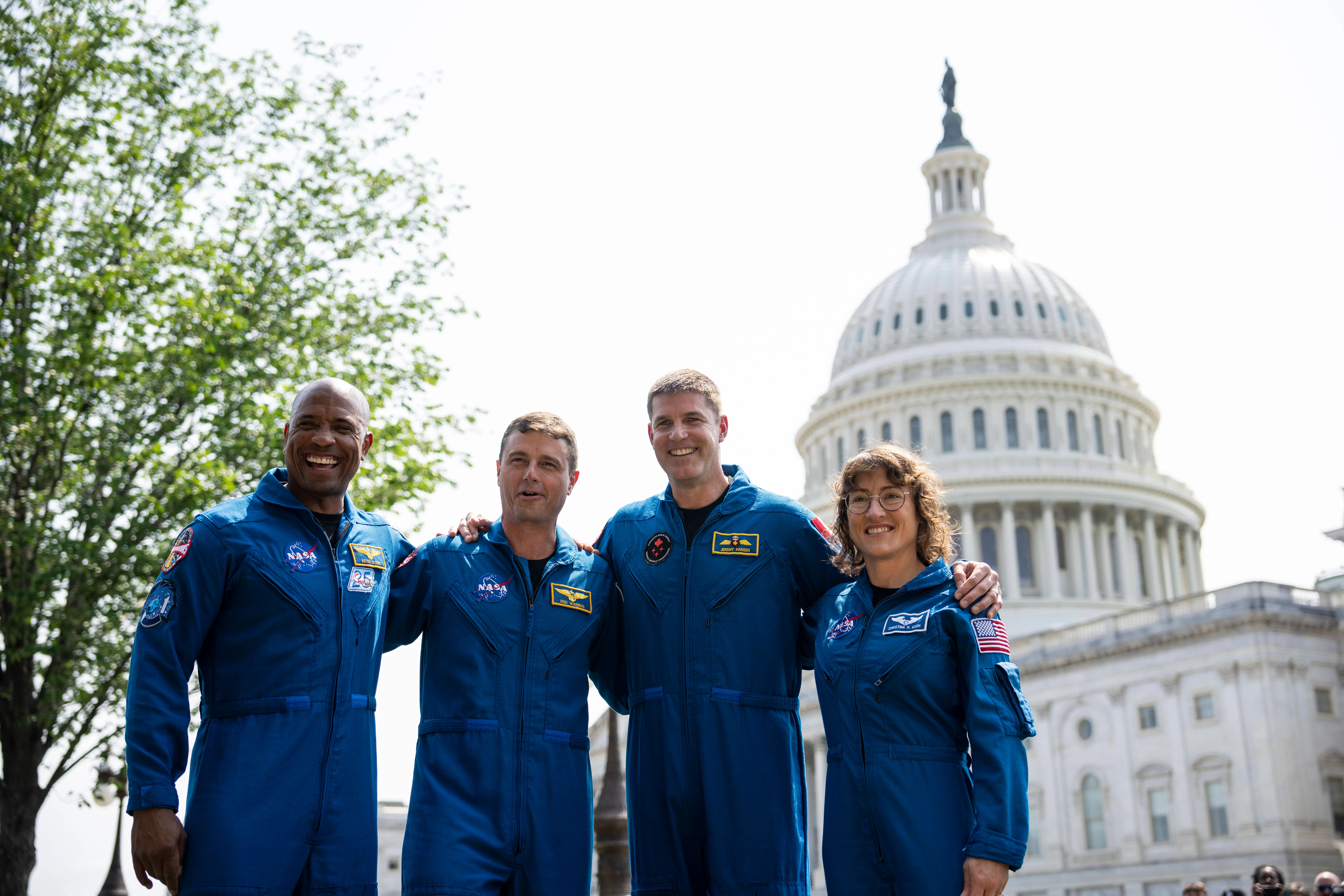 NASA astronauts Victor Glover, Reid Wiseman, Canadian Space Agency astronaut Jeremy Hansen and NASA astronaut Christina Hammock Koch pose for pictures after a news conference about the NASA's Artemis II mission outside the U.S. Capitol May 18, 2023 in Washington, DC. Planned for launch by the Space Launch System in November 2024, the Artemis II mission will include a crewed Orion spacecraft that will perform a lunary flyby and return to Earth (Image via Getty)
In 2025, NASA reported significant milestones across lunar, Martian, and Earth science missions.
The agency confirmed that preparations for the Artemis II test flight, the first crewed mission around the Moon in over 50 years, were completed with the stacking of the Space Launch System rocket and Orion spacecraft.
The preparations also included more than 30 mission simulations involving the Artemis II crew, comprising Reid Wiseman, Victor Glover, Christina Koch, and Jeremy Hansen, as well as ground teams.
NASA introduced a new class of astronaut candidates and advanced commercial lunar payload missions.
In parallel, the agency continued its work on Mars mission simulations, deep space communications, and Earth observation projects.
NASA also celebrated 25 years of continuous human presence aboard the International Space Station.
Lunar exploration and Artemis missions
By the year 2025, NASA pushed further lunar exploration with the Artemis program.
The agency wrapped up the integration of the different parts of the Space Launch System (SLS) rocket and the Orion spacecraft at the Kennedy Space Center in Florida.
The Artemis II crew ran onboard activities and rehearsals of planned operations from launch to flight and recovery, which they verified by actual countdown demonstrators.
The steps toward the goal included a booster firing test, an RS-25 engine check, and a hybrid rocket motor test.
Besides, NASA was working with JAXA on rover mockup testing, and with Axiom Space on spacesuit development at the Neutral Buoyancy Laboratory.
Commercial Lunar Payload Services (CLPS) missions included Firefly's Blue Ghost Mission One and Intuitive Machines' Nova-C lunar lander, both carrying technology demonstrations, navigation experiments, and the recording of engine plumes on the Moon.
NASA has given a task order to Blue Origin to deliver the VIPER lunar rover to the South Pole in 2027.
Gateway development continued with the production of a power and propulsion system and habitation element, along with science and technology demonstrations.
The Lunar Surface Innovation Consortium drew together more than 3,900 members from the academic world, industries, and government, leading to a wide range of studies and presentations regarding the capacities of the lunar surface.
Moreover, NASA has fulfilled 1,000 days of operational activities for the CAPSTONE CubeSat in lunar orbit, to facilitate experiments in autonomous navigation and space communications.
Mars mission preparations
NASA launched the ESCAPADE spacecraft to study Mars’ magnetic environment and space weather.
Ground-based simulations of human Mars missions began for a second year, including testing of an inflatable deep-space habitat concept.
Entry, Descent, and Landing technology tests were conducted to advance precision landings on Mars.
The agency accomplished the Deep Space Optical Communications experiment, which is a technology that enables high-bandwidth communication for long-duration missions.
Studies on fluid behavior, space crop cultivation, and quantum experiments were carried out with the aim of developing technology for long-term space missions.
The Artemis Accords added seven new signatories, thereby increasing the partnership for the peaceful exploration of the Moon and Mars.
Earth Science and International Space Station operations
NASA continued a series of Earth observation missions, among them a joint satellite mission with India to monitor land and ice-covered surfaces. The agency used 12 spacecraft and telescopes to track the interstellar object 3I/ATLAS.
Heliophysics missions such as PUNCH, EZIE, TRACERS, IMAP, and the Carruthers Geocorona Observatory were focused on the Sun and space weather.
Furthermore, in 2025, the James Webb Space Telescope, Nancy Grace Roman Space Telescope, and other observatories kept their operations going.
The International Space Station celebrated 25 years of continuous human presence and was home to 25 crew members from six countries. It also supported 12 spacecraft visits.
Around the station, experiments related to astronaut health, human physiology, space radiation, stem cells, and in-space medical and semiconductor manufacturing were conducted.
In order to facilitate the development of privately operated stations, NASA collaborated with commercial entities. In support of the ongoing aeronautics research, the X-59 supersonic aircraft finished its very first flight in October 2025.
In 2025, NASA’s triumphs were characterized by international collaboration, commercial partnerships, technology demonstrations, and public engagement activities. The achievements provided operational and scientific data across lunar, Martian, and Earth environments.
The agency also took steps to broaden its digital and media footprint via NASA+, social media, and educational programs.
Stay tuned for more updates.
TOPICS: NASA 2025 achievements, Artemis II mission, NASA, NASA 25 years ISS, NASA Artemis program, NASA International Space Station, NASA space technology updates