
Features
Firefly Blue Ghost Mission 2 completes key prelaunch tests at JPL
Firefly Aerospace’s Blue Ghost Mission 2 completed vibration and acoustic prelaunch tests at NASA’s JPL, preparing the spacecraft to deliver NASA and international payloads to the Moon’s far side.
-
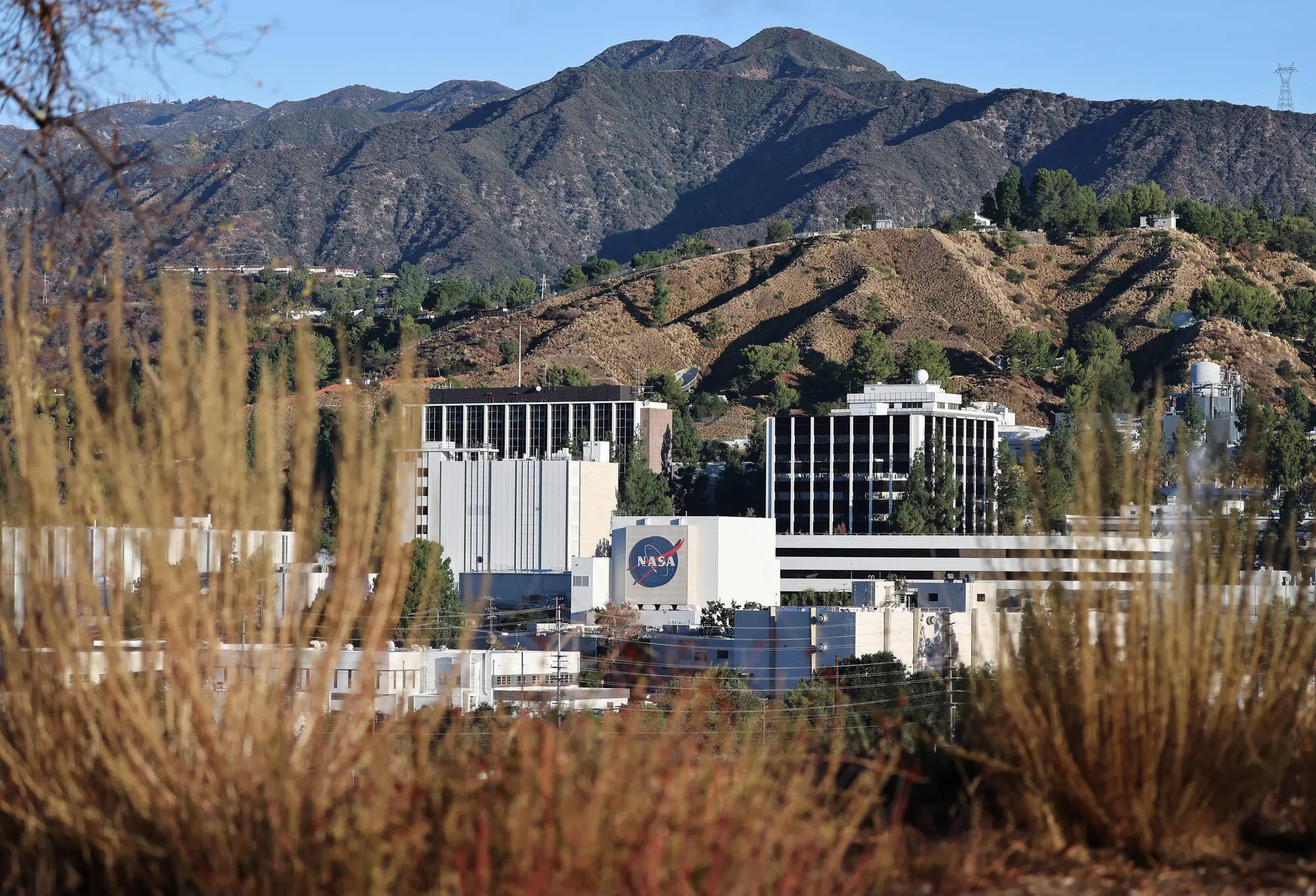 The NASA logo is displayed at NASA’s Jet Propulsion Laboratory on October 15, 2025 in La Cañada Flintridge, California. Around 550 people, or over ten percent of the famed lab’s workforce, are being laid off as part of an ongoing reorganization following two rounds of large layoffs last year. Layoffs at the laboratory, which is funded by NASA and managed by CalTech, are not related to the federal government shutdown (Image via Getty)
Firefly Aerospace’s Blue Ghost Mission 2 has completed major prelaunch tests at NASA’s Jet Propulsion Laboratory, confirming that the spacecraft’s structural design can withstand the conditions of launch.
According to NASA, a full-scale structural qualification model of the spacecraft underwent vibration and acoustic testing at JPL’s Environmental Test Laboratory in Southern California.
These tests simulated the stresses of a rocket launch to ensure the spacecraft and its payloads remain intact.
The mission is scheduled to deliver multiple payloads to the Moon’s far side, including instruments for NASA and international partners, with a projected launch as early as 2026.
Structural testing in the environmental test laboratory
As reported by NASA on December 16, 2025, the Environmental Test Laboratory at JPL performed vibration tests on the Blue Ghost Mission 2 structural model.
The spacecraft stack, which includes the Blue Ghost lunar lander atop Firefly’s Elytra Dark orbital vehicle, was secured to a shaker table and subjected to repeated jolts in three directions.
Hundreds of sensors monitored the movement, and data were collected to compare actual performance against computer model predictions.
The tests were designed to approximate the dynamic environment during launch without exceeding thresholds that could damage the hardware, as noted by Michel William, a JPL engineer leading the tests.
Acoustic testing was conducted in a separate chamber designed to simulate the high-decibel noise experienced during rocket liftoff.
Giant horns generated sound levels up to 153 decibels using compressed nitrogen, a process intended to replicate the intense pressure waves that spacecraft encounter during launch.
Both vibration and acoustic tests included multiple iterations at increasing intensity, with adjustments made to either the hardware or the computational models if discrepancies were observed.
Preparation of flight hardware
While the structural qualification model underwent environmental testing, the actual flight hardware for Blue Ghost Mission 2 will undergo additional trials.
Flight-ready spacecraft typically undergo electromagnetic testing to verify that electronic components do not interfere with one another.
Thermal vacuum testing is also conducted in JPL’s space simulators, which can expose spacecraft to extreme temperatures in a vacuum to replicate the conditions of space.
Additional tests on flight hardware may include mechanical load and deployment checks to ensure that moving parts, such as landing legs and antennae, operate correctly under expected launch and lunar conditions.
These tests ensure that the lander and orbital vehicle will function as intended from launch through lunar operations.
Mission objectives and payloads
Firefly Blue Ghost Mission 2 is designed to deliver both NASA and international payloads to the Moon.
The mission will include LuSEE-Night, a radio telescope developed jointly by NASA, the U.S. Department of Energy, and the University of California, Berkeley Space Sciences Laboratory.
A JPL-developed payload called User Terminal will test a low-cost S-band communication system intended for future far-side lunar missions.
The Elytra Dark orbital vehicle will deploy the European Space Agency’s Lunar Pathfinder communications satellite into lunar orbit.
Both the lander and orbital vehicle will operate in coordination to relay data from the Moon’s far side back to Earth.
The mission is part of NASA’s Commercial Lunar Payload Services program, supporting Artemis campaign objectives for robotic and future human exploration of the Moon.
Completion of the Environmental Test Laboratory procedures for the structural qualification model marks a significant step in Firefly Aerospace’s preparation for launch.
The flight hardware is now moving into final assembly and verification stages before transportation to the launch site.
Stay tuned for more updates.
TOPICS: Firefly Blue Ghost Mission 2, Blue Ghost lunar lander, Firefly Aerospace lunar mission, NASA, NASA Artemis program lunar mission, NASA JPL spacecraft testing