
Features
NASA's Parker Solar Probe captures images of Interstellar Comet 3I/ATLAS
NASA’s Parker Solar Probe and Europa Clipper captured detailed observations of interstellar comet 3I/ATLAS in 2025, providing data on its trajectory, composition, and behavior as it passed through the solar system.
-
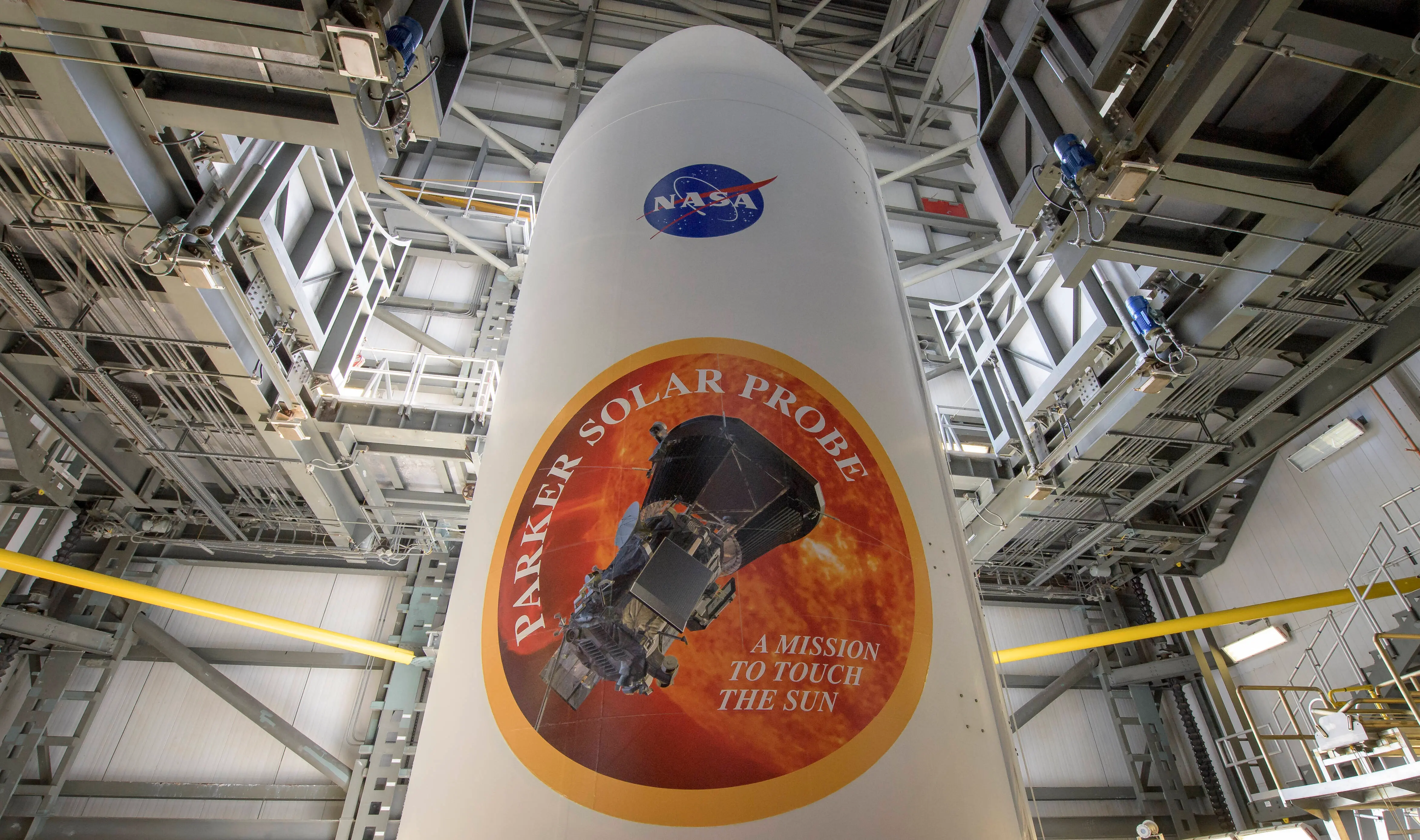 In this NASA handout, The United Launch Alliance Delta IV Heavy rocket payload fairing is seen with the NASA and Parker Solar Probe emblems, August 8, 2018 at Launch Complex 37, Cape Canaveral Air Force Station, Florida. Parker Solar Probe will travel through the Suns atmosphere, closer to the surface than any spacecraft before it (Image via Getty)
NASA’s Parker Solar Probe captured images of interstellar comet 3I/ATLAS between October 18 and November 5, 2025, using its Wide-Field Imager for Solar Probe (WISPR) instrument.
The spacecraft recorded roughly ten images per day while moving away from the Sun following its 25th solar flyby on September 15, 2025.
At the time of imaging, Parker Solar Probe was located between 172 million and 195 million miles from the comet.
These observations allowed scientists to view 3I/ATLAS during a period when it was not observable from Earth due to its proximity to the Sun.
The images will undergo further calibration and processing to improve accuracy, according to NASA.
Parker Solar Probe observations
The WISPR images show comet 3I/ATLAS moving behind the Sun from the perspective of Parker Solar Probe.
The spacecraft rolled along its axis to capture views of the comet, placing north at the bottom of the images.
Initial processing removed the bright solar corona, and further calibration is ongoing. During this period, the comet was near its closest approach to the Sun, approximately 130 million miles away, just outside the orbit of Mars.
The WISPR team is continuing to correct for variations in exposure times and stray sunlight that affected apparent brightness.
Final images are intended to provide more detailed data on the comet’s trajectory and physical properties, according to NASA’s NRL and JHUAPL teams.
The observations also capture the comet’s motion relative to the background stars, allowing for refined trajectory measurements.
Europa Clipper observations
In addition to Parker Solar Probe, NASA’s Europa Clipper observed comet 3I/ATLAS on November 6, 2025, using its Europa Ultraviolet Spectrograph (Europa-UVS) instrument.
The spacecraft collected data over seven hours from a distance of approximately 102 million miles.
Europa-UVS scanned the ultraviolet light emitted by the comet and separated it into individual wavelengths to determine the composition and distribution of elements in the comet’s coma.
These observations were processed to produce visible images by stacking multiple exposures.
Europa Clipper’s instruments, primarily designed for studying Jupiter’s moon Europa, were repurposed to gather data on 3I/ATLAS during its passage through the solar system, as reported by NASA/JPL-Caltech and SWRI.
The data from Europa-UVS also contribute to comparisons with observations from other NASA spacecraft, enhancing multi-mission studies of the comet.
Discovery and characteristics
Comet 3I/ATLAS was discovered by the NASA-funded ATLAS survey telescope in Rio Hurtado, Chile, on July 1, 2025. It is the third known interstellar object identified in the solar system.
Pre-discovery images were obtained from the ATLAS telescopes and the Zwicky Transient Facility at the Palomar Observatory archives that helped to extend the observations until June 14, 2025.
The comet is moving through the solar system on a hyperbolic orbit, which suggests that it is from outside the solar system, and the comet is not a danger to Earth, at a closest distance of about 1.8 astronomical units.
3I/ATLAS made its closest approach to the Sun around 30th October 2025, at a distance of 1.4 astronomical units.
Hubble, Webb, TESS, Swift, SPHEREx, Perseverance Mars rover, MRO, MAVEN, Europa Clipper, Lucy, Psyche, Parker Solar Probe, PUNCH, and ESA/NASA's SOHO are some of the NASA's assets that are currently observing 3I/ATLAS.
The observations from Hubble on July 21, 2025, have shown the comet's dusty shell encompassing its icy core that has allowed scientists to come up with a diameter range of between 1,444 feet (440 meters) and 3.5 miles (5.6 kilometers).
Parker Solar Probe and Europa Clipper observations have confirmed these earlier findings, thus expanding the data set on the interstellar comet, as stated by NASA.
Stay tuned for more updates.
TOPICS: NASA Parker Solar Probe, 3I/ATLAS, 3I/ATLAS comet images 2025, 3i/ATLAS recent updates, Comet 3I/ATLAS discovery, Europa Clipper comet observations, interstellar comet 3I/ATLAS, WISPR instrument Parker Solar Probe
More NASA Parker Solar Probe
on Primetimer: