
Culinary Class Wars Season 2 quietly dismantles the Black Spoon vs. White Spoon divide
-
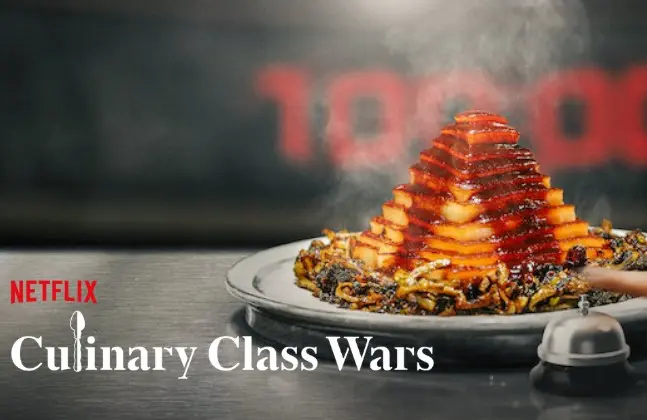 Culinary Class Wars 2 (Image via Netflix)
From its first moments, Culinary Class Wars Season 2 presents itself as a continuation of a rigid hierarchy: celebrated White Spoon chefs versus lesser-known Black Spoon challengers.
Yet across Episodes 1 and 2, the season begins to quietly dismantle that divide—not through speeches or rule changes, but through outcomes.
Survival, elimination, and evaluation steadily erode the idea that status alone separates the two sides.
The structure initially reinforces the binary. White Spoon chefs occupy the upper level, observing. Black Spoon chefs cook below, fighting for survival.
Titles, Michelin stars, television fame, and decades of experience appear to establish a clear order.
However, as Culinary Class Wars Season 2 progresses through its opening episodes, the results repeatedly contradict the premise that pedigree guarantees safety or that obscurity signals weakness.
Culinary Class Wars Season 2 exposes a shared standard of judgment
The Black Spoon Elimination Round becomes the clearest mechanism through which this dismantling occurs.
Every dish—regardless of who prepared it—is subjected to the same immediate scrutiny from judges Paik Jong-won and Anh Sung-jae.
Familiarity with a chef’s résumé offers no insulation. What matters is what appears on the plate.
This is most evident in the Hidden White Spoon twist. Two returning White Spoon chefs, Choi Kang-rok and Kim Do-yun, are deliberately placed among the Black Spoons.
Their presence collapses the hierarchy in practice. Kim Do-yun, a Michelin-starred chef, is eliminated after failing to satisfy both judges. Anh Sung-jae states,
“For my taste buds… I don’t think I would call this delicious.”
His departure results in no increase in surviving Black Spoons, underscoring that status does not bend the rules.
Choi Kang-rok survives, but only after passing the same double-judge threshold. Paik Jong-won praises his braised eel, while Anh Sung-jae carefully evaluates texture and composition before approving.
The outcome confirms that White Spoon distinction does not alter the standard—it merely raises expectations.
At the same time, Black Spoon chefs repeatedly outperform assumptions. One chef advances with a Korean juansang-inspired meal paired with alcohol, despite presenting what he describes as “ordinary” food.
His survival is confirmed after Paik Jong-won notes the absence of fishiness and bones in the mackerel bibimbap, responding, “That was great.” The moment reframes what qualifies as competitive cooking on the show.
Little Tiger’s vegetable-focused juansang pushes this dismantling further. With no meat on the plate, her dish challenges conventional competition instincts.
Yet after tasting, Paik Jong-won says, “I didn’t need meat with my drink,” before confirming survival. Her success demonstrates that restraint and clarity can rival complexity and prestige.
The episode also reveals White Spoon chefs watching with visible unease. From the balcony, they remark on how difficult Korean food is to execute under scrutiny and how narrow the margin for error has become.
Son Jong-won observes,
“Korean food is definitely more challenging. It seems easy, but it’s not.”
These reactions signal that the pressure once associated primarily with Black Spoons has equalised.
Emotionally charged survivals further blur the divide. French Papa, a veteran of classical French cuisine, advances not because of sympathy, but because his bouillabaisse meets technical expectations.
Paik Jong-won acknowledges the importance of temperature in reducing fishiness, a detail French Papa anticipates. His survival reinforces that experience matters only if it translates into execution.
Meanwhile, Barbecue Lab Director, a former corporate employee who taught himself barbecue techniques, succeeds by adapting his method to competition constraints.
His beef ribs survive after Paik Jong-won confirms both smokiness and tenderness. The result places a self-taught pitmaster on equal footing with chefs trained in Michelin kitchens.
By Episode 2, the scoreboard tells a different story than the show’s premise suggests. White Spoon chefs are not immune.
Black Spoon chefs are not underqualified. Both groups succeed and fail for the same reasons: balance, texture, restraint, and judgment.
What Culinary Class Wars Season 2 ultimately dismantles is not the existence of hierarchy, but its permanence.
The show reframes class as temporary and conditional. A White Spoon title can be lost. A Black Spoon label can be transcended.
This quiet dismantling is more effective than any overt twist. It unfolds through eliminations, survivals, and judges’ comments rather than declarations.
By applying identical standards to everyone, Culinary Class Wars Season 2 turns its class war into something subtler: a test of whether skill can stand alone once status is stripped away.
Stay tuned for more updates.
TOPICS: Culinary Class Wars , Culinary Class Wars season 2 Episode 1, Culinary Class Wars season 2 Episode 2
- Who is Jun Lee from Culinary Class Wars season 2? Everything to know about the chef explored
- Who is Hu Deok-juk from Culinary Class Wars season 2? Everything to know about the chef explored
- Who is Son Jong-won from Culinary Class Wars season 2? Everything to know about the chef explored
- Culinary Class Wars: Season 2 redraws the class war by stacking the Black Spoon side with overqualified elites