
Culinary Class Wars Season 2 Episode 7 shows how "bold flavor" becomes a psychological burden
-
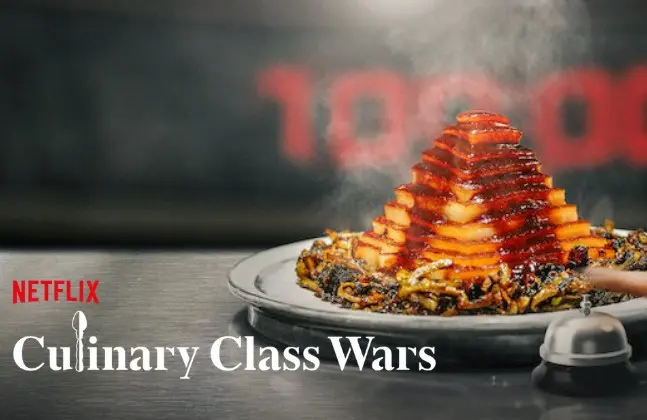 Culinary Class Wars 2 (Image via Netflix)
From the outset of Culinary Class Wars Season 2 Episode 7, the word “bold” looms larger than any ingredient. It is spoken of as strategy, intention, and expectation.
Yet as the episode unfolds, boldness begins to function less as a creative goal and more as a psychological weight — one that alters decision-making long before the judges ever taste a dish.
The concept is introduced early. Reflecting on the first match, Seong-keun frames success in terms of broad appeal:
“If we make something everyone likes, we’ll win for sure.”
Another chef adds, “The public’s scary.” The implication is clear. Flavor is no longer just an expression. It is risk management.
Culinary Class Wars and the danger of cooking to expectation
As the second match approaches, that pressure intensifies. The Black Spoon Team openly reframes its strategy around boldness. Witch with a Wok articulates the goal without hesitation:
“What I really wanted was to smack the taste buds of the judges.”
Boldness becomes not just desirable but necessary — a corrective to the perceived subtlety that cost them earlier.
Yet the episode repeatedly demonstrates how chasing boldness can narrow perspective. When sauce adjustments begin, comments focus on extremes.
“It’s salty. Really salty. So make it sweet.”
Fixes pile onto fixes. Boldness stops being flavor and becomes volume.
Judging commentary later exposes the cost of that mindset. Paik Jong-won directly addresses the disconnect between intention and execution:
“At the start of the tasting, you said you wanted to prepare a dish that was ‘as bold as it was delicious.’ But that wasn’t the impression I got. To me, the flavor seemed more delicate than bold.”
The critique is not about failure. It is about expectation shaping perception.
Meanwhile, the White Spoon Team wrestles with the opposite burden. Their dish risks becoming too rich, too familiar. Yu-gang voices the concern:
“Mash, cream, cheese, it’s too heavy. Too rich.”
The response is not to abandon restraint but to counterbalance it. Sam Kim explains the adjustment:
“We need to add acidity as a kick.”
Boldness here is redefined not as intensity, but as contrast.
The episode repeatedly shows chefs negotiating with their own language. Witch with a Wok later reflects on a final tweak:
“It felt like 2% off. The flavor wasn’t exactly bad. It just wasn’t intense enough.”
The margin is tiny, yet the anxiety is outsized. Boldness becomes something to chase rather than something to trust.
By the time the judges deliberate, the psychological toll is visible. Sung-jae offers measured criticism:
“I felt the seasoning was a bit too much. In particular, the sweetness was very overwhelming.”
The comment echoes earlier warnings from inside the kitchen itself. What was framed as ambition begins to look like overcorrection.
Culinary Class Wars Season 2 does not argue against bold cooking. Instead, Episode 7 reveals how the expectation of boldness can distort judgment.
Chefs stop asking whether a dish is complete and start asking whether it is loud enough. In that shift, instinct gives way to anxiety.
By the episode’s end, boldness remains unresolved — praised in theory, questioned in practice. The result is not a lesson about taste, but about pressure.
In Culinary Class Wars, flavor is never just flavor; it is a response to fear, confidence, and the invisible weight of what chefs believe they are supposed to deliver.
Stay tuned for more updates.
TOPICS: Culinary Class Wars season 2 , Culinary Class Wars Season 2 Episode 7
- Culinary Class Wars Season 2 keeps Paik Jong-won on the judging panel despite backlash
- Son Jong-won says Culinary Class Wars 2 strengthened bonds and reshaped his perspective
- Culinary Class Wars 2 exposes the limits of molecular gastronomy through Anh Sung-jae's critique
- Culinary Class Wars Season 2 quietly reveals how leadership styles shape the kitchen