
Culinary Class Wars Season 2 Episode 2 turns Korean comfort food into the most dangerous gamble
-
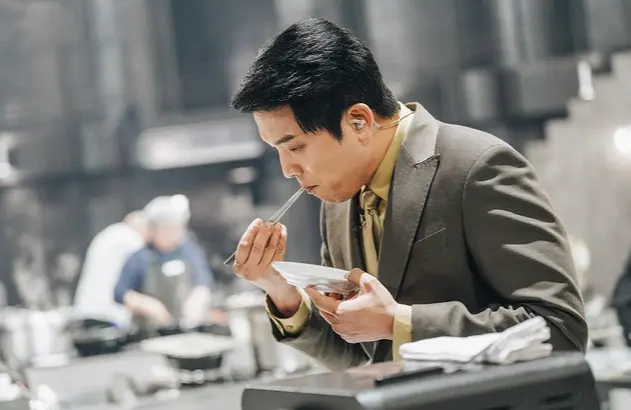 Anh Sung-jae (Image via Instagram/@netflixkr)
Culinary Class Wars Season 2 Episode 2 turns Korean comfort food—long associated with warmth, nostalgia, and reliability—into the most dangerous gamble on the floor, exposing how little margin for error remains when judges apply elite standards to everyday flavors.
The episode unfolds almost entirely inside the Black Spoon Elimination Round, where survival depends on delivering a single dish that can withstand immediate, uncompromising scrutiny.
A lot of cooks figure Korean food might give them better odds. That’s because these meals live in everyday routines, flavors the judges grew up with, and recipes they’ve made so often it feels automatic.
Yet Culinary Class Wars Season 2 Episode 2 reveals that this very familiarity makes Korean comfort food uniquely vulnerable.
Culinary Class Wars Season 2 Episode 2 raises the bar for Korean cuisine
As Korean dishes begin arriving at the judges’ table, a clear pattern emerges. The critiques are swift, specific, and unforgiving.
Paik Jong-won and Anh Sung-jae repeatedly signal that recognizability is not an asset. Instead, it becomes a liability.
One dish is told that it’s “too ordinary,” and another is criticized for the imbalance:
“The seasoning wasn’t harmonious.”
Texture issues recur, with comments noting chewiness, lingering bitterness, or flavors that overstay their welcome.
What makes these eliminations striking is not their frequency, but their tone. The judges do not dismiss Korean comfort food as unworthy; rather, they judge it more harshly precisely because they know it so well.
As Son Jong-won observes from the White Spoon balcony,
“Korean food is definitely more challenging. It seems easy, but it’s not. We have certain expectations.”
In Culinary Class Wars Season 2, familiarity raises expectations instead of lowering them.
This dynamic places chefs cooking Korean food in a narrow corridor. There is no room to hide behind novelty, nor behind tradition alone.
A dish must be technically exact, emotionally resonant, and immediately balanced. Anything less is eliminated.
Several chefs fall victim to this standard. Dishes described as home-style or roadside fare are rejected for lacking distinction.
Tteokbokki, a staple of Korean street food, is eliminated after being described as having an “artificial” umami profile.
A braised fish dish is dismissed for texture issues. In each case, the flaw is not ambition, but execution under a microscope.
Against this backdrop, the survival of certain Korean comfort dishes becomes even more telling.
Dweji-Gomtang in NY, known internationally for his pork soup, advances with a dish that strips the form down to its essence.
He explains that his broth is made using only pork, resulting in a clear, clean flavor.
When Paik Jong-won tastes it, he remarks that it is “savory” without being greasy and praises its clarity. The success lies not in reinvention, but in precision.
Similarly, Seoul Mother’s Seoul-style set meal survives by embracing restraint.
Her presentation includes neobiani, beef brisket and radish soup, rice, and seasonal sides—ingredients described by observers as simple rather than luxurious.
Yet the execution wins approval. After tasting, Paik Jong-won remarks, “It’s changed my dialect. I feel like I’m from Seoul now,” before confirming her survival.
The comment underscores what Episode 2 repeatedly demonstrates: comfort food succeeds only when technique supports emotion.
This contrast defines Culinary Class Wars Season 2 Episode 2. Korean dishes that rely on familiarity alone are eliminated.
Those who balance emotional resonance with flawless execution advance. The margin between the two is razor-thin.
The episode also highlights how risky Korean comfort food becomes when placed beside global or technique-forward dishes.
While some chefs attempt molecular gastronomy, fermentation, or live distillation, Korean cuisine faces judges whose palates are calibrated daily to these flavors.
As Ven. Sunjae notes, “Everyone knows the taste.” In this environment, even minor deviations are magnified.
By the end of Episode 2, the pattern is undeniable. Korean comfort food is no longer a refuge; it is a test.
Culinary Class Wars Season 2 Episode 2 transforms dishes meant to soothe into high-stakes evaluations where every imbalance is fatal.
The chefs who survive do so not because they chose Korean food, but because they mastered it under pressure.
Stay tuned for more updates.
TOPICS: Culinary Class Wars season 2 , Culinary Class Wars season 2 Episode 2
- Who is Jun Lee from Culinary Class Wars season 2? Everything to know about the chef explored
- Culinary Class Wars Season 2 Episode 2 shows that emotions can elevate a dish, but only if the technique holds
- Who is Hu Deok-juk from Culinary Class Wars season 2? Everything to know about the chef explored
- Culinary Class Wars: The Hidden White Spoon twists turns Season 2 into a high-risk redemption test for returning champions