
Two giant stars are set to crash into each other, creating a massive supernova that could light up Earth’s sky
-
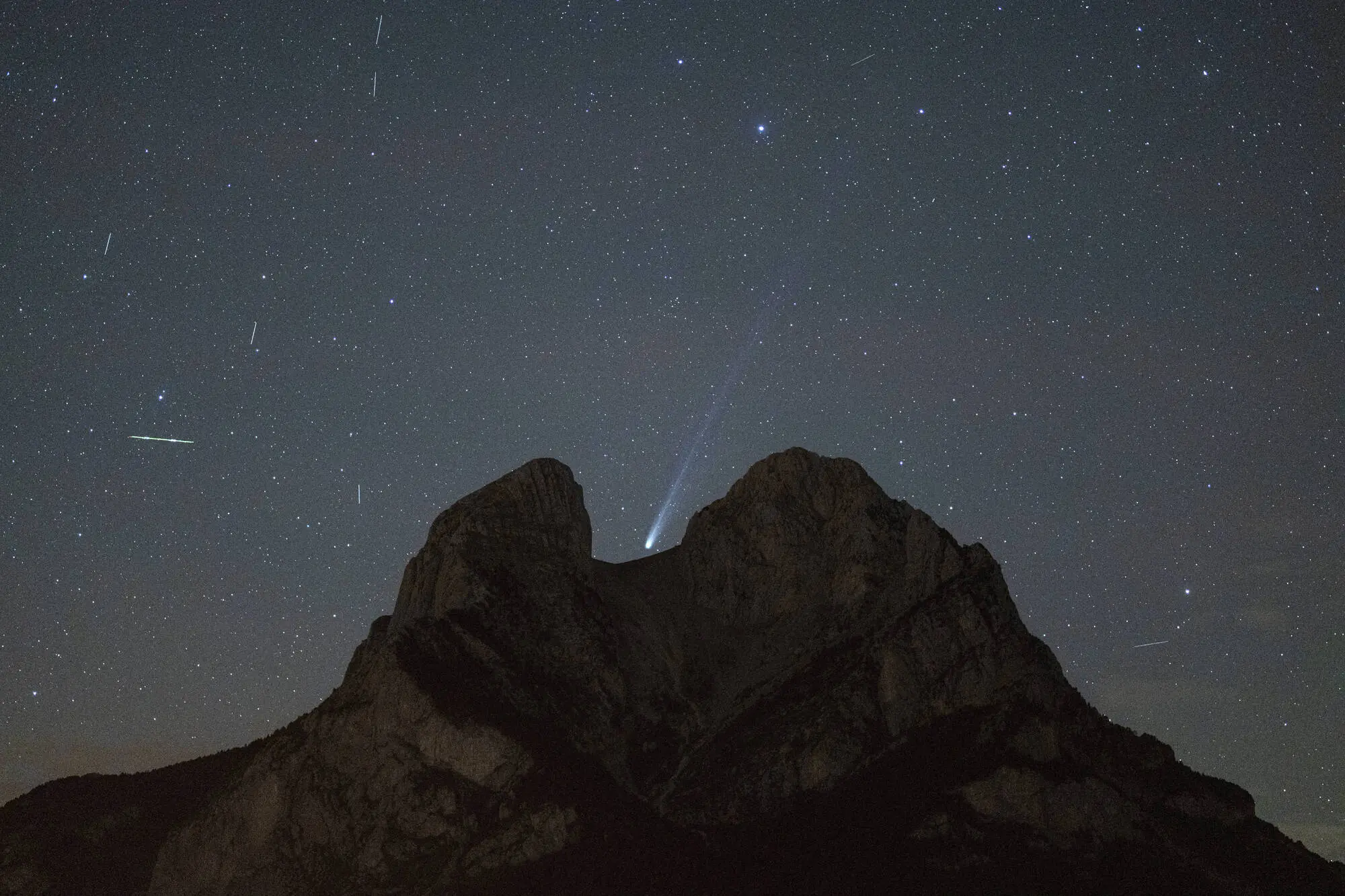 PEDRAFORCA, SPAIN - OCTOBER 24: The comet C/2019 U6 (Lemmon), discovered on October 31, 2019, from the Mount Lemmon Observatory in Arizona, streaks across the night sky behind Pedraforca mountain in the Bergueda region in Spain on October 24, 2025. The comet, composed mainly of ice and dust, was named after the observatory where it was first detected, part of the Catalina Sky Survey program dedicated to tracking near-Earth objects. Pedraforca, located within the Cadi-Moixero Natural Park, is one of Spain's most iconic mountains, recognized for its distinctive double peak and symbolic importance to Catalan mountaineering. (Photo by Lorena Sopena/Anadolu via Getty Images)
Astronomers and researchers have recently made an exciting discovery about a star system, V Sagittae. It’s located 10,000 light-years away from Earth. This star system is home to two stars, one of which is a white dwarf, a dense, leftover core of a dead star, and the other is a larger, still-burning star.
In a new study, scientists found that the white dwarf is gorging on its companion star at a speed never seen before, causing the system to shine unusually bright, as per livescience.com. This “feeding frenzy” is so intense that it might result in an explosion so powerful that it could be seen from Earth, even during the day.
Concept of two giant stars that are set to create a supernova: Explained
The system, which has baffled astronomers for over a century, is now finally revealing some of its secrets. The white dwarf, which is usually very dim, is now burning much brighter than expected. This is because it’s sucking in material from its larger companion star.
According to Professor Phil Charles from the University of Southampton, “V Sagittae is no ordinary star system – it's the brightest of its kind and has baffled experts since it was first discovered in 1902.”
The white dwarf is pulling in “material at a huge rate,” causing the material to build up on its surface. The process is so intense that the material is turning into a thermonuclear reaction. "It’s a process so intense that it's going thermonuclear on the white dwarf’s surface, shining like a beacon in the night sky," says Professor Charles.
This incredible brightness could lead to an event visible to the naked eye here on Earth. V Sagittae might soon explode in a nova, an incredibly bright burst of energy.
The two stars in V Sagittae are caught in a tight orbit, completing a full revolution around each other every 12.3 hours. This is extremely fast for a star system, and as they orbit each other, the stars are slowly pulling closer together. Their interaction is described as an “extraterrestrial tango” due to the extreme forces at play.
What do nova and supernova mean?
A nova is a huge burst of energy caused by the white dwarf becoming overloaded with material from its companion. This burst could make V Sagittae visible to the naked eye from Earth, but that’s just the beginning. Eventually, when the two stars get too close, they will collide, creating an even more powerful explosion: a supernova. This supernova will be so bright that it could be visible even during the daytime.
The star system V Sagittae is in the midst of an incredible cosmic feeding frenzy. As the white dwarf devours material from its companion star, it’s creating an extremely bright system that will eventually lead to a spectacular supernova explosion. This explosion will be so bright that it will light up Earth’s sky.
Scientists believe this event could happen soon, possibly within "the coming years." The study of V Sagittae could provide researchers with valuable clues about the life cycles of stars and how they end their lives in massive explosions.
TOPICS: Supernova