
Giant 250,000-mile X-ray Cloud found around 3i/Atlas, and experts admit they don’t understand it yet
-
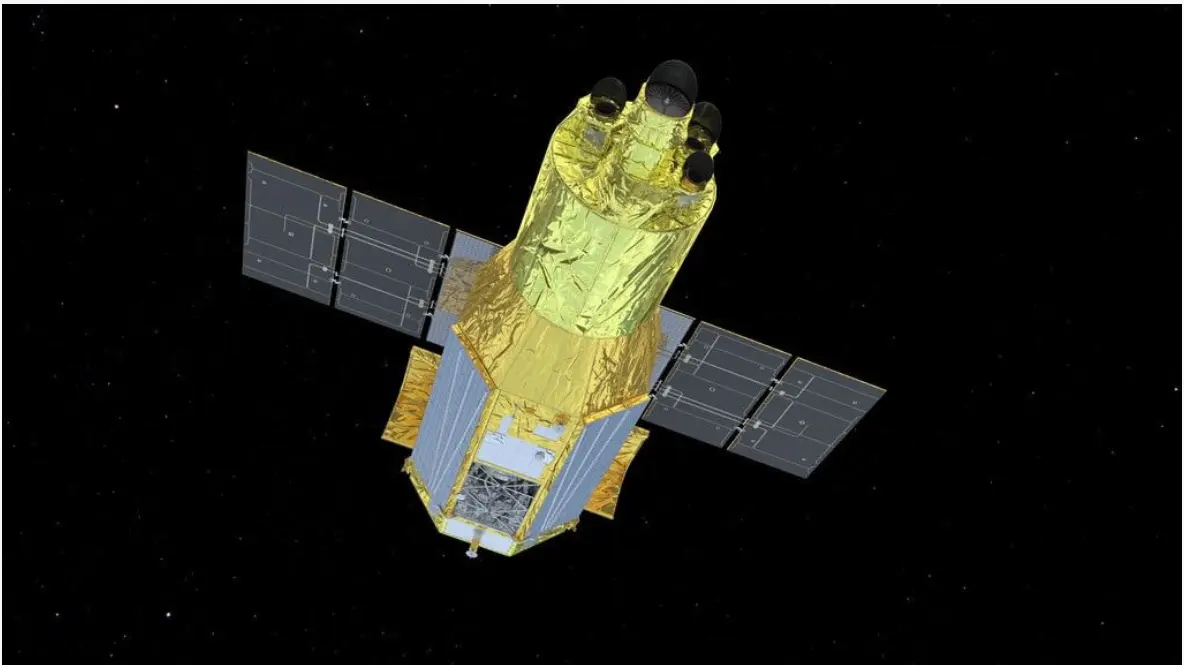
Scientists have found something very surprising around the interstellar object 3I/ATLAS. A giant 250,000-mile-wide X-ray cloud is glowing around it, and experts say they still do not fully understand what they are seeing.
The discovery has quickly been called strange and puzzling because it does not match what scientists usually know about comets.
What did the Space Mission XRISM discover?
The X-ray glow was spotted by XRISM, a space mission run by Japan’s JAXA along with NASA and ESA. 3I/ATLAS is not from our solar system, so scientists are closely watching it while it passes by.
XRISM found that the glow stretches extremely far—almost 250,000 miles from the center of 3I/ATLAS. Harvard professor Avi Loeb explained that the X-ray picture even covers a space millions of kilometers wide, showing a faint but real glow all around the object.
This is special because no interstellar visitor has ever shown X-rays before. Until now, 3I/ATLAS was only seen in visible light, UV, radio waves, and infrared.
Why is the X-Ray Glow appearing? Scientists have a guess
Space experts think they may know what is causing the glow. When comets get close to the Sun, their icy surfaces warm up and release gas. This gas forms a cloud around the comet called a coma.
When the gas cloud meets the solar wind—a flow of tiny charged particles from the Sun—it can create a reaction called charge exchange. This reaction can make X-rays.
The XRISM team believes this might be the most likely reason behind the glow.
However, the glow is much bigger and brighter than what is normally seen from comets in our own solar system. Because of this, scientists say they need more checks.
Some of the glow might even be caused by things like camera noise or other instrument effects. They must first confirm that the glow is real and not an error.
Studying 3I/ATLAS before it leaves the Solar System
3I/ATLAS will leave our solar system next year, so scientists say they have limited time to learn from it. Teams from many countries are preparing new observations.
They want to:
- measure the true size of the gas cloud
- understand how strong the X-ray glow really is
- check if the glow matches what they see in normal comets
- learn how objects from outside the solar system behave near the Sun
Because 3I/ATLAS is only the third known interstellar object, every new detail is valuable. The X-ray cloud may help scientists understand how objects travel between stars.
For now, the huge glow remains a mystery—but one that experts are very excited to solve.
- New image reveals comet 3I/ATLAS emerging from behind the Sun over Egypt
- Interstellar comet 3I/ATLAS shines in fresh views from Hubble and the Juice spacecraft
- Avi Loeb discusses how the anti-tail of 3I/ATLAS appears to flip without responding to solar radiation
- 3i/Atlas mystery deepens as Avi Loeb calls out experts rejecting his idea that the visitor could be technological