
Xtend telescope captures first X-ray image of interstellar object 3I/ATLAS
-
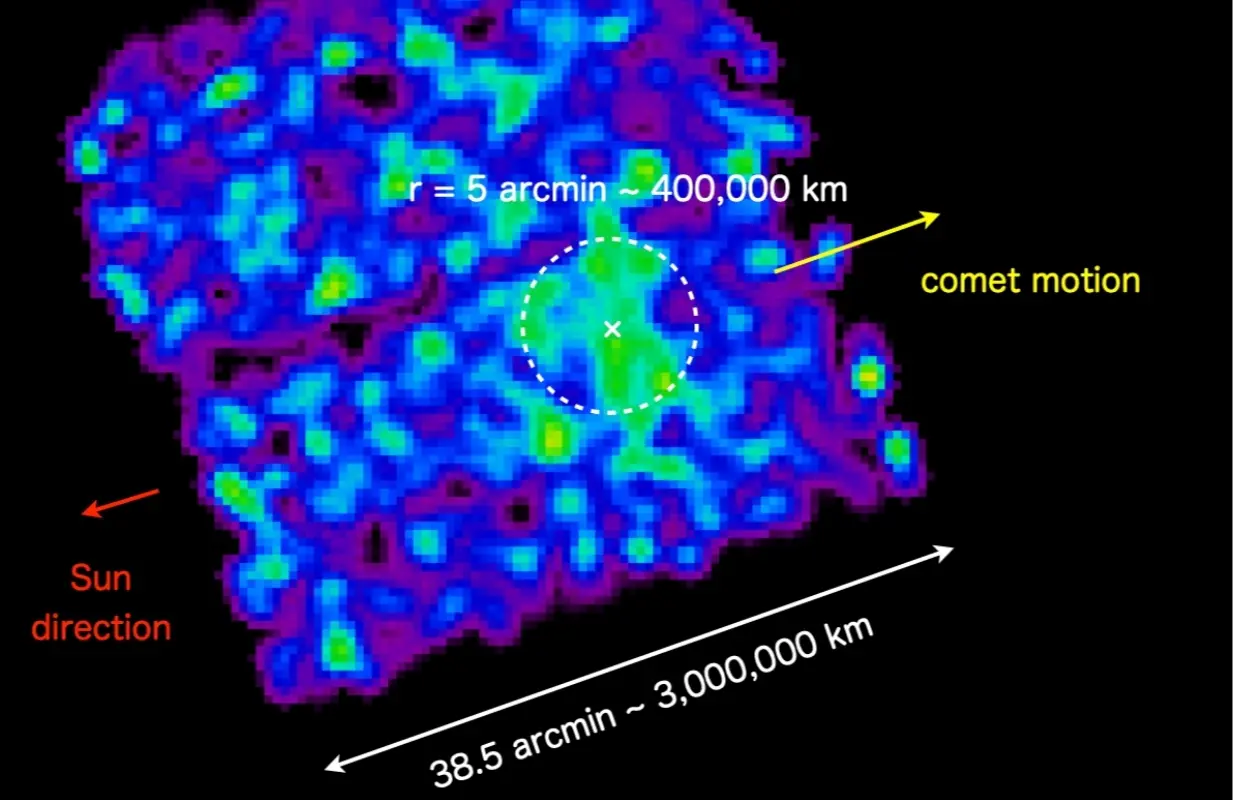 X-ray image of Comet 3I/ATLAS captured by the soft X-ray imaging telescope Xtend (Image via XRISM)
The XRISM satellite's Xtend telescope successfully captured the first X-ray image of the interstellar object 3I/ATLAS, marking a significant observational milestone.
This detection provides initial insight into the behavior and composition of objects originating outside our solar system.
The target, C/2025 N1 (3I/ATLAS), is a record-breaking rare visitor, making a trio of interstellar objects only, out of the three, which have been observed in the entire universe so far: 1I/ʻOumuamua and 2I/Borisov.
Scientists have been gathering data on these foreign objects to our solar system in different spectral bands to get a picture of the universe beyond the Sun. They are using the optical, infrared, and radio wavelengths.
The Xtend instrument, a soft X-ray imaging telescope onboard XRISM, is a unit consisting of an X-ray telescope for focusing and a CCD camera for detection, both of which were developed primarily by ISAS/JAXA in collaboration with the Japanese universities and research institutes.
Initial X-ray detection of interstellar comet 3I/ATLAS by XRISM's Xtend
Previous observations of Cometary X-rays
Within the solar system, comets are known to emit X-rays. This phenomenon was first documented in 1996 with Comet Hyakutake and subsequently confirmed in several other comets.
Despite this understanding of solar system comets, the expected X-ray behavior of interstellar comets traversing the solar system remained an open question.
Attempts to observe X-rays from these objects had been unsuccessful until the observation of 3I/ATLAS.
Whether interstellar comets exhibit properties similar to solar system comets or possess distinct characteristics has been a subject of research.
The high level of activity observed in comet 3I/ATLAS positioned it as a candidate for X-ray observation.
Analysis of the Xtend data
After reconstructing comet-centered images from the data obtained by the Xtend telescope, a preliminary analysis revealed the presence of a faint X-ray emission.
The light ray was spreading for about 5 arcminutes around the cometary nucleus, which corresponds to a distance of approximately 400,000 km.
The given extent, in fact, allows for the interpretation that there is a diffuse cloud of gas around the comet which is very faintly emitting X-rays and is several hundred thousand kilometers in size.
On the other hand, instrumental effects like vignetting, which is a decrease in the detected X-ray intensity towards the edges of the field of view, or detector noise can mimic similar structures.
Further, a more detailed analysis is required to confirm the emission as definitively cometary in origin.
The mechanism of X-ray emission
Comets are covered with gas clouds created when the sun heats their icy parts and the ices sublimate. The gas around the comet thus produced meets the solar wind, which is a very energetic stream of charged particles coming from the Sun.
The meeting of these two things triggers a charge-exchange reaction. A charge-exchange reaction is when a positively charged ion hits a neutral atom or molecule and takes one of its electrons.
The ion is very briefly in a highly excited state; when it goes to a more stable, lower-energy state it gives out X-ray photons of a certain kind.
The comet's central region close to the Xtend area was used to get the spectrum and it showed that the components emitting X-ray might be carbon, nitrogen, and oxygen.
The characteristics of these spectral components are not consistent with known ordinary background emissions, such as Galactic X-rays or Earth's atmospheric emission.
The spectral data presented here imply that the emission observed could be the result of charge-exchange interactions between the gas released by comet 3I/ATLAS and the solar wind.
Dissemination and future research
The results of the XRISM observation were promptly shared on December 3 as a publication in The Astronomer's Telegram (ATel), which is an online platform for the rapid dissemination of urgent astronomical discoveries to researchers.
The short data from XRISM are now being used as a roadmap by other teams for their next observation's planning.
The XRISM group keeps on improving their data handling and analysis to unveil more details about the interstellar comet's activity and the nature of its interaction with the solar wind.
Stay tuned for more updates.
TOPICS: 3I/ATLAS, 3I/ATLAS observation, Comet X-ray emission, First X-ray image interstellar object, Interstellar comet 3I/ATLAS X-ray, XRISM 3I/ATLAS detection, Xtend telescope X-ray image 3I/ATLAS
- YouTube removes AI-generated 3I/ATLAS videos impersonating Harvard Professor Avi Loeb
- New analysis presents unusual features documented in the 3I/ATLAS trajectory and activity
- Periodic light variability in interstellar object 3I/ATLAS linked to jet activity
- What we know so far about 3I/ATLAS: Everything understood to date