
Features
SpaceX Falcon 9 Booster lands record 32nd flight after Starlink mission
SpaceX’s Falcon 9 Booster 1067 lands for a record 32nd time after launching 29 Starlink satellites, marking continued reuse and expansion of the Starlink network.
-
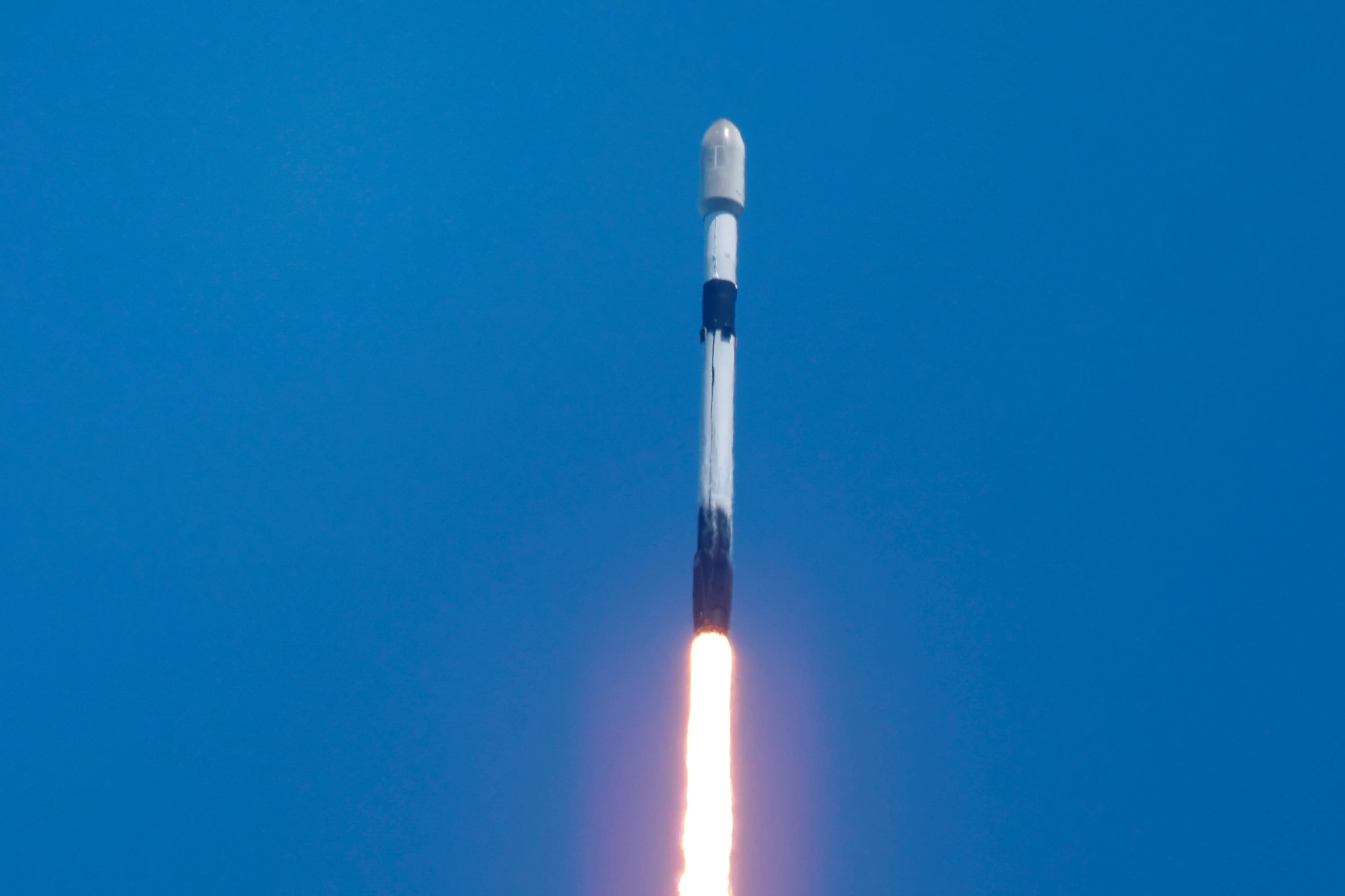 A SpaceX Falcon 9 rocket lifts off from Launch Complex 40 at Cape Canaveral Space Force Station on May 06, 2024 in Cape Canaveral, Florida. The rocket is carrying 23 Starlink satellites into low Earth orbit (Image via Getty)
The Falcon 9 rocket operated by SpaceX achieved a new milestone when its first stage, Booster 1067, completed a 32nd flight following the launch of Starlink satellites on December 8, 2025.
The 29 broadband internet satellites were sent to low Earth orbit from NASA's Kennedy Space Center in Florida at 5:26 p.m. EST by the launch.
After the upper stage separation which was about two and a half minutes into the flight, Booster 1067 came back to Earth and made a successful landing on the autonomous droneship Just Read the Instructions that was located in the Atlantic Ocean.
The company announced the event in a blog post identifying the flight as the record-setting one for the booster.
Falcon 9 launch details
The launch was to take place on December 7, but the event was put on hold due to bad weather.
The Falcon 9 first stage was the part of the rocket that gave it the initial acceleration before it separated and went back to the droneship.
As a result, the upper stage went ahead to orbit and did a second firing of the Merlin engine to drop off the 29 Starlink Group 6-92 satellites in low Earth orbit.
Release of the satellites was about one hour from the time of the rocket launch.
SpaceX says that the Starlink system has more than 9,100 satellites that are functional and can provide broadband internet access to any part of the world that does not have the usual way of connectivity.
Moreover, the satellites make it possible for the users of the Wi-Fi systems in commercial airliners to surf the internet; also, by the cell-to-satellite lines on certain carriers, the users are able to communicate via the satellites.
The Monday flight was the 158th Falcon 9 mission of 2025 and the 510th time that a Falcon 9 first stage has been reused since 2017.
On December 7, SpaceX launched a Falcon 9 rocket from Vandenberg Space Force Base in California carrying 29 additional Starlink satellites to complete their constellation in orbit.
Such consecutive launches are a testament to the rate at which Falcon 9 flights take place and to the perpetually growing Starlink satellite network.
Booster 1067 reuse record
Booster 1067 last made its 31st flight in October 2025, with a payload of 28 Starlink satellites, and it landed on a different droneship, A Shortfall of Gravitas.
With the 32nd flight, it became the record-holder for a "flight-proven" first stage. SpaceX points out that Falcon 9's reusability is the main reason they can do the most expensive components of the rocket repeatedly, which is their way to reduce launch costs.
The middle stage of the Falcon 9 is still a consumable, whereas the first stage is a unitally designed for a series of missions. SpaceX says that this solution is the main thing in their business model.
Falcon 9 rocket overview
The Falcon 9 is a two-stage, orbital-class rocket that was both designed and built by SpaceX. Its height is 70 meters, the diameter is 3.7 meters, and the liftoff weight is 549,054 kilograms in total.
Falcon 9 is capable of carrying 22,800 kilograms to a low Earth orbit, 8,300 kilograms to a geostationary transfer orbit, and 4,020 kilograms to Mars.
According to the data from SpaceX, Falcon 9 has been on 573 missions, has had 527 landings, and has done 492 re-flights of first-stage boosters.
It is the first orbital-class rocket to be designed so that the first stage can be re-flown again, thus allowing a more efficient way of getting to space.
The launch on December 8 is an example of the continuing operational capabilities of Falcon 9 boosters and the ongoing deployment of the Starlink satellite constellation.
Information from the SpaceX website regarding its operations confirms that the 32nd flight of the booster is a part of a long-term program to provide global internet connection using reusable launch technology.
Stay tuned for more updates.
TOPICS: SpaceX Falcon 9, Kennedy Space Center, NASA, SpaceX, SpaceX Starlink