
NASA funds next-generation drone flight software for Mars exploration
-
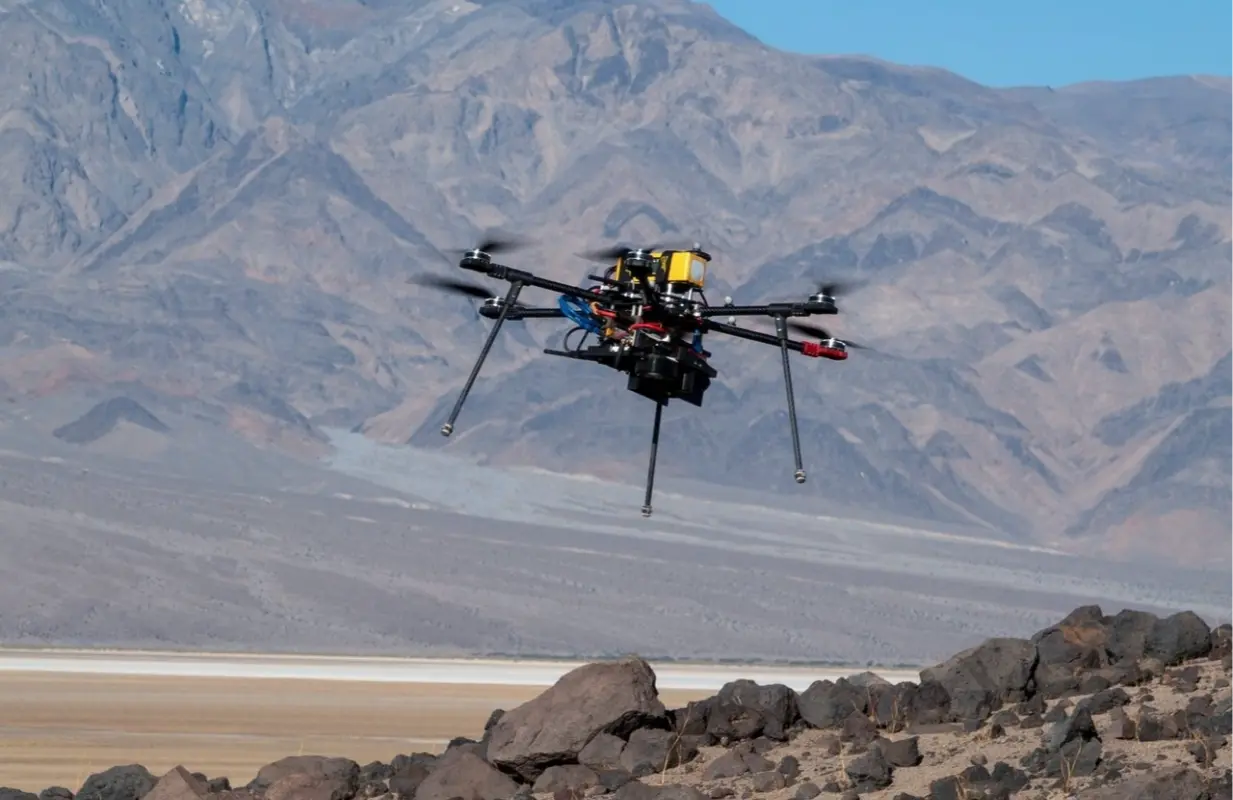 One of three JPL drones (Image via JPL NASA)
NASA is funding the development of next-generation drone flight software, which will enhance the capabilities of future aerial vehicles exploring the Martian surface.
This initiative is one of 25 projects supported by the agency's Mars Exploration Program this year, focusing on advancing technologies for the Red Planet.
The new software, known as Extended Robust Aerial Autonomy, addresses a key navigational challenge encountered by the Ingenuity Mars Helicopter - difficulty in maintaining flight control over visually featureless terrain.
Testing the software in Earth-based environments that mimic Martian conditions is a necessary step for technology validation prior to space missions.
The overall objective is to develop autonomous systems capable of exploring varied and challenging Martian landscapes, ultimately supporting both robotic and crewed missions.
Advancing autonomous flight capabilities for Martian robotics
Terrestrial analogues for Mars testing
Engineers and scientists utilize terrestrial environments that serve as analogues for Mars to test new hardware and software rigorously.
This methodical approach ensures the reliability of technology before its deployment in space. The testing procedures aim to replicate the physical challenges encountered on Mars, such as varied terrain types and reduced atmospheric density.
NASA's Jet Propulsion Laboratory (JPL) recently conducted field tests in two distinct desert locations in the United States to gather data for the Extended Robust Aerial Autonomy software.
The team deployed three research drones to Death Valley National Park in California, a site with a history of NASA testing dating back to the 1970s for the Viking lander project.
The Mesquite Flats Sand Dunes in the park provided barren, featureless terrain essential for stress-testing the drone's navigation algorithms.
This particular environment simulates the types of bland Martian areas that previously confused Ingenuity's vision-based navigation system, which relied on tracking visual features on the ground to estimate motion.
The tests, which were carried out under tough weather conditions with the temperature going up to 45°C, yielded results about the comparative effectiveness of different camera filters and newly developed algorithms for the safe landing of drones in a cluttered environment.
To gather more data, the team flew to the Dumont Dunes in the Mojave Desert, which has rippled sand, thus providing a different kind of featureless terrain.
According to Roland Brockers, a JPL researcher and drone pilot, the aim is to make the next generation of aerial vehicles more adaptable and capable of going through difficult terrains without any limitations.
Autonomous ground and air systems
The development of autonomous exploration technology is not limited to aerial systems. The Mars Exploration Program is also funding the development of advanced ground vehicles.
Researchers from NASA’s Johnson Space Center in Houston traveled to White Sands National Park in New Mexico to test the Legged Autonomous Surface Science in Analogue Environments for Mars (LASSIE-M) robot.
This "dog" form-factor robot is designed to scout ahead of rovers or human explorers across rocky and sandy surfaces.
The robot uses the physics experienced by its legs to estimate the physical properties of the surface, ensuring the safety of accompanying missions.
White Sands, another long-standing NASA test site, provided varied terrains for evaluating the robot’s stability and surface-monitoring capabilities.
In a different effort, researchers at NASA's Langley Research Center on the East Coast have been developing the Mars Electric Reusable Flyer (MERF).
This autonomous flying machine uses a wing to glide, aiming for significantly longer distances than Ingenuity achieved.
The MERF prototype incorporates vertical take-off and landing propellers and a downward-facing camera, facing similar surface recognition challenges as its predecessor.
Field tests in a Virginia field focused on testing the aerodynamics of a half-sized prototype and assessing the lightweight materials' capacity to withstand take-off and landing forces.
Future capabilities for Mars exploration
The diversity of projects supported by the Mars Exploration Program highlights a deliberate move to Mars exploration to be able to operate with full autonomy.
Technologies such as Extended Robust Aerial Autonomy, LASSIE-M, and MERF conceive a world in which robots carry out complicated scouting operations on their own or, as a most necessary, help astronaut crews.
These trials, which took place in various Earth environments, symbolize the undertaking of testing the technologies needed to broaden the operational range of future Mars missions to surpass the capabilities of current explorers.
This effort is a mirror of the dedication of NASA scientists and engineers who are constantly working on finding solutions to the difficulties of the Red Planet exploration.
Stay tuned for more updates.
TOPICS: NASA drone flight software, Death Valley NASA testing, Extended Robust Aerial Autonomy, Ingenuity Mars Helicopter navigation, JPL field testing, Mars exploration technology, Next-generation Mars helicopter