
Astronomers spot a brown dwarf and huge exoplanet in Subaru telescope’s first discoveries
-
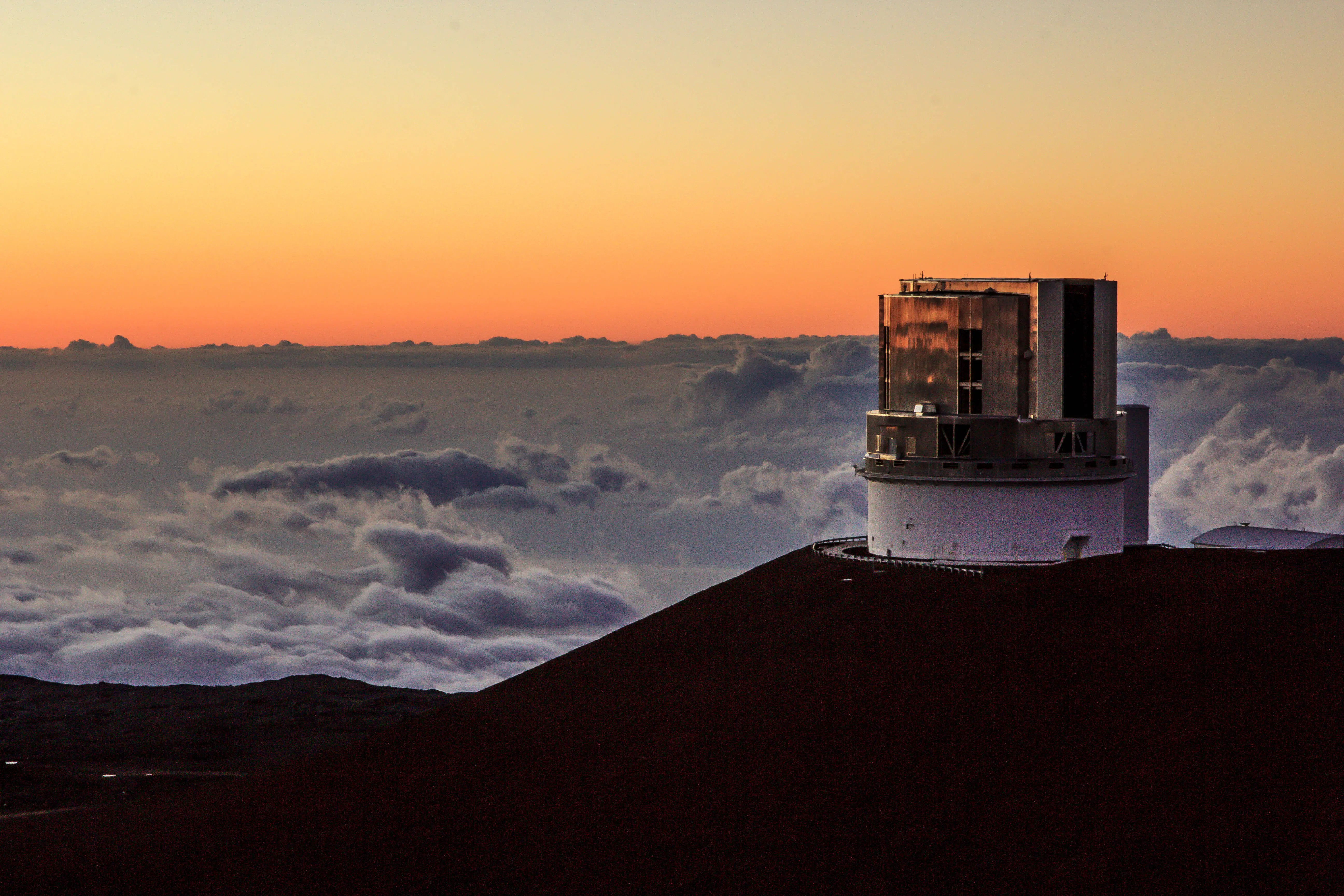 Subaru Optical IR Telescope Located on the Summit at the Mauna Kea Observatories on the Big Island of Hawaii (Image via Getty)
Space.com reports the first results from the OASIS program, which uses the Subaru Telescope on Maunakea in Hawaii to search for hidden companions around nearby stars.
The program combines precision measurements from ESA’s Hipparcos and Gaia missions with direct imaging from Subaru’s advanced SCExAO/CHARIS system.
The National Astronomical Observatory of Japan explains that “the program uses measurements from two European Space Agency missions, Hipparcos and Gaia, to identify stars being tugged by the gravity of unseen companions.”
Using this method, astronomers confirmed two new objects: the exoplanet HIP 54515 b and the brown dwarf HIP 71618 B. HIP 54515 b lies about 271 light-years away in the Leo constellation.
It has a mass close to 18 times that of Jupiter and orbits its star at a distance similar to Neptune’s distance from the Sun.
HIP 71618 B is located around 169 light-years away in the Bootes constellation. It is a brown dwarf, an object that forms like a star but does not have enough mass to sustain nuclear fusion.
These discoveries mark the first confirmed results from OASIS, providing astronomers with new targets for detailed study now and in future space missions.
Understanding HIP 54515 b and HIP 71618 B
HIP 54515 b was detected after researchers noticed shifts in its host star’s motion that suggested a companion with significant mass.
The combined Hipparcos and Gaia data allowed scientists to identify the star as a good candidate, and Subaru’s imaging system confirmed the object. The planet is roughly 17–18 Jupiter masses and orbits its star at about 25 astronomical units, a separation similar to Neptune’s orbit around the Sun. Its distance of 271 light-years and wide separation make it suitable for direct study through high-contrast imaging.
HIP 71618 B, the second discovery, is a brown dwarf orbiting a young A-type star. Brown dwarfs form like stars but do not reach the mass required to sustain long-term fusion.
Estimates place this object at approximately 60 Jupiter masses, with an orbit of around 11 astronomical units. Spectral modeling places it in the M-type range, where its brightness and temperature can be measured clearly.
Both discoveries demonstrate how motion-based searches combined with imaging can reveal companions that might otherwise go unnoticed. As one research lead explained,
“With OASIS, we are able to find, weigh, and track the orbits of massive planets and brown dwarfs around stars we never thought of looking at before.”
Why HIP 71618 B is important for the Roman Telescope
NASA’s upcoming Nancy Grace Roman Space Telescope will test a coronagraph designed to block starlight and reveal faint nearby companions. To evaluate this technology, mission planners need a real system that has predictable brightness and a clear separation between the star and its companion. HIP 71618 B fulfills these requirements.
The National Astronomical Observatory of Japan noted that “Roman will carry out a technology demonstration to test coronagraph systems that future telescopes will need to photograph Earth-like planets around other stars, planets that are ten billion times fainter than their host stars.”
A suitable test object must fall within Roman’s observing field and provide the right contrast ratio, and HIP 71618 B aligns with those criteria.
Because the brown dwarf’s orbit and brightness have already been measured from the ground, it offers a stable and reliable target for Roman’s early performance checks once the telescope launches in 2026 or 2027. Engineers can use the system to examine how well the coronagraph blocks the star’s light and separates it from the nearby companion.
By providing a confirmed target for the mission, the OASIS discovery removes a major uncertainty and supports future efforts to image faint planets that are difficult to detect directly.
______________________________________
Stay tuned for more updates.TOPICS: Astronomy, Brown Dwarf, Exoplanet, NASA, Subaru Telescope